

The smallest rental isn’t automatically the best choice for using less fuel. A compact hatchback may suit a city stay with light luggage, while more passengers, bags, hills or longer distances can change what’s practical. For a fuel efficient car rental nz travellers can feel confident about, match the vehicle to your trip rather than choosing by category name alone.
It’s reasonable to want a clear idea of fuel use before you book, especially when New Zealand’s varied terrain is part of your itinerary. But labels such as compact hatchback, intermediate sedan and compact SUV don’t tell you exactly how much fuel a particular car will use. The assigned model and your route matter too.
This guide explains how to compare those vehicle categories against your passengers, luggage and plans, and what fuel-economy details to check before booking. You’ll also find practical ways to avoid unnecessary fuel use on the road, from driving smoothly on hills to carrying only what you need. A vehicle that fits your itinerary can help you avoid paying for more space than you need.
Key Takeaways
- Choose a car that fits your route, passengers and luggage. Extra space you don’t need can mean carrying unnecessary weight.
- To compare a fuel efficient car rental nz option, map your trip and check the assigned vehicle’s model and fuel-economy details before booking.
- Compare compact hatchbacks, intermediate sedans and compact SUVs by practical space and trip needs, not by category name alone.
- Drive smoothly, avoid unnecessary idling and remove unneeded luggage to help manage fuel use on the road.
- For winter or alpine travel, check whether snow chains are appropriate for your plans and confirm the vehicle guidance.
What Makes a Fuel-Efficient Rental Car a Good Fit for NZ Travel?
A fuel-conscious rental is one that suits your route, passengers and luggage, while using fuel efficiently for the journey. The best fit isn’t automatically the smallest car. Fuel use depends on the specific vehicle and how, where and how heavily it’s driven.
Fuel economy describes how much fuel a vehicle uses to cover a distance. Figures are commonly expressed as litres per 100 kilometres (L/100km). A fuel economy figure can help you compare vehicles, but it’s only one part of the decision. A category label such as compact hatchback or SUV doesn’t confirm a particular car’s fuel use or show that it will be more efficient than another rental.
Why the right vehicle fit matters on a New Zealand trip
A city trip may involve short journeys and stop-start traffic. An intercity itinerary can include longer stretches, hills or winding roads, depending on the route. These conditions affect fuel use, so a listed figure can’t guarantee what you’ll use on your trip.
Start with who’s travelling and what needs to fit. A compact car may be practical for fewer occupants and lighter luggage, while a different category may better suit your group or bags. Aim to avoid carrying more vehicle than you need without sacrificing space that makes the journey workable. For an overview of Drive NZ’s categories, see the Drive NZ vehicle fleet guide.
What fuel-efficiency information should renters look for?
Use vehicle-specific information where it’s available. Check the model’s fuel-economy figure, the units, and whether the listing describes a particular model or only a vehicle category. If the assigned vehicle isn’t identified, ask the rental provider whether they can confirm its model and relevant fuel details before you book.
Test figures provide a consistent reference for comparing vehicles, but real-world use can differ. Passenger and luggage load, traffic, terrain, weather and driving style all play a part. A published figure can help narrow down options, but it isn’t a promise of the fuel use you’ll achieve on New Zealand roads.
For a fuel efficient car rental nz travellers can assess with confidence, compare the confirmed vehicle details with your planned route and space requirements. Drive NZ’s confirmed categories include compact hatchbacks, intermediate sedans and compact SUVs, but the category alone can’t establish which individual rental will use the least fuel.
How to Assess Fuel Use Before Hiring a Car in New Zealand
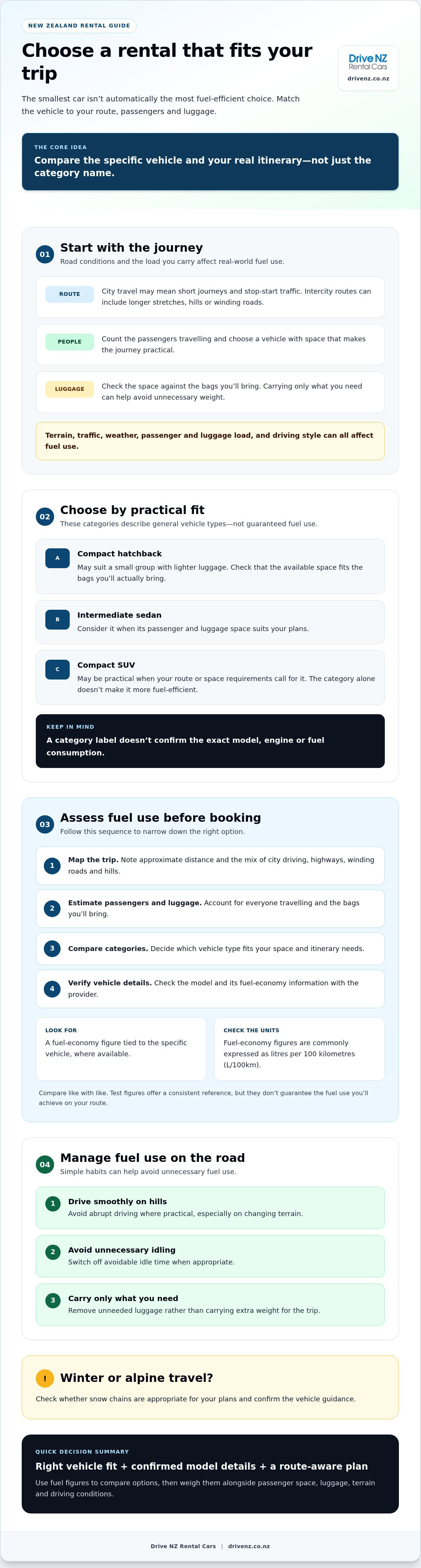
Start with your itinerary, not the rental category. This sequence can help you narrow down your options:
- Map the trip: Note the approximate distance and the mix of city driving, highways and winding or hilly roads.
- Estimate passengers and luggage: Account for everyone travelling and the bags you’ll bring.
- Compare categories: Decide whether a compact hatchback, intermediate sedan or compact SUV fits those needs.
- Verify vehicle details: Check the listing or contact the provider for the model and its fuel-economy information.
Vehicle-specific fuel figures are more useful than category assumptions because cars in the same class can differ. A category tells you the general type of vehicle, not its exact model, engine or fuel consumption. For a fuel efficient car rental nz choice, look for information tied to the vehicle you’re booking or are likely to receive.
Match the car category to passengers, luggage, and itinerary
A compact hatchback may suit a small group with lighter luggage, but check the available space against the bags you’ll actually bring. An intermediate sedan may work well if its passenger and luggage space suits your plans. A compact SUV can be a practical option when your route or space requirements call for it, but it isn’t automatically more fuel-efficient.
Drive NZ offers these three categories, but the fleet information doesn’t identify specific models or fuel figures. Before choosing, ask whether your booking confirms a particular model or a vehicle class. That will help you understand which details can be compared in advance.
Compare figures carefully before confirming a rental
If a listing provides a fuel-economy figure, check its units and what it represents. Confirm whether it’s a standardised test result or an estimate, and compare like with like rather than setting a test figure beside an informal real-world report. Test results help compare vehicles under stated conditions, but they don’t guarantee what you’ll use on your trip.
Ask whether the figure applies to the specific model or assigned vehicle, and whether the booked category guarantees a particular model. If vehicle-specific data isn’t available, treat the category as a guide to vehicle type, not proof of fuel use. Check what a rating measures and whether the information is current rather than relying on a label alone.
Actual consumption also depends on how and where you drive. GenLess shares fuel-efficient driving tips that can help you look beyond the advertised figure. Once you’ve narrowed down the category that suits your plans, explore Drive NZ’s vehicle options and confirm model details with the provider before booking.
Compact Hatchback, Sedan, or Compact SUV: Which Rental Suits Your Trip?
Use the vehicle category as a starting point, then check the actual car’s space and fuel information. This table offers general guidance, not guaranteed specifications. Models within a category can differ, and no category alone proves which rental will use the least fuel.
| Category | Typical use case | Space considerations | Fuel-data check |
|---|---|---|---|
| Compact hatchback | City breaks or trips where a smaller vehicle may be practical | Check that passenger seating and luggage space suit your group | Ask for the specific model’s fuel information; don’t infer it from its size |
| Intermediate sedan | Journeys where this category’s layout may suit your travel plans | Confirm passenger comfort and whether your bags fit | Compare model-specific figures on the same basis as other options |
| Compact SUV | Trips where the category’s space or vehicle type better fits your plans | Check the actual passenger and luggage capacity you need | Check the assigned model’s figures; the category isn’t an efficiency ranking |
When a compact hatchback may be a practical choice
A compact hatchback may work well if you want a compact vehicle and have modest passenger and luggage needs. Consider the bags you’ll actually bring, not just the number of travellers. A full group with bulky luggage may need a different fit, and a hatchback won’t suit every route or itinerary.
Size alone doesn’t tell you fuel use. Ask which model is assigned, whether your booking confirms a particular model or only a vehicle class, and whether model-specific fuel information is available. That’s a better basis for comparing a fuel efficient car rental nz option than relying on the word “compact.”
When a sedan or compact SUV may better fit the journey
An intermediate sedan may suit a trip if its seating and layout work for your passengers and plans. Check the actual vehicle’s space, especially if you’ll carry several bags. A compact SUV may be a better practical fit if your plans call for the room or vehicle type it offers. Neither category is automatically more fuel-efficient, so compare confirmed model details where possible.
For winter or alpine travel, check what equipment your route and rental vehicle require, and confirm suitability and availability with the provider. Drive NZ has snow chains available for hire, but check that they’re appropriate for your plans. To review the available categories, see the Auckland and Christchurch vehicle fleet guide.
How to Reduce Fuel Use While Driving a Rental Car in NZ
Your driving habits can help limit avoidable fuel use, even though they can’t control every part of the journey. Accelerate gently, keep a steady pace where conditions allow, and avoid unnecessary idling. Before setting off, remove bags or equipment you don’t need in the car. A lighter load means less weight to carry.
Check the tyres for visible issues and follow the rental provider’s vehicle guidance. Don’t adjust tyre pressure unless the provider’s instructions call for it. Traffic, terrain, weather and how heavily the car is loaded can all affect fuel use, so a figure from a vehicle listing won’t tell the whole story.
You can control how smoothly you drive, how much you carry and how you prepare. You can’t control traffic, terrain or weather. For more practical advice, see GenLess’ fuel-efficient driving tips.
Plan routes around real travel conditions
Driving in Auckland may involve stop-start traffic, while a regional journey from Christchurch can bring different distances and road conditions. Check current route information before leaving, and allow realistic travel time so you’re not tempted to rush. Choose a route that suits your plans and conditions. Don’t assume a particular road uses less fuel without comparable, up-to-date evidence.
For a fuel efficient car rental nz trip, planning helps you anticipate where conditions may change. Leave room for breaks and itinerary changes rather than assuming the shortest route on a map is automatically the best option.
Prepare for winter and alpine driving without overpacking
Winter or alpine travel may call for preparation beyond choosing a vehicle category. Check current road conditions, understand the rental provider’s vehicle guidance, and confirm what equipment is appropriate for your route. Drive NZ has snow chains for hire. Ask about availability and suitability for your planned journey before setting off.
Pack for the conditions, but avoid loading the car with items you don’t need. If you’re planning a South Island drive, the Christchurch road-trip guide can help you think through your itinerary. To compare the confirmed rental categories for your plans, review Drive NZ’s car options.
Choose and Book a Fuel-Conscious Car Rental with Drive NZ
A confident booking starts with a clear match between your plans and the vehicle. Consider your route, passenger numbers, luggage and any winter travel needs. Then compare the categories and confirm which vehicle details and rental terms apply. This helps you choose a practical fuel efficient car rental nz option without assuming a category guarantees a particular model or fuel-use figure.
Drive NZ’s confirmed rental categories are compact hatchback, intermediate sedan and compact SUV. Each gives you a different vehicle type to compare against your trip, but none can be ranked for fuel use without current, model-specific information. Use this checklist before you book:
- Trip needs: Note your route, expected driving conditions, passenger numbers and luggage.
- Category: Choose the vehicle type that can comfortably meet those needs.
- Model details: Ask what model may be supplied and whether its fuel-economy information is available.
- Winter equipment: If your plans involve winter or alpine travel, ask about suitable equipment, including snow chains, and confirm availability.
Questions to confirm before booking your rental
Ask which models may be supplied within your selected category and whether your booking confirms a particular model or only a vehicle class. Check whether fuel-economy information is available for the vehicle being offered, and clarify any rental terms you need to understand before confirming. Tell the provider about your passenger, luggage, route and winter-equipment needs so you can check that the category is a practical fit.
Make the next step simple in Auckland or Christchurch
Drive NZ Rental Cars has locations in Auckland and Christchurch. Compare its confirmed categories against your travel plans, then verify current vehicle details and availability with the provider rather than relying on category labels alone. If you’re planning a city stay or starting your journey in Auckland, the Auckland car rental guide offers further trip-planning context.
Once you know what space, route and vehicle information you need, you’re ready to take the next step. Explore Drive NZ rental options and confirm the details that matter for your trip before booking.
Choose a Car That Fits Your New Zealand Journey
A sensible fuel choice starts with your itinerary, passengers and luggage, not a category label alone. Compare compact hatchbacks, intermediate sedans and compact SUVs against your plans, then check the model-specific fuel details available before booking. Your driving habits matter too. Smooth acceleration, lighter loads and avoiding unnecessary idling can help manage fuel use, while traffic, terrain and weather are outside your control.
For a fuel efficient car rental nz option, focus on a vehicle that meets your needs without carrying space you won’t use. Drive NZ Rental Cars offers these three vehicle categories. Specific models and fuel-consumption figures aren’t confirmed in the fleet information, so ask the provider to verify the details for your booking. If winter or alpine roads are on your route, ask about snow chains and confirm availability.
Ready to compare the options for your trip? Explore Drive NZ rental options, then confirm the details that matter before booking.
Frequently Asked Questions
Which type of rental car is most fuel-efficient in New Zealand?
No vehicle category is automatically the most fuel-efficient. Actual fuel use depends on the specific model, its engine, the route, passenger and luggage load, and driving conditions. Drive NZ Rental Cars offers compact hatchbacks, intermediate sedans and compact SUVs, but you’ll need to confirm specific models and fuel-consumption figures with the provider. Compare model-specific figures on the same basis rather than choosing by category name alone.
How can I compare fuel economy between rental cars?
Compare fuel-economy figures for the specific vehicle models you’re considering, and check that the figures use the same units and test basis. In New Zealand, fuel consumption is commonly shown in litres per 100 kilometres (L/100km). A standardised test figure helps with comparison, but actual use can differ with traffic, terrain, load and driving style. Ask the provider for vehicle-specific information if the listing only names a category.
Does a compact car always use less fuel than an SUV?
No. A compact car may be smaller, but its category alone doesn’t prove it will use less fuel than a compact SUV. The specific model, engine, load and road conditions all matter. First check which vehicle type fits your passengers and luggage, then compare model-specific fuel figures if available. Drive NZ offers compact hatchbacks and compact SUVs, but doesn’t provide confirmed fuel-consumption figures for individual models.
Can my route and luggage affect rental car fuel use?
Yes. A full load of passengers and luggage can affect fuel use, as can hills, traffic and winding roads. Remove bags you don’t need, and consider the roads you’ll travel when comparing vehicles. A trip through Auckland traffic may differ from a regional drive from Christchurch, so a published test figure is a comparison point, not a promise of actual consumption.
What should I check before booking a fuel-conscious rental car?
Match the category to your route, passengers and luggage, then ask which model may be supplied and whether fuel-economy information is available for it. Check whether your booking specifies a model or only a vehicle class, and review the rental terms before confirming. If you’re travelling from Auckland or Christchurch in winter, ask whether snow chains are suitable for your plans and confirm availability.
Is fuel consumption different on New Zealand city and regional roads?
It can be. City travel, such as driving in Auckland, may involve stop-start traffic, while regional journeys from Christchurch can include longer stretches, hills or winding roads. Weather, traffic flow, load and driving habits also affect consumption. No single figure predicts every trip. Use model-specific test data to compare cars, then remember that actual fuel use depends on the conditions of your journey.
Can I hire snow chains with a rental car from Christchurch?
Drive NZ Rental Cars has locations in Christchurch and offers snow chains for hire. If your plans include winter or alpine roads, contact the provider to confirm availability for your booking and check that the chains are suitable for the vehicle and route. Follow the rental provider’s vehicle guidance and check current road conditions before travelling. Snow chains are relevant to suitable journeys, not a substitute for route preparation.


