
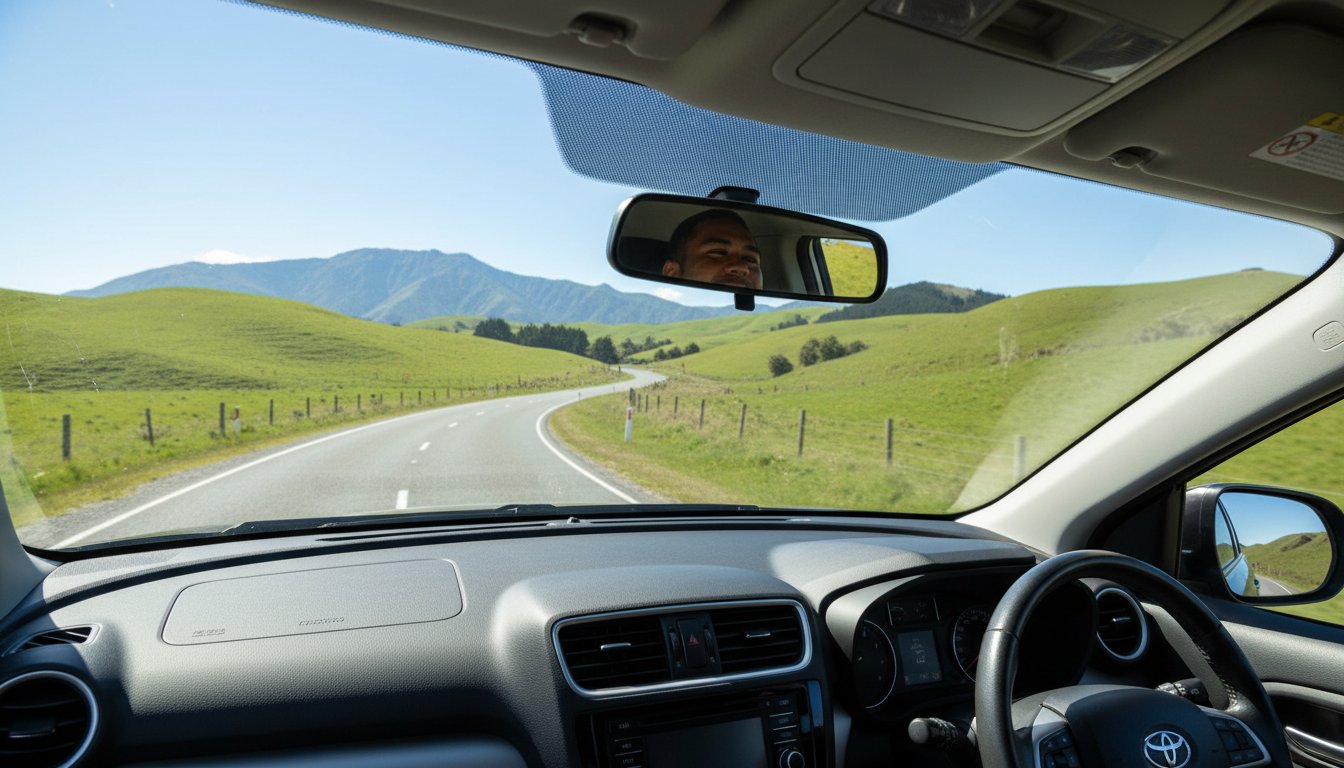
You've just landed at Auckland International Airport after a long flight, but as you slide into the driver's seat, a sudden wave of panic hits because everything is mirrored. It's a common scenario for many of the 3.8 million annual visitors to New Zealand who worry about drifting into oncoming traffic or confusing the indicators with the windshield wipers. We understand that those first few kilometers after leaving a rental hub can feel overwhelming, especially when you're navigating unfamiliar intersections. You want your trip to be about the scenery, not a stressful battle with your own habits.
While NZ Transport Agency data shows that overseas drivers are involved in only about 6% of crashes nationwide, that initial anxiety is real. This guide provides the essential mental tricks and local rules you need for mastering driving on the left in nz with total confidence. We'll teach you the "driver-to-center" rule and specific strategies to handle multi-lane roundabouts without any confusion. We'll walk you through everything from safely exiting the airport to navigating the scenic stretch between Auckland and Christchurch so your journey remains seamless and safe.
Key Takeaways
- Learn the "Driver-to-Center" mental trick to simplify the transition and keep your vehicle perfectly positioned on the road.
- Identify common rental car control mistakes, such as mixing up wipers and indicators, to ensure a smooth start to your journey.
- Navigate complex multi-lane roundabouts with ease by mastering the specific priority rules used in major hubs like Auckland.
- Simplify your journey when driving on the left nz by preparing for the unique road realities of the Auckland Southern Motorway and Christchurch’s grid system.
- Discover how local support and flexible car subscription models can remove the typical stress and complexity of long-term vehicle hire.
The Fundamentals of Driving on the Left in NZ
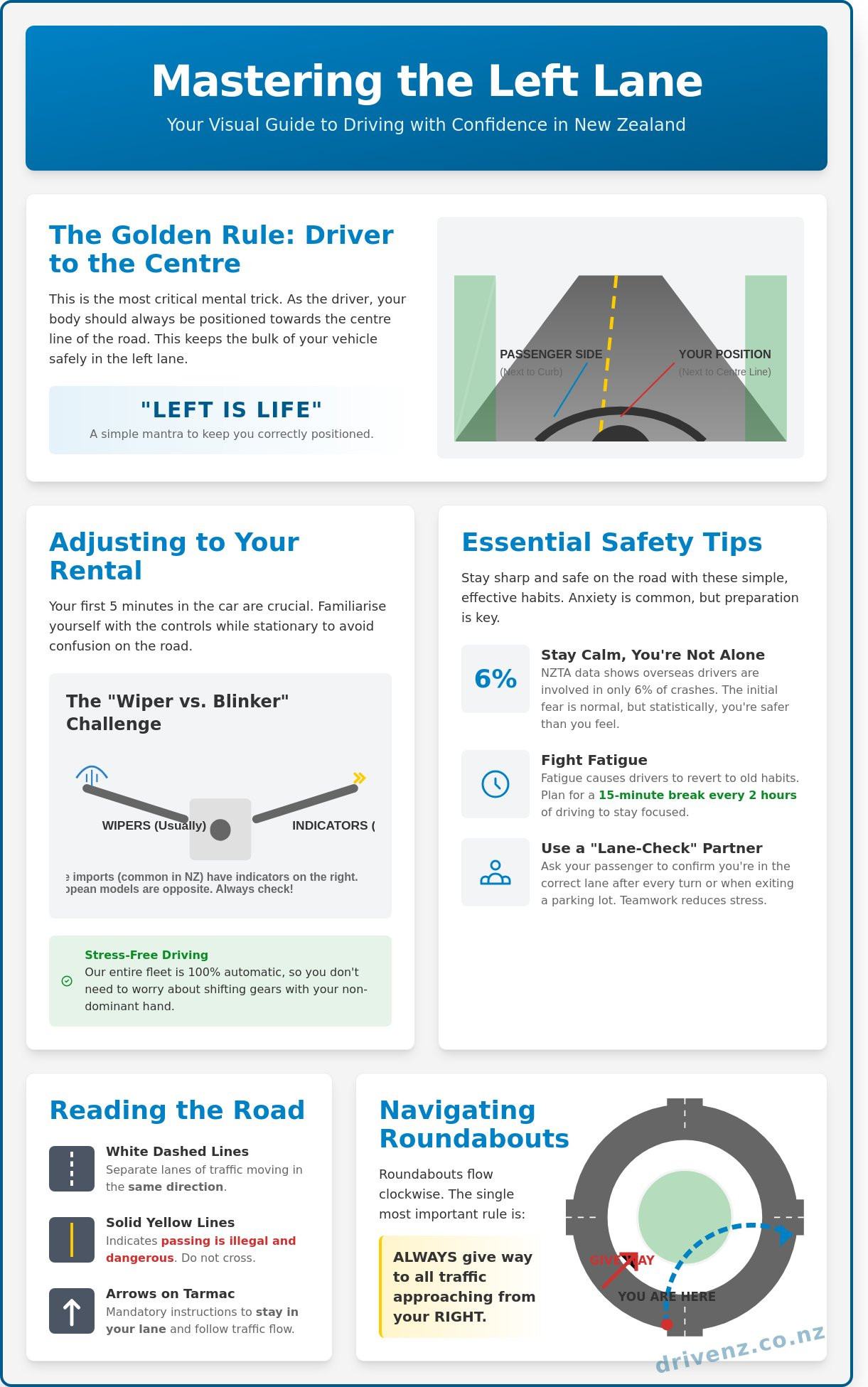
Adapting to New Zealand roads is a seamless process once you understand the core spatial logic. New Zealand follows the British system of motoring, a standard that has defined Transport in New Zealand since the mid 19th century. When you're driving on the left nz, your primary spatial anchor is the center line. You sit on the right side of the vehicle, which keeps your body positioned toward the middle of the road while the rest of the car extends toward the left curb. This "driver-to-center" orientation is the most reliable way to ensure you're in the correct lane.
The psychological shift is often the biggest hurdle for international visitors. According to 2023 Waka Kotahi (NZTA) safety data, most lane-position errors occur at empty intersections or when pulling out of rural driveways where there's no lead traffic to follow. Your instincts might betray you in these quiet moments. Mastering the art of driving on the left nz starts with acknowledging that your muscle memory needs a manual override. Waka Kotahi standards emphasize that visitors should take frequent breaks, as fatigue often causes drivers to revert to their home country's habits. We recommend planning for a 15 minute break every two hours to keep your focus sharp.
The Golden Rule: Driver in the Middle
Visualizing your position is the fastest way to build confidence. Always ensure the center line of the road is right next to your shoulder. If the curb is next to you, you're on the wrong side. We encourage travelers to adopt the "Left is Life" mantra. It's a simple, rhythmic reminder that keeps your priorities clear. If you're traveling with a companion, ask them to act as a "lane-check" partner. Their job is to verify your position every time you turn onto a new road or exit a parking lot. This collaborative approach removes the stress of solo navigation and ensures a reliable journey.
Standard NZ Road Markings
New Zealand road markings follow a strict color code to help you stay safe. White lines are used to separate lanes of traffic moving in the same direction or to mark the edge of the road. Yellow lines are more critical. A solid yellow line near the center of the road indicates that passing is too dangerous and is legally prohibited. On motorways, you'll frequently see large white arrows painted on the tarmac. These are not just suggestions; they are vital reminders to keep left and follow the designated flow of traffic. The New Zealand Keep Left rule requires all vehicles to stay as far to the left side of the roadway as is practicable at all times.
Step-by-Step: Adjusting to Your Rental Car Controls
Stepping into your vehicle at our Auckland or Christchurch hubs is the moment your New Zealand adventure becomes real. While you might be focused on the scenery, your first priority is recalibrating your brain to the cabin layout. Driving on the left nz feels more natural when you aren't fighting the car's controls. We maintain a 100% automatic transmission fleet because it removes the complexity of shifting gears with your left hand. This allows you to focus 100% of your attention on the road ahead.
Before you shift into drive, take three minutes to locate the handbrake and gear selector. In many modern vehicles, these are electronic buttons or dials rather than traditional levers. Familiarizing yourself with these while stationary prevents frantic searching at a busy intersection. You should also adjust your mirrors to account for the shifted perspective. Your "new" blind spot is on the right side of the car, so angle your mirrors to see the lane markings clearly. This simple adjustment is a core recommendation in the official guide to keeping left which helps prevent lane drifting.
The "Wiper vs. Blinker" Challenge
The most common mistake for visitors is activating the windshield wipers instead of the turn signal. This happens because New Zealand's vehicle market is a mix of Japanese and European imports. In most Japanese cars, the indicator stalk is on the right of the steering wheel. In European models, it's on the left. This inconsistency can be jarring when you're already concentrating on driving on the left nz for the first time.
Perform a mental drill before leaving the Drivenz lot. Flick the indicator five times while saying "right for turn" out loud. If you do accidentally trigger the wipers mid-turn, don't let it distract you. Keep your hands on the wheel, complete your maneuver safely, and then turn the wipers off once you're driving straight again. It's a rite of passage for almost every tourist, so don't let it knock your confidence.
Setting Up for Success
A seamless journey starts with a tidy cockpit. Position your phone in a secure mount before you start the engine. Having your GPS at eye level is essential for navigating Auckland's motorways or Christchurch's one-way systems without taking your eyes off the traffic. Ensure your phone is plugged into the USB port to avoid battery drain during long coastal drives.
Verification is also key. Double-check that your physical license is easily accessible. Whether you hold a full or restricted license, it must be in English or accompanied by an official translation to be valid on our roads. Finally, perform a "pre-drive" walkaround. Our team at the hub will help you check the lights and tire pressure. If you prefer a more flexible way to travel, our modern car subscription service offers a reliable alternative to traditional rentals, ensuring you always have a late-model vehicle with the latest safety tech.
Navigating Intersections and Roundabouts with Confidence
Mastering the art of driving on the left nz requires focus, especially when you reach your first major urban intersection. New Zealand roads operate on a strict "Give Way to the Right" system that keeps traffic moving without the need for excessive stop signs. If you're navigating the busy motorways of Auckland, which saw a 15% increase in traffic volume over the last decade, lane discipline is vital. When you turn left, you must stay in the leftmost lane. When turning right, you should end up in the corresponding right lane on the new road. This predictable flow reduces stress and prevents side-swipe accidents in heavy traffic.
Mastering the NZ Roundabout
Roundabouts in New Zealand flow in a clockwise direction. You must always look to your right before entering and yield to any vehicle already in the circle. A frequent challenge for visitors is the Memorial Avenue roundabout near Christchurch International Airport. To navigate this safely, you must signal left as you pass the exit immediately before the one you intend to take. This signaling requirement, updated in the 2023 Road Code, informs other drivers of your exit point and prevents sudden braking. For a deeper look at local road rules, Driving in New Zealand for tourists offers comprehensive guidance for international visitors. Our Drivenz team recommends practicing in quieter suburban areas before tackling multi-lane roundabouts in city centers.
Rural Road Etiquette
Canterbury is famous for its unique "One-Way Bridges," which require a specific understanding of road signs. You'll encounter circular signs featuring a large black arrow and a small red arrow. If the large black arrow points in your direction, you have the right of way. If the small red arrow points your way, you must stop and wait for oncoming traffic to clear the bridge entirely. Driving on the left nz also means being mindful of locals on narrow backroads. If more than four vehicles are following you, it's polite to pull into a "slow vehicle bay" to let them pass. If your journey takes you through the Southern Alps during the winter season, which typically runs from June to October, carrying snow chains is a legal necessity. Drivenz provides winter-ready subscription vehicles equipped with all-inclusive support to make your alpine crossing seamless and safe.
Auckland and Christchurch Road Realities: What to Expect
Transitioning from the airport terminal to the driver's seat requires a quick mental shift. Auckland and Christchurch present distinct environments, but the core principles of driving on the left nz remain the same. While Auckland is defined by its multi-lane motorway systems, Christchurch offers a structured grid that transitions quickly into vast, open plains. Understanding these local nuances ensures your first few kilometers are handled with confidence.
Starting Your Journey in Auckland
Exiting our Montgomerie Road location in Mangere is straightforward if you plan your first three turns. First, turn left out of the driveway onto Montgomerie Road. Second, take a right onto Richard Pearse Drive. Third, follow the signage to turn right onto George Bolt Memorial Drive, which feeds directly toward the SH20 and SH1 motorways. When merging onto these multi-lane roads, always stay in the left-hand lane unless you're overtaking. Auckland's peak hour congestion is significant, typically running from 6:30 AM to 9:30 AM and 3:30 PM to 6:30 PM. During these times, average speeds on the Southern Motorway can drop to 20 km/h. Patience is your best safety tool here; don't rush lane changes in heavy traffic.
Exploring from Christchurch
Your South Island adventure begins at Logistics Drive, just 5 minutes from the terminal. From here, you'll head toward the Great Alpine Highway (SH73) to cross the Southern Alps. While Christchurch follows a logical grid system, remember that the 2011 earthquake permanently altered many road levels. You'll encounter occasional dips or uneven surfaces even on paved city streets. Once you hit the Canterbury Plains, the roads become exceptionally straight and long. These stretches are notorious for driver fatigue. Data from the Ministry of Transport shows that fatigue is a factor in approximately 13% of fatal crashes. Stop every 2 hours at local spots near Harewood, using the International Antarctic Centre as a primary landmark to keep your bearings before you leave the city limits.
Speed limits in New Zealand require a practical interpretation. While the "100" sign marks the legal maximum on open roads, the country's volcanic and alpine geography means the road itself often dictates a slower pace. On winding rural routes, you'll see yellow "suggested speed" signs on sharp corners. If a sign suggests 65 km/h, trust it. Taking a corner at 100 km/h when 65 km/h is recommended is a leading cause of rental vehicle accidents.
Finally, be aware of parking regulations. Under the Land Transport (Road User) Rule 2004, you must park in the direction of traffic flow. Parking on the right-hand side of the road facing oncoming traffic is illegal and carries a fine between $40 and $60. Always pull over to the left side of the road to ensure you're parked legally and safely.
Ready to hit the road? Choose a flexible car subscription from Drivenz to ensure you have a modern, reliable vehicle for your New Zealand journey.
Stress-Free Rental Support with Drive NZ
Choosing the right vehicle is the final piece of the puzzle for a successful trip. While the rules of the road are manageable, adjusting to driving on the left nz style requires more than just knowing the rules; it requires the right support system. Our local team at Drive NZ specializes in helping international visitors transition safely. We provide a detailed safety briefing the moment you arrive, walking you through the specific controls of your vehicle and the nuances of local intersections. This isn't a generic handout. It's a personalized session to ensure you feel confident before you even leave the lot.
We've curated our fleet specifically for New Zealand's unique geography. Since 85% of our state highways consist of just a single lane in each direction, oversized vehicles can feel cumbersome. We recommend our range of compact SUVs and hatchbacks. These vehicles offer the perfect balance of visibility and maneuverability for our 7-meter wide rural roads. You'll have enough power to climb steep mountain passes without the stress of navigating a massive frame through tight coastal bends.
Long-term travelers often find traditional rentals restrictive. If you're planning to explore for more than 30 days, our Subscription model offers a modern, flexible alternative. It removes the rigid constraints of standard contracts, providing a seamless experience that feels more like owning a car than renting one. Every vehicle in our fleet also comes with 24/7 Roadside Assistance. Whether you've encountered a flat tire on a remote West Coast road or a flat battery in the Southern Alps, help is only a phone call away, 365 days a year.
Why Local Knowledge Matters
Our staff goes beyond the paperwork. We help you map out your first 10 kilometers to ensure your initial experience with driving on the left nz is on low-stress routes. If you're heading to the South Island between June and October, we'll ensure you're equipped with snow chains and provide a quick tutorial on how to fit them. Transparency is our core value. The price you see is the price you pay. Our "No Hidden Fees" promise means no surprise charges for insurance or extra drivers, letting you budget your trip with 100% accuracy.
Ready to Hit the Road?
Your adventure starts with a few clicks. Booking your vehicle online through our streamlined platform ensures a fast pickup so you can get your holiday started sooner. Before you turn the key, run through this final checklist: verify your mirrors, confirm your phone is mounted for hands-free navigation, and take a deep breath. With the right car and the right support, the transition to New Zealand roads becomes second nature within the first hour.
Don't leave your travel comfort to chance. Book your stress-free NZ rental car today and experience the South Island with total peace of mind.
Start Your New Zealand Journey with Confidence
Mastering the art of driving on the left nz becomes straightforward when you focus on lane positioning and roundabout etiquette. By familiarizing yourself with your rental vehicle's layout and understanding traffic flows in Auckland and Christchurch, you'll eliminate the guesswork from your trip. Since 2005, Drivenz has leveraged over 20 years of local expertise to help travelers navigate these roads safely. Our hubs at Auckland and Christchurch Airports ensure your transition from the terminal to the driver's seat is efficient and stress-free.
We provide all-inclusive support packages that prioritize your peace of mind throughout your stay. You don't need to worry about the technicalities of vehicle hire when you have a modern mobility partner by your side. Our transparent service model ensures you're always in control of your adventure. New Zealand's landscapes are waiting for you, and we're here to make sure you enjoy every mile of the journey.
Explore our reliable fleet and book your NZ adventure to begin your seamless travel experience today. We'll see you on the road soon.
Frequently Asked Questions
Is it hard for Americans or Europeans to drive on the left in NZ?
It takes about 20 to 40 minutes for most drivers to adjust to the new layout. While it feels different initially, the road markings and following the flow of traffic make the transition manageable. We recommend staying alert at intersections where you might instinctively turn into the wrong lane. Mastering driving on the left nz is straightforward if you keep the driver's seat toward the center of the road.
What happens if I accidentally drive on the wrong side of the road?
You must immediately pull over to a safe spot on the left side and regain your bearings. Driving on the wrong side is a primary cause of head-on collisions, which accounted for 30 percent of fatal crashes in 2023 NZ transport statistics. If a police officer stops you, you'll likely face a fine of 150 NZD or more. This penalty depends on the immediate risk caused to other road users.
Do I need an International Driving Permit (IDP) to rent a car in NZ?
You only need an IDP if your national driver license isn't written entirely in English. New Zealand law requires a certified English translation for any foreign license to be valid. Ensure your license is current and hasn't expired. Most Drivenz customers from the USA, UK, or Australia use their standard home country licenses without issues because they meet the 12 month temporary visitor requirement.
Are there many roundabouts in New Zealand cities like Auckland?
Auckland features over 500 roundabouts across its metropolitan area to manage traffic flow efficiently. You must always give way to traffic coming from your right before entering the circle. Signal left as you exit to inform other drivers of your intentions. These intersections reduce serious injury crashes by 75 percent compared to traditional traffic lights. They're a staple of the local driving experience for every visitor.
How do I handle one-way bridges in the South Island?
You must follow the specific road signs that indicate which direction has the right of way. A small red arrow on the sign means you must give way to oncoming traffic, while a large white arrow means you have priority. There are 100 one-way bridges remaining on the South Island state highway network. Always slow down to 30km/h when approaching these narrow crossings to ensure safety for everyone.
Can I park on either side of the road in New Zealand?
You can only park in the direction of traffic flow on your side of the road. Parking against the flow of traffic is illegal and carries a 40 NZD fine under the Land Transport Rule 2004. This rule ensures that when you pull out, you have a clear view of oncoming vehicles. Always look for the white lines that mark legal parking zones to avoid an expensive ticket during your trip.
What is the speed limit on New Zealand open roads?
The standard speed limit on open roads and motorways is 100km/h unless signs indicate otherwise. In residential areas, the limit is typically 50km/h, though 30km/h zones are common near schools. Speed cameras are active across the 11,000 kilometers of state highways. Staying within these limits ensures a safe experience while driving on the left nz. It also helps you avoid expensive infringement fees from local authorities.
Does Drivenz provide maps or GPS for first-time visitors?
Drivenz equips every vehicle with integrated GPS navigation or smartphone mirroring like Apple CarPlay and Android Auto. This modern technology helps you focus on the road instead of fumbling with paper maps. Our 24/7 roadside assistance is also available if you ever encounter mechanical issues. We aim to make your journey through New Zealand a seamless, all inclusive experience that prioritizes your peace of mind and flexibility.


