

What if the biggest expense on your New Zealand road trip isn't the car itself, but the money you can't actually spend? For many travelers landing in Auckland or Christchurch, the "security hold" at the counter feels like a hidden cost that locks away a significant portion of their holiday budget. Having the rental car bond explained NZ style means realizing this isn't a fee, but a variable security measure that you can control through your insurance choices. It's common to feel frustrated when your credit limit vanishes before you've even left the airport, particularly when you just want to get behind the wheel and explore.
We know that waiting for a refund or feeling confused by the difference between insurance and a deposit adds unnecessary stress to your journey. This guide will show you exactly how to manage your bond, from picking the right payment card to choosing a strategy that minimizes the amount held. You'll learn about current 2026 refund timelines, specific requirements for major providers, and how your choice of a compact hatchback or SUV affects the final hold on your account so you can travel with total peace of mind.
Key Takeaways
- Learn the difference between a temporary hold and a permanent charge with our rental car bond explained NZ guide, so you aren't surprised by your bank statement.
- Master the mechanics of financial liability by distinguishing between your insurance excess and the actual security deposit held on your card at the counter.
- Identify the specific credit card requirements needed at pickup to ensure a smooth start for your compact hatchback or SUV rental.
- Understand the standard 2026 refund timelines and the vehicle inspection steps required to get your funds released efficiently after your trip.
- Gain a clear strategy to minimize your bond amount through smart insurance choices, allowing you to book your Auckland or Christchurch trip with confidence.
What is a Rental Car Bond in New Zealand?
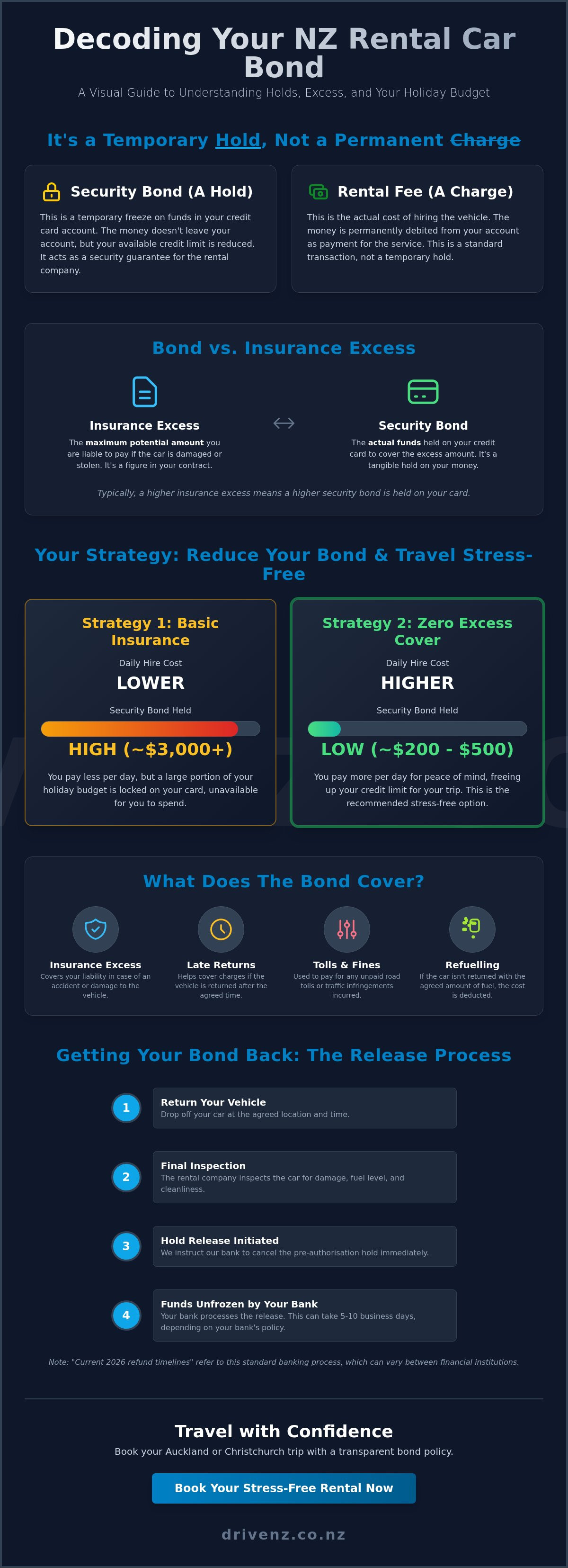
A rental car bond is a temporary financial guarantee that you provide to the rental company at the start of your hire. Unlike the rental fee, which is the actual price you pay to use the vehicle, the bond is a security deposit. It isn't money spent; it's money held. Having a rental car bond explained NZ style means recognizing that this amount is usually "frozen" on your credit card rather than being withdrawn from your account. This ensures that funds are available if any unexpected costs arise during your trip.
The primary purpose of Car rental security deposits is to manage risk for the provider while keeping the booking process efficient for you. By holding these funds, companies can confidently hand over the keys to a high-value asset. If you return the car in the same condition you received it, with a full tank and no outstanding charges, the hold is simply released. It's a standard practice across the industry that protects both the local operator and the traveler.
Why Do Rental Companies Need a Bond?
Rental companies use bonds to cover small, post-trip expenses that might otherwise be difficult to collect once you've headed home. For instance, if you pass through a toll road in Auckland or Tauranga without paying the fee, the rental provider will use the bond to settle that balance. It also acts as a safeguard to ensure the car returns with the agreed amount of fuel. If the tank is empty, the cost of a refill is deducted from this deposit.
The most significant reason for the bond relates to insurance. In New Zealand, every rental includes basic insurance, but this usually comes with an "excess." This is the maximum amount you'd have to pay if the car is damaged. The bond often mirrors this excess amount, ensuring the company can cover the initial portion of a claim immediately if an accident occurs. It's a practical way to keep the business running smoothly while you enjoy the open road. Using a rental car bond explained NZ context helps you see that this isn't a hidden fee, but a security measure for the vehicle's protection.
Typical Bond Amounts for NZ Car Hire
The amount of money held on your card depends heavily on the type of vehicle you choose and the insurance level you select. For example, compact hatchbacks generally require a smaller bond because they have lower replacement and repair costs. If you upgrade to a compact SUV or an intermediate sedan, the bond might increase to reflect the higher value of the vehicle.
Risk profile also plays a role in determining the final figure. Local operators in New Zealand often offer different tiers of insurance that can reduce your bond significantly. If you choose a "zero excess" or "total protection" package, many companies will reduce the bond to a nominal amount. Conversely, if you stick with basic coverage, you might see a much larger hold. This flexibility allows you to decide whether you'd rather pay a bit more for insurance or have a larger amount held on your credit card during your stay.
Bond vs. Excess: Understanding the Financial Mechanics
One of the most common points of confusion at the rental counter involves the difference between your insurance excess and your security bond. While they are closely linked, they serve two distinct purposes. Your insurance excess represents your maximum financial liability if the vehicle is damaged or stolen. If you have a $3,000 excess, that is the most you'll pay for a covered incident. The bond, however, is the actual amount the rental company places on hold from your bank account to ensure funds are available to cover that liability. Having the rental car bond explained NZ style helps you see that while the excess is a theoretical cost, the bond is a tangible hold on your credit limit.
Understanding your rights when renting a car is vital here. New Zealand consumer law protects you from unfair charges, but companies are legally allowed to hold a bond as security for their asset. Typically, the higher your insurance excess, the higher the bond will be. Many travelers choose to pay a slightly higher daily hire rate to reduce their excess, which simultaneously lowers the required bond. This trade-off is a strategic way to manage your holiday cash flow. It's about deciding whether you want to pay a smaller amount upfront as a fee or risk a larger temporary hold on your card.
The Excess Reduction Trade-off
Choosing between standard insurance and excess reduction is a balance of daily costs versus upfront holds. Standard insurance keeps your daily hire price low, which makes it attractive for budget-conscious travelers. However, this path requires a substantial bond, often several thousand dollars. If you prefer to keep your credit limit available for dining and activities, opting for full coverage is the smarter move. This usually reduces your bond to a very small amount or even zero. It creates a more predictable budget where you pay a bit more each day to avoid a massive temporary hold on your funds.
Third-Party Travel Insurance and Bonds
A common trap for international visitors is assuming that external travel insurance removes the need for a rental bond. If you have insurance through your credit card or a third-party provider, it usually operates on a "pay and claim back" model. The rental company isn't part of that external contract, so they will still require a full bond at the counter. You would pay the rental company for any damage first, then seek reimbursement from your own insurer later. If you want to avoid a large hold entirely, it's often more efficient to book with local excess reduction options directly. This keeps the financial mechanics simple and ensures your funds stay in your pocket during your trip.
Payment Methods: Credit Cards, Debit Cards, and 'Holds'
Choosing the right payment method is just as vital as picking the right vehicle for your trip. Most rental operators in New Zealand prefer a major credit card for the security deposit. This card must be in the name of the main hirer, and that person must be present at the counter when you collect your compact hatchback or SUV. This requirement exists because the rental agreement is a legal contract; the financial security must match the person responsible for the car. Using a credit card is the most efficient way to have the rental car bond explained NZ style, as it uses the bank's money to secure the hold rather than your own cash.
Cash and prepaid travel cards are almost never accepted for bonds in New Zealand. These methods don't provide the same level of security for the rental company. Since a bond needs to be adjustable for things like toll fees or fuel, a physical credit card provides a reliable link to the bank. If you try to use a prepaid card, you might find yourself unable to complete the booking at the Christchurch or Auckland counter. Planning ahead with a valid credit card ensures a quick, stress-free start to your holiday.
The Pre-authorization Process
When you arrive at the counter, the staff will perform a pre-authorization on your card. A pre-authorization is a merchant block on funds, not a transfer of money. While the money hasn't left your account, it is "frozen" and cannot be spent on other things. This effectively reduces your available credit limit for the duration of the hold. It's smart to call your bank before arriving in New Zealand. This prevents your bank from flagging the hold as suspicious activity and ensures your limit is high enough to cover both the bond and your travel expenses. Most 2026 banking apps show these as "pending" transactions, so you can track the status in real time.
Renting with a Debit Card in NZ
Renting with a debit card is possible with some local providers, but it works differently than a credit card. Instead of a simple hold, a debit card bond often involves a "charge and refund" mechanic. The company might actually deduct the funds from your bank account and then process a refund once the car is returned. This can be a challenge because the refund may take several business days to appear back in your balance.
Debit card users often face higher bond requirements or mandatory insurance upgrades to offset the increased risk. If you are looking for under 21 car rental options, using a debit card might require even more careful planning. Always check the specific terms for debit use to avoid surprises at the airport. Knowing these modern processing details helps you maintain total control over your travel budget.
The Refund Process: How Long Until You Get Your Bond Back?
After a successful road trip through the Southern Alps or along the Coromandel coast, returning your vehicle should be a smooth and predictable experience. The refund process starts the moment you pull into the rental depot for the final vehicle inspection. During this check, staff will verify the fuel level and look for any new damage. If everything is in order and you've settled any outstanding costs, the rental company will trigger the release of your funds. Having the rental car bond explained NZ style means knowing that while the company might release the hold immediately, the time it takes for those funds to reappear in your account depends largely on your bank's internal processing cycles.
It's a common misconception that the rental company keeps your money for weeks after the trip. In reality, most local operators want to close the file as quickly as possible. Once the company sends the electronic release to the bank, the "merchant block" is removed from their end. From that point forward, the speed of the refund is determined by the banking system. Understanding this distinction helps reduce the frustration of waiting for your credit limit to return to normal. If you're looking for a provider that prioritizes clarity and speed, you can book your next rental car here to ensure a transparent return process.
Timeline of a Bond Release
The journey of your bond from "held" to "available" typically follows a standard sequence. On Day 0, the vehicle is returned and the final inspection is completed; if no issues are found, the release is authorized. Between Day 1 and Day 3, the rental company’s merchant system communicates with the global card networks to cancel the pre-authorization. Finally, between Day 5 and Day 10, your specific bank clears the hold from your statement. While some modern digital banks reflect this change almost instantly, traditional banks often take the full ten business days to update your available balance.
What Can Delay Your Refund?
Several factors can pause the release of your security deposit. Unpaid toll road notifications from Waka Kotahi (NZTA) are the most frequent culprit. Because toll records can take a few days to reach the rental company, they may hold the bond until they've confirmed no charges are pending. Additionally, if a vehicle requires specialized cleaning due to excessive dirt or sand, the cost will be assessed and deducted before the remaining balance is released.
Missing or damaged equipment can also cause a hold-up. For example, if you rented snow chains for a winter trip, they must be returned in their original condition and stored correctly. Any undisclosed minor damage, like a small chip in the windscreen or a scuff on a wheel, will require a repair quote before the bond can be finalized. Ensuring the car is clean and all accessories are present is the best way to guarantee a fast, hassle-free refund. Knowing these details is a vital part of having the rental car bond explained NZ for your 2026 travel planning.
Stress-Free Rentals with Drive NZ Rental Cars: Our Transparent Bond Policy
Choosing a local partner for your journey means you get more than just a set of keys. At Drive NZ Rental Cars, we believe that having the rental car bond explained NZ style should involve total transparency from the moment you browse our website to the second you return the vehicle. We've designed our financial policies to remove the friction often found with international franchises. Our focus is on providing a dependable service that respects your holiday budget and your time. Whether you're picking up a car at our Auckland or Christchurch locations, you'll receive clear, upfront communication about every dollar held on your card.
Our diverse fleet allows you to choose a vehicle that fits both your travel plans and your comfort level with security deposits. A compact hatchback typically offers the most straightforward bond structure, while an intermediate sedan or compact SUV provides extra space for longer South Island road trips. Because we manage our own fleet locally, we can provide specific advice on how your insurance choice will impact the final hold on your account. This personalized approach ensures you aren't left guessing at the counter, allowing you to focus on the scenery rather than your bank balance.
Why Choose Drive NZ Rental Cars for Your 2026 Trip?
We pride ourselves on a "no surprises" philosophy. You won't find hidden "admin" fees or unexpected surcharges tucked into the fine print when you arrive. Our team is here to provide expert guidance on how much to rent a car in NZ, helping you factor in the total cost of hire along with the bond. We use modern, efficient processing systems to trigger bond releases as soon as your final inspection is clear. This efficiency is part of our commitment to being a tech-savvy partner that values your peace of mind.
Ready to Explore New Zealand?
Your New Zealand adventure deserves a start that is free from financial stress. We invite you to browse our range of well-maintained vehicles, including:
- Compact Hatchback: Perfect for city driving and fuel efficiency.
- Intermediate Sedan: Ideal for comfortable cruising between regions.
- Compact SUV: Great for those needing a bit more ground clearance and luggage space.
- Snow Chains: Essential add-ons for safe winter travel in the Southern Alps.
If you have specific questions about how your chosen card will work with our rental car bond explained NZ policy, our Auckland and Christchurch teams are just a phone call or email away. We can walk you through our current insurance reduction options to find the perfect balance between your daily rate and the security deposit. Contact Drive NZ Rental Cars today to secure your vehicle and start your 2026 trip with total financial confidence.
Secure Your New Zealand Journey with Confidence
Navigating the financial side of your trip doesn't have to be complicated. By understanding the mechanics of security deposits, you can protect your holiday budget and avoid any surprises at the rental counter. Mastering the difference between a temporary hold and an actual charge is the key to managing your funds effectively. Having the rental car bond explained NZ style means you can now choose the best insurance and payment strategy for your specific needs; whether you're driving a compact hatchback through city streets or taking an SUV into the mountains.
Drive NZ Rental Cars is committed to making your experience as smooth as possible through our transparent bond policies and local expertise in Auckland and Christchurch. Our modern, reliable fleet is ready to take you wherever your itinerary leads. If you're ready to start your adventure with a partner who values honesty and efficiency, Book Your Stress-Free NZ Rental with Drive NZ Rental Cars Today. We're here to support you at every turn, ensuring your focus stays on the incredible landscapes ahead. Safe travels and we look forward to seeing you at the counter soon.
Frequently Asked Questions
How much is a standard car rental bond in New Zealand?
Bond amounts vary based on the vehicle and insurance tier you select. For instance, international providers like Enterprise require a standard bond of NZD $200.00, while local companies like Yes Rentals often hold around $250. This variability is why having the rental car bond explained NZ for your 2026 trip is essential for accurate budgeting, as choosing basic insurance can see these amounts rise significantly.
Can I pay my rental car bond in cash?
No, cash is not accepted for security bonds in the New Zealand rental market. Companies require a valid credit or debit card to ensure they can manage post-trip expenses like tolls or fuel refills. This policy provides a secure link to a financial institution that a cash deposit simply cannot offer, protecting both the operator and the vehicle asset.
Is the bond deducted from my account or just held?
On a credit card, the bond is usually a pre-authorisation hold that freezes your credit limit without taking the money. For debit card users, the company may actually deduct the funds as a charge and refund them later. This distinction is vital because a debit charge affects the actual cash you have available to spend on your holiday activities.
Will my travel insurance cover the cost of the bond?
Travel insurance does not pay the bond at the counter. Most external policies operate on a "pay and claim" basis, meaning you must provide the bond upfront to the rental company yourself. If a deduction occurs for damage, you then seek reimbursement from your insurer by providing the rental agreement and repair receipts after the trip is over.
What happens to my bond if I have a small accident?
The rental company will hold the bond to cover the initial cost of repairs or your insurance excess. Once the final costs are determined, any remaining balance is released back to your card. If you've chosen a zero-excess insurance option, your bond is typically protected from these deductions, provided you've followed the terms of your rental agreement.
Do I need a credit card for a car rental bond in NZ?
While a credit card is the preferred method, many operators now accept Visa or Mastercard debit cards. Be aware that using a debit card often comes with specific conditions, such as a surcharge of approximately 2% or the requirement to purchase a higher level of insurance coverage to reduce the risk associated with non-credit accounts.
How long does it take for a rental bond to show back in my bank account?
You should expect the funds to reappear within three to ten business days. While the rental company releases the hold shortly after you return the car, the banking system takes time to update your balance. During peak travel seasons like Christmas or Easter, the full ten-day window is common across most New Zealand banks.
Can I use someone else’s credit card for the bond?
No, the security card must be in the name of the main hirer. The person who signs the rental contract must provide a card that matches the name on their driver's license. Rental companies won't accept a card from a friend or family member who is not present and listed as the primary driver on the agreement.


