

That gives you a useful real-world reference, but it reflects one trip, not a fixed rate for every visitor. The cost of petrol in NZ for tourist driving depends on how far you travel, your vehicle’s fuel efficiency and the route you choose.
Fuel can take up a substantial part of a road-trip budget, so look beyond the pump price. Your itinerary and vehicle both affect how quickly fuel costs add up.
This guide explains what drives petrol spending in New Zealand, how to use a reported trip cost as a planning reference, and what to consider when choosing a rental vehicle. You’ll get a clearer way to estimate fuel needs for your trip without treating someone else’s total as a guarantee.
Key Takeaways
- Build your fuel estimate around your planned route and total driving distance, not just the length of your stay.
- Use a vehicle’s expected fuel efficiency as a starting point, but allow for real-world driving to affect consumption.
- Factor in how your route and driving plans may change the amount of fuel you use.
- Choose a vehicle that suits your trip, with options including a Compact Hatchback, Intermediate Sedan, and Compact SUV.
Cost of petrol in NZ for tourist driving
The cost of petrol in NZ for a tourist driving depends on more than the pump price. Your total fuel spend reflects the distance you cover, the vehicle’s fuel efficiency and the route you take. Long drives between destinations use fuel differently from shorter local trips. Treat the pump price as one part of the calculation, not the whole budget.
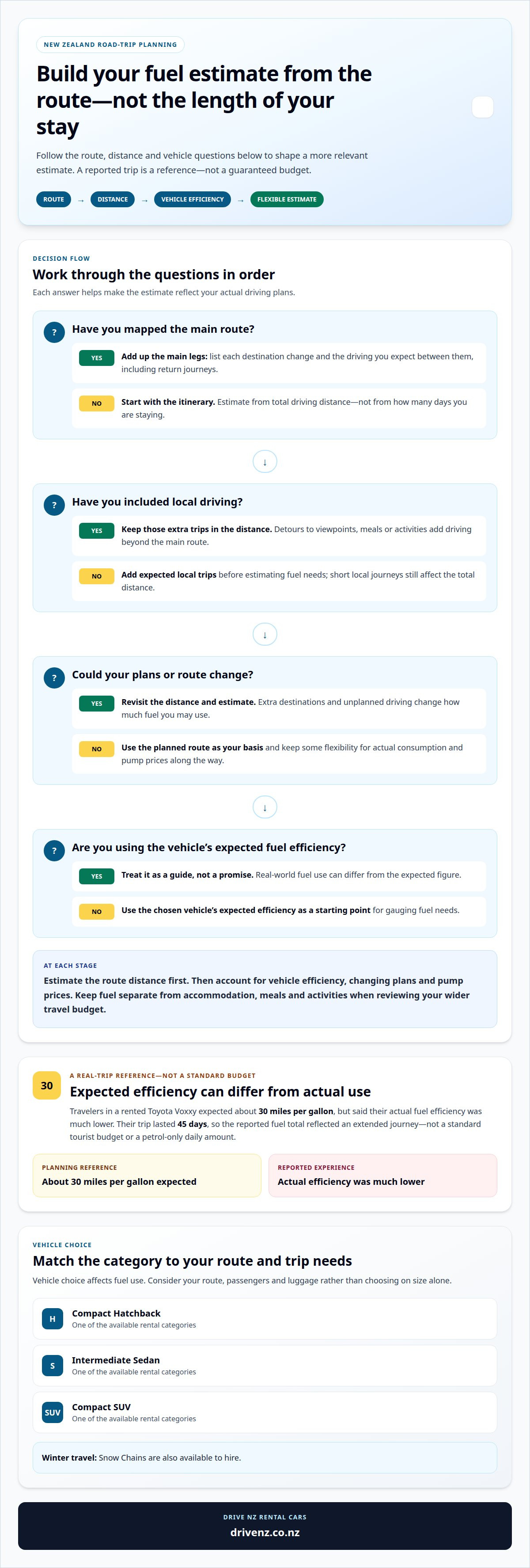
A reported New Zealand trip offers a useful example of why estimates need context. The travelers drove a rented Toyota Voxxy and expected it to achieve about 30 miles per gallon. They said their actual fuel efficiency was much lower. That difference shows why a vehicle’s expected efficiency is a planning reference, not a promise of real-world consumption.
Trip length also matters. The travelers spent 45 days in New Zealand, so their fuel total reflected an extended journey rather than a short visit. Those figures describe their whole trip, not a standard tourist budget or a petrol-only daily amount.
Build a fuel estimate around your route
Start with your itinerary, then estimate fuel use from the distance and the vehicle’s efficiency. A route linking several destinations may involve more driving than a stay based around one town. Add the planned legs together, including any return journeys, before estimating fuel. This gives you a more relevant estimate than multiplying the length of your stay by an assumed daily amount.
- Map the main legs. List each destination change and the driving you expect between them.
- Include local trips. A short detour to a viewpoint, meal, or activity adds distance beyond the main route.
- Use the vehicle’s efficiency as a guide. The Toyota Voxxy example shows that actual consumption can differ from an expected figure.
- Revisit the estimate when plans change. Adding destinations or extra driving changes the distance, and therefore the fuel needed.
Next, consider pump prices along your route. A budget based on one price may need adjusting if the price differs at another stop. Your total also depends on how much fuel your driving requires, so both the price per unit and your consumption matter. Track these separately, so a change in one doesn’t obscure the other.
Driving conditions and trip style affect your estimate, too. Frequent stops, detours or extra local driving can use more fuel than a direct itinerary. For example, adding an unplanned destination increases the distance you drive. Travelers in a Toyota Voxy reporting lower-than-expected efficiency is a reminder to allow for actual use rather than relying only on an expected figure.
For a practical budget, estimate your route first, then use the chosen vehicle’s expected efficiency to gauge fuel needs. Leave some flexibility for route changes and actual consumption. Your driving distance and vehicle use will vary.
Finally, compare your fuel estimate with the rest of your travel budget. Separating fuel from accommodation, meals and activities makes it easier to see how a longer route affects your planned spending.
Drive NZ Rental Cars
Drive NZ Rental Cars offers rental vehicles to suit New Zealand itineraries, helping you plan your driving and fuel needs together. Options include a Compact Hatchback, Intermediate Sedan and Compact SUV. The right fit depends on your route, passengers and luggage. Because vehicle choice affects fuel use, match the category to your trip rather than choosing on size alone.
For winter travel, Snow Chains are also available to hire. Once you’ve mapped your destinations, choose a vehicle category suited to your route and plans. This gives you a practical starting point for budgeting fuel without treating another traveler’s experience as a direct forecast.
Contact Drive NZ Rental Cars to discuss your rental needs.
Make Your Road Trip Plan Work for You
Let your fuel budget support the trip you want, rather than dictate every stop. The cost of petrol in NZ for tourist driving is one part of a wider travel plan, so leave room for the places and experiences that matter most. A thoughtful itinerary can help balance driving days with time to explore.
Before setting off, make your route and vehicle choice work together. A rental vehicle suited to your plans can make the practical side of travelling easier to manage, leaving you to focus on the journey.
If you’re ready to plan your rental, contact Drive NZ Rental Cars to discuss your trip. With a clear plan in place, you can look forward to discovering New Zealand at your own pace.


