

The biggest car isn’t automatically the easiest choice for your parents. Reliable car hire for parents visiting Auckland starts with matching the vehicle to who’ll be driving, their driving preferences and the luggage they’ll bring. If you’re arranging a rental for a family member travelling without you, treat the booking arrangements and vehicle choice as separate decisions.
It’s sensible to compare practical details before settling on a category, especially when automatic transmission, drivetrain and space for bags matter. This guide compares compact hatchbacks, intermediate sedans and compact SUVs, with a focus on what each category may suit and how to think about luggage capacity. It also explains which driving preferences to weigh up when choosing between automatic and drivetrain options, so you can narrow the choice around your parents’ plans rather than simply picking the largest vehicle.
Key Takeaways
- Match the vehicle category to the passengers and luggage so the car suits the trip, not just the passenger count.
- Compare automatic transmission and drivetrain choices with your parents’ driving preferences and planned routes in mind.
- Learn how luggage space differs by vehicle category before choosing a car for bags and travel essentials.
- Understand how rental excess and insurance choices affect the booking, including when a credit-card hold may apply.
What are the Best Car Rentals in New Zealand for Families?
For a family rental, match passenger space and luggage to the trip, then compare pickup convenience and cover. Auckland car rental choices range from small cars to larger family vehicles.
Vehicle Size and Luggage Fit
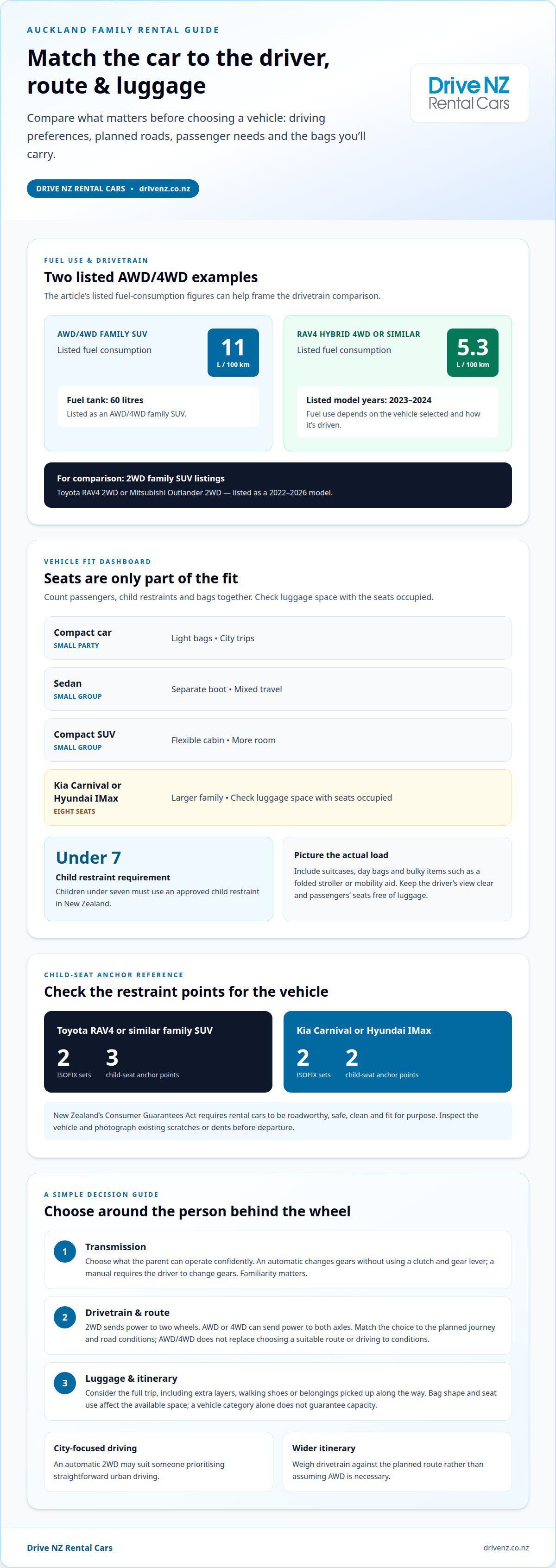
A compact car can suit a small party with light bags, while a sedan or SUV may give luggage more room. An eight-seat Kia Carnival or Hyundai IMax offers more passenger seats, but the vehicle’s size matters less than whether everyone’s bags fit safely. Children under seven must use an approved child restraint in New Zealand.
| Option | Passengers | Luggage fit | Family use |
|---|---|---|---|
| Compact car | Small party | Light bags | City trips |
| Sedan | Small group | Separate boot | Mixed travel |
| Compact SUV | Small group | Flexible cabin | More room |
| Kia Carnival or Hyundai IMax | Eight seats | Check space with seats occupied | Larger family |
Choose by counting passengers, child restraints and bags together, not by seats alone.
Rental Safety and Roadworthiness
New Zealand’s Consumer Guarantees Act requires rental cars to be roadworthy, safe, clean and fit for purpose. A Toyota RAV4 or similar family SUV has two sets of ISOFIX points and three child-seat anchor points; the Kia Carnival or Hyundai IMax has two ISOFIX sets and two anchor points. Before departure, inspect the vehicle and photograph existing scratches or dents. These steps create a record of its condition.
Pickup and Drop-off Locations
Auckland Airport pickup can suit families starting their adventure on arrival, while a city-centre location may be more convenient after a stay in town. Compare the pickup and return points with your arrival plans and accommodation, including how you’ll reach each location. A rental car offers direct travel and room for family luggage; taxis and rideshares can avoid driving, while public transport follows its routes and schedules.
Insurance and Excess Reduction Options
Compare the rental agreement’s included cover, excess and exclusions before choosing excess reduction. Rental companies in New Zealand may place a credit-card hold when the rental excess is above $0. Read each charge and coverage term in the agreement to understand what applies; this is also a practical way to spot unexpected fees or suspicious booking requests. Overseas visitors drive on the left and need a licence valid for driving in New Zealand. Check that the licence meets local recognition requirements before the trip.
Automatic transmission and drivetrain options
Transmission and drivetrain describe different parts of a rental car. Transmission affects how the car changes gears; drivetrain describes which wheels receive engine power. For parents travelling around Auckland, choosing each with the driver’s preferences and planned routes in mind can make driving more manageable. Reliable car hire for parents visiting Auckland means matching these choices to the person behind the wheel.
An automatic changes gears without the driver operating a clutch and gear lever. A manual requires the driver to change gears. Auckland traffic, unfamiliar roads and frequent stops may make an automatic simpler for someone used to driving one. Familiarity matters, though: someone comfortable with a manual may prefer that familiar control.
Drivetrain is a separate consideration. A two-wheel-drive vehicle sends power to two wheels, while all-wheel or four-wheel drive can send power to both axles. This may matter if the planned journey includes varied road conditions, but it doesn’t remove the need to drive to the conditions or choose a suitable route.
Compare the Toyota RAV4 2WD or Mitsubishi Outlander 2WD family SUV, listed as a 2022-2026 model. For an AWD/4WD family SUV, the listed fuel consumption is 11 litres per 100 kilometres, with a 60-litre fuel tank. A RAV4 Hybrid 4WD or similar, listed as a 2023-2024 model, has fuel consumption of 5.3 litres per 100 kilometres. These figures help frame the trade-off between drivetrain and fuel use.
A reliable car hire for parents visiting Auckland also means considering the driver’s comfort on the planned route. For city travel, an automatic 2WD may suit someone prioritising straightforward urban driving. For a wider itinerary, including Christchurch, weigh drivetrain against the route rather than assuming AWD is necessary. Fuel consumption also depends on the selected vehicle and how it’s driven.
- Choose the transmission the parent can operate confidently.
- Match 2WD or AWD/4WD to the planned journey.
- Compare listed fuel consumption alongside drivetrain.
Use these criteria to compare rental car options before arranging the trip.
Luggage capacity by vehicle category
Passenger seats alone don’t show whether a rental car will fit your luggage. Consider the space available with the seats in use, along with the number and shape of your bags. A compact hatchback may suit a parent travelling light, while an intermediate sedan has a separate boot. A compact SUV has a different cabin layout, but its category alone doesn’t guarantee a particular capacity.
Picture the actual load before booking. Include suitcases, day bags and bulky items such as a folded stroller or mobility aid. A hard-shell case may use space differently from a soft bag, and bags may not stack neatly around other items. Keep the driver’s view clear and don’t plan to put luggage where passengers need to sit.
For a road trip from Auckland to Queenstown, consider more than the bags needed on arrival. Layers, walking shoes and items picked up along the way can add to the load. A journey between the North and South Islands may also mean carrying belongings between the car and other transport. Choose a vehicle for the full itinerary, not just the first drive.
Use these steps to compare vehicles rather than relying on the category label:
- List each passenger’s main bag and any bulky item.
- Think about which seats will be occupied throughout the trip.
- Prioritise a layout that keeps luggage secure and passengers comfortable.
At pickup, load the planned bags before setting off. If they don’t fit without blocking sightlines or passenger space, rethink the arrangement rather than forcing it. This practical test helps show whether the vehicle suits the group’s luggage.
A larger category won’t automatically solve every packing problem. Compact SUVs, sedans and hatchbacks arrange passenger and cargo space differently. The best fit depends on the bags, seating plan and journey, not an assumed capacity. Consider those details when booking and leave room for essentials you’ll need during the drive.
What insurance coverage and excess reduction options should visitors choose when renting a car in New Zealand?
For a New Zealand rental, compare the included insurance, excess and exclusions before selecting excess reduction. The excess is the amount you may have to pay if covered damage occurs. Excess reduction can lower that amount, but it doesn’t automatically change which events or parts the policy covers. The agreement’s wording is the key to understanding the difference.
Read the rental terms alongside any excess-reduction option. Look for what the policy covers, what it excludes, and whether each option changes the excess, the scope of cover, or both. For example, a lower excess may feel worthwhile for a family planning a longer Auckland stay, but it doesn’t answer whether a particular kind of damage is covered. Compare the terms, not just the option name.
A rental company in New Zealand may place a hold on a credit card when the rental excess is above $0. Factor that hold into your payment planning, especially if the same card will cover accommodation or other travel expenses. The hold is not the same as a charge; the rental agreement explains the relevant conditions.
Before booking, use this short comparison:
- Included cover: Identify the events and damage the base policy covers.
- Exclusions: Note situations or vehicle parts the policy excludes.
- Excess reduction: Compare how the option changes your potential excess and which terms remain unchanged.
- Payment hold: Account for a possible credit-card hold when the excess is above $0.
For parents arranging a rental for someone else, share the policy terms with the travelling driver. Make sure they understand the excess, exclusions and steps required if an incident occurs. A clear comparison helps the family weigh the potential out-of-pocket amount against the cover’s limits, without assuming that choosing excess reduction removes every exclusion.
Explore rental options as you plan the trip and weigh vehicle choice alongside the rental agreement’s cover.
Drive NZ Rental Cars
Drive NZ Rental Cars gives visiting families a practical starting point for matching a rental category to their passengers, luggage and travel plans. Its options include a Compact Hatchback, Intermediate Sedan and Compact SUV, so parents can compare different vehicle categories rather than choosing by passenger seats alone. Snow Chains are also available for hire for trips where winter driving equipment is relevant.
Use the comparisons above to decide which category best fits the planned journey and the driver’s preferences. Then consider luggage, transmission and drivetrain needs alongside the rental agreement’s insurance and excess terms. This approach helps keep the decision focused on what the visiting parent will actually need on the road.
For help arranging a suitable rental, contact Drive NZ Rental Cars.
Make the booking decision with your parent in mind
Reliable car hire for parents visiting Auckland starts with a decision centred on the person who’ll drive. Consider what will make their time behind the wheel manageable, and choose a vehicle category that fits their plans rather than defaulting to the biggest option. If you’re arranging the trip from elsewhere, keep your parent’s preferences and itinerary at the centre of the choice.
Drive NZ offers a Compact Hatchback, Intermediate Sedan and Compact SUV. These categories give you practical options when arranging transport for a visiting family member in Auckland. Compare them against your parent’s travel plans and luggage, then choose the vehicle that suits their trip.
Use the details in this guide to decide which category suits your parent’s trip, then take the next step when you’re ready. Contact Drive NZ Rental Cars to discuss arranging a rental, and help your parent look forward to exploring Auckland with confidence.
Frequently Asked Questions
Can I rent a car for a family member if I'm not travelling?
You can arrange the trip, but the person who’ll drive should be named in the rental agreement and meet its driver requirements. Enter the travelling parent’s details as the renter or approved driver, as applicable. If you’re paying remotely, keep the payment arrangement separate from who will collect and drive the car. This helps avoid confusion at pickup.
Do I need to pay extra for child seats when booking?
Child seats may involve an additional charge with rental companies in New Zealand, so include that possibility in your trip budget. The amount and arrangement depend on the rental terms. For example, a family travelling with a toddler may need to plan for both the suitable restraint and its fitting. Don’t assume a child seat is included with the vehicle booking.
Do car rentals have car seats for different age groups?
Rental companies in New Zealand commonly offer infant capsules, toddler seats or booster seats, but families should reserve the appropriate type when booking. Start with the child’s age and restraint needs, then include that request with the vehicle reservation. For example, a booster for an older child differs from an infant capsule, so naming the required type helps make the arrangement clear.
Which car hire companies in Auckland have the best reliability ratings and recent customer reviews?
There’s no single reliability rating that answers every family’s needs. When comparing rental options, look for consistent feedback about booking accuracy, vehicle condition, pickup instructions and how issues were handled. A recurring pattern is more informative than an isolated complaint or positive review. For parents arranging a rental remotely, prioritise clear communication and whether the vehicle and collection process matched the booking.
Which Auckland car rental companies offer convenient airport pickup and clear after-hours return options?
Drive NZ serves Auckland Airport through off-airport locations, with a free 24/7 shuttle bus; it also serves Christchurch Airport. For an after-hours return, follow the specific instructions in the booking details. Opening hours alone don’t explain where to leave the car or keys. Check that the return process fits the family’s flight schedule, especially if the travelling parent will return the vehicle without your help.
What should parents check before accepting and returning a rental car in Auckland?
At pickup, compare the car’s visible condition with the rental record and photograph any existing marks before driving away. Also make sure the child restraint and luggage arrangement suit the planned passengers. At return, take fresh photos and keep the return confirmation with the booking documents. For example, a dated set of images can help distinguish pre-existing marks from changes noticed after the trip.


