

The ECO light is an efficiency indicator, not a warning that the car has a fault. To understand what the ECO light means in a rental car, read it as a cue that the vehicle is operating efficiently under its current conditions, not as a signal you need to keep illuminated. Its behavior can vary by vehicle.
The symbol may come on during gentle acceleration, steady driving or coasting, depending on how the vehicle’s systems respond to speed, engine revs and accelerator input. Some cars also have an ECO mode that changes throttle response or gear shifts to reduce energy use. That’s different from a check engine light, which signals a possible fault.
This guide explains how the ECO indicator relates to acceleration and fuel economy, why safe, responsive driving matters more than keeping it on, and how to distinguish it from a warning light. You’ll be better prepared to read the dashboard and drive comfortably in an unfamiliar rental car.
Key Takeaways
- Read the ECO symbol as feedback about efficient driving, not as a target you need to maintain throughout every trip.
- Learn how acceleration, coasting and vehicle settings can affect fuel use and when the ECO indicator appears.
- Distinguish an efficiency indicator from a warning light, and understand why a warning deserves attention.
- Find out how ECO mode controls may work in rental cars and when responsive acceleration matters more than economy settings.
Eco-friendly acceleration and fuel economy
The ECO indicator reflects how a vehicle is being driven, but the conditions that trigger it depend on the vehicle’s systems. Speed, engine RPM and accelerator position can all influence when it appears.
Fuel-Saving Changes in ECO Mode
ECO mode adjusts vehicle responses to encourage lower energy use, often by softening throttle response or changing transmission shifts. If acceleration feels less immediate, gentle pressure on the accelerator can support efficiency, but keeping the ECO light on isn’t the goal. In some vehicles, the system may also adjust ignition timing, fuel use or electric systems.
For example, a car may show its ECO indicator during steady cruising or while coasting downhill, when the engine is under less load. The vehicle’s computer uses inputs such as speed, engine RPM and accelerator position to decide when the indicator appears. Accelerate smoothly when conditions allow, rather than treating the light as a score.
ECO Mode in Hybrid and Electric Rentals
In a hybrid, ECO mode may adjust throttle response, gear changes or electric-system use; in an electric car, it can manage energy use instead of fuel consumption. The exact effect depends on the vehicle, so the same ECO symbol can represent different settings across models.
Does ECO mode affect hybrid or electric rental cars differently? Yes. A hybrid may coordinate its petrol engine and electric systems, while an electric car focuses on battery energy. In either case, gentler responses can support efficiency, but the dashboard indicator alone doesn’t show how much energy a trip will use. Hills and acceleration demands, for instance, affect the energy needed to maintain speed.
Using ECO Mode Controls
ECO mode controls vary by rental car, so identify the vehicle’s button or dashboard setting before changing it. Look for an “ECO” label near the console or in the driving-mode display, then use the marked control. Some cars show an indicator without offering a separate mode switch.
To turn off a selectable mode, use the same control or display option and check that the selected setting changes. Does a rental company require drivers to use ECO mode? ECO mode is a vehicle setting, not a universal rental-car instruction; follow the rental agreement and the car’s displayed directions. If the control is unclear, the owner’s manual explains how that model operates.
ECO indicator versus a warning light
An ECO indicator and a warning light serve different purposes. The ECO symbol generally shows that the vehicle is operating efficiently under current conditions. It isn’t a fault alert like the check engine light. For example, the ECO indicator may go dark when the driver accelerates more firmly, while a warning light signals an issue that needs attention.
The distinction matters because dashboard symbols can be unfamiliar in a rental car. Check the symbol’s shape and label, then compare it with the vehicle’s owner’s manual. A green or clearly labelled ECO indicator usually relates to driving efficiency. A symbol marked “engine,” “oil,” “ABS” or “SRS” refers to a vehicle system, not fuel-saving performance.
What should you do if the ECO light flashes or stays on unexpectedly? If it’s the ECO indicator alone, consult the manual for that model’s meaning, since its behavior varies by vehicle. If a separate warning appears, treat that symbol as a different issue and follow the manual’s instructions.
A Toyota ABS warning indicates a fault in the anti-lock braking system. The fault doesn’t mean the vehicle will lose its brakes, but the car should be inspected promptly. A Toyota engine management light signals a detected fault in that system, which calls for immediate inspection. A Toyota SRS warning that stays on may indicate airbags or seat-belt tensioners could fail during a crash, so have the vehicle checked immediately.
Some Toyota warnings call for immediate action rather than continued driving. If the charging system warning appears while driving, stop and seek professional help. A low engine oil pressure warning means oil pressure is low: stop immediately and check the oil level. These examples show why the symbol’s label matters more than its colour or proximity to the ECO light.
A check engine light may also prevent the ECO indicator from illuminating because engine efficiency is reduced. Treat the warning and ECO symbols separately, and follow the manual’s guidance for the specific rental model.
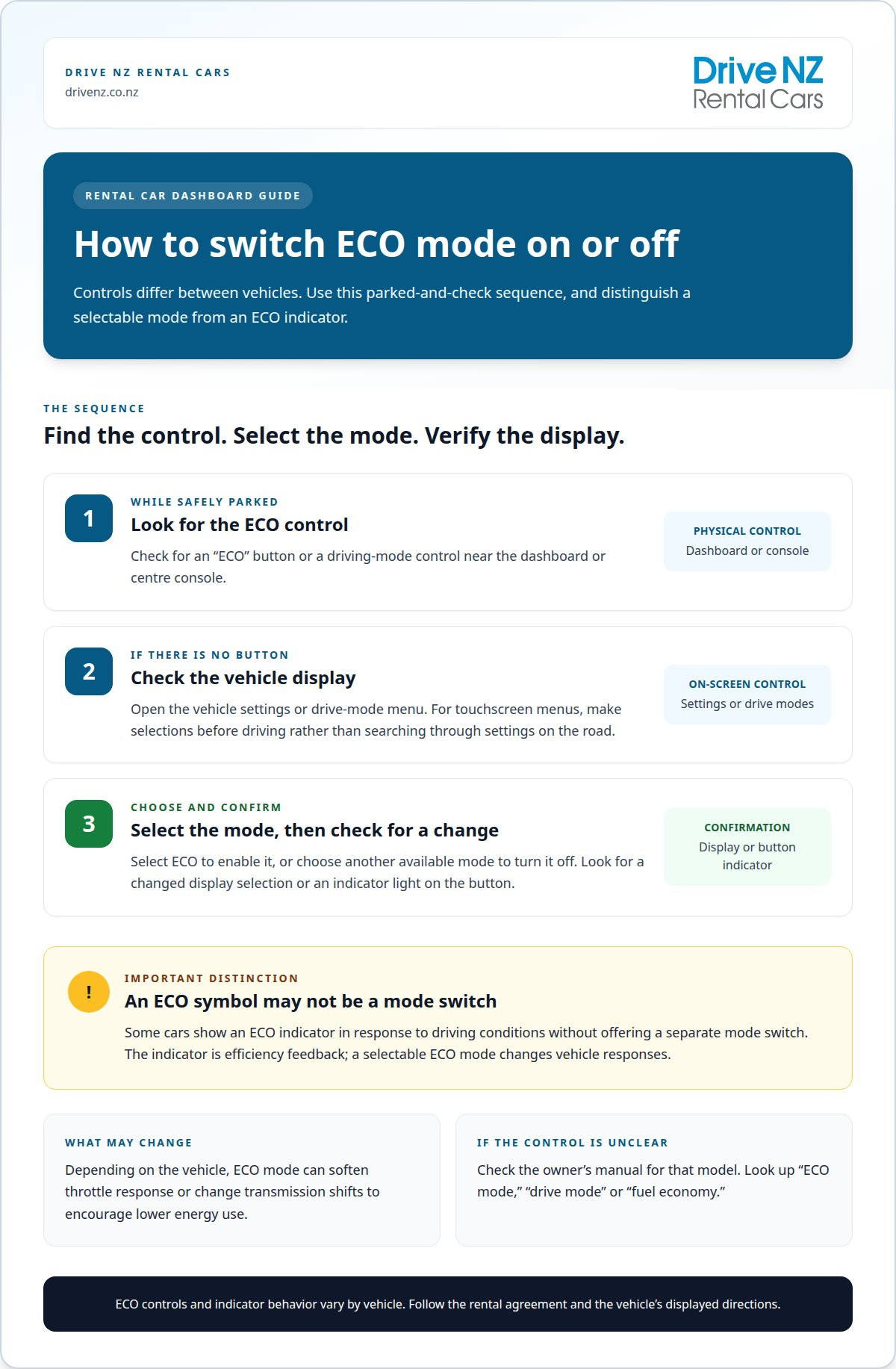
How do you turn ECO mode on or off in common rental cars?
ECO mode controls differ between rental cars, so there isn’t one button location or sequence for every model. Some vehicles use a clearly labelled dashboard or console button; others place driving modes in an infotainment screen. First distinguish a selectable ECO mode from an ECO indicator, which may simply light up to show efficient driving.
Use this simple sequence while the vehicle is safely parked:
- Look for an “ECO” button or a driving-mode control near the dashboard or centre console.
- If there’s no physical control, open the vehicle settings or drive-mode menu on its display.
- Select ECO to enable it, or choose another available mode to turn it off.
Watch the display for a clear change in the selected mode. For example, a screen may highlight “ECO” when selected, while a button may have an indicator light. Don’t assume every ECO symbol means the mode is active. A separate dashboard indicator may respond to driving conditions without offering an on/off switch.
If the control isn’t obvious, use the owner’s manual for the exact model. Search its index for “ECO mode,” “drive mode” or “fuel economy,” then follow the instructions. This avoids confusing an ECO setting with a nearby control for another vehicle function. For touchscreen menus, make selections before driving rather than searching through settings on the road.
Turning ECO mode off may change how the vehicle responds to accelerator input or shifts gears, depending on its design. It doesn’t mean the engine has developed a fault, and it doesn’t necessarily switch off the ECO driving indicator. If the car has no mode control, you can still drive smoothly without trying to keep an indicator illuminated.
Rental cars can have different layouts, even within the same vehicle category. Use the model’s labels and manual as your guide: identify whether you’re changing a selectable driving mode or simply observing a dashboard cue, then use the control provided for that function.
Can ECO mode be unsafe when merging, passing, or driving on hills?
ECO mode isn’t automatically unsafe, but efficient driving shouldn’t limit safe acceleration. Some vehicles soften throttle response or alter gear shifts, which can make acceleration feel less immediate. That matters when entering fast-moving traffic, overtaking or climbing a steep road. Focus on the space and speed you need, not on keeping the ECO indicator lit.
Consider a highway example: merging at 40 MPH into traffic travelling at 60 MPH could be dangerous. Build speed when it’s safe, check for a suitable gap, and merge smoothly. Don’t delay acceleration just to preserve the indicator. If your car has a selectable ECO mode and its response feels too slow for the situation, use another available setting when safe.
Passing also requires enough room and responsive acceleration. If a vehicle ahead slows, assess the road, traffic and visibility before overtaking. ECO mode may change how the accelerator or transmission responds, depending on the car. Don’t begin a pass if you can’t complete it safely. The indicator gives efficiency feedback, not a signal that conditions are suitable for overtaking.
On hills, the engine may need more power to maintain speed, so the ECO light may go out. That doesn’t mean you’re driving badly. Use steady, controlled acceleration and choose a safe speed for the slope and road conditions. Downhill, easing off the accelerator can reduce demand, but keep your attention on traffic and vehicle control.
Before setting off, learn whether your rental has a selectable ECO mode or only an indicator. If you’re unsure how its controls work, consult the vehicle manual while parked. Prioritize safe acceleration and control over fuel-saving prompts whenever traffic or a hill requires a different response. For a vehicle suited to your trip, explore rental car options.
Drive NZ Rental Cars
Drive NZ Rental Cars offers practical rental vehicles for your New Zealand trip, whether you’re comparing an economy-focused driving mode or planning for varied road conditions. Choose from Compact Hatchback, Intermediate Sedan and Compact SUV options, with Snow Chains available for hire. The ECO light depends on the vehicle’s systems, so knowing the difference between an efficiency indicator and a warning light can help you feel more prepared when collecting your rental.
Consider your passengers, luggage and route when choosing a vehicle category. For winter travel, Snow Chains are a useful option to consider alongside your plans. If you have questions about the ECO light in your rental or want to discuss your vehicle choice, contact Drive NZ Rental Cars.
Make your next drive feel more familiar
Knowing what the ECO light means in a rental car gives you a useful starting point, but the best preparation is understanding the vehicle you’ll drive. Before setting off, take a moment to get familiar with its dashboard and controls while parked. That pause can make unfamiliar symbols and settings easier to interpret on the road. Keep your attention on the conditions around you, and let efficiency features support your driving rather than dictate it.
Your vehicle choice is another part of planning a comfortable trip. Think about the route, passengers and luggage you’ll carry, then choose a rental category that suits those needs. Drive NZ Rental Cars offers Compact Hatchback, Intermediate Sedan and Compact SUV options. If you’re ready to plan your drive, contact Drive NZ Rental Cars and take the next step with confidence.
Frequently Asked Questions
What Does the ECO Driving Indicator Light Mean?
The ECO driving indicator shows that the vehicle’s current operation meets its efficiency conditions. It responds to driving inputs rather than confirming that a separate mode has been switched on. For example, it may change as you move from steady cruising to stronger acceleration. Treat it as dashboard feedback, not an instruction to change speed when traffic or road conditions call for another response.
What do they mean?
If you mean the dashboard symbols, each one points to a different vehicle function or condition. An ECO symbol relates to efficiency, while a high-beam icon shows that the headlights’ high beams are on. An open-door symbol means a door or trunk isn’t fully closed. Check the symbol’s label and the vehicle manual, especially when an unfamiliar icon appears alongside another light.
What does the ECO light mean in a rental car?
If you’re wondering what the ECO light means in a rental car, it indicates efficient operation as judged by that vehicle’s system. Its exact behavior depends on the model, so the symbol may work differently in different rentals. In Auckland or Christchurch, take a moment before setting off to identify the symbol in the rental’s manual and distinguish it from alerts that need attention.
Does the ECO light indicate a fuel-saving driving mode or just efficient driving?
The light can indicate efficient driving without confirming that a selectable ECO mode is active. A mode is a setting you choose through a button or vehicle menu; an indicator can simply respond to how the car is operating. For example, a rental may display ECO during a steady drive even if you haven’t selected an ECO setting. Look for a separate control or mode label to tell the difference.
How does ECO mode affect engine power, acceleration, and air conditioning?
ECO mode may make acceleration feel less responsive by changing throttle behavior or gear shifts. Its effect on air conditioning depends on the vehicle, so don’t assume the ECO symbol tells you how the climate system is set. For comfort, use the cabin’s temperature controls and consult the rental’s manual to understand any ECO-related climate settings for that model.
Is the ECO light different from the check-engine or warning lights?
Yes. The ECO indicator provides efficiency information, while the check-engine light signals a detected engine-management fault. Other alerts can identify issues involving systems such as ABS or airbags. If a warning symbol appears, use the vehicle manual to identify it and follow its directions rather than treating it as an ECO message. This distinction is useful when several dashboard lights appear together.


