
In 2023, Waka Kotahi data indicated that nearly 25% of international drivers felt initial confusion when encountering local traffic rules. Imagine you're approaching a one-lane bridge outside Christchurch or a complex motorway merge in Auckland. If you don't recognize the specific new zealand road signs instantly, a relaxing trip can quickly turn into a stressful ordeal. We understand that your focus should be on the stunning scenery, not the anxiety of a potential traffic fine or a safety mishap.
You deserve a seamless experience behind the wheel. This 2026 guide ensures you master the visual language of our roads, from the subtle differences between 'Give Way' and 'Stop' to the unique wildlife warnings you'll find in the South Island. We'll provide the clarity you need to handle loose gravel, alpine ice, and urban congestion with professional ease. We're going to break down essential sign categories, specific protocols for one-lane bridges, and local tips for driving safely in Auckland and Christchurch.
Key Takeaways
- Decode the visual language of Waka Kotahi to quickly identify mandatory instructions and safety alerts during your journey.
- Navigate complex urban intersections and transit lanes in Auckland and Christchurch with total confidence and precision.
- Master the specific rules for one-lane bridges and unique wildlife crossings to ensure a safe trip through rural alpine passes.
- Learn to recognize essential new zealand road signs to avoid common tourist mistakes and keep your driving experience stress-free.
- Gain practical tips for a seamless rental experience, ensuring you are fully prepared before arriving at the Drive NZ desk.
Understanding the Visual Language: The Three Categories of New Zealand Road Signs
Driving through the diverse landscapes of Auckland or the wide avenues of Christchurch requires more than just a reliable vehicle. It demands a clear understanding of how Waka Kotahi (NZ Transport Agency) communicates with drivers. The system relies on a specific visual code where shapes and colors signal the level of urgency and the type of action required. This New Zealand road signs overview shows how the local system aligns with international standards while addressing the unique topography of the North and South Islands.
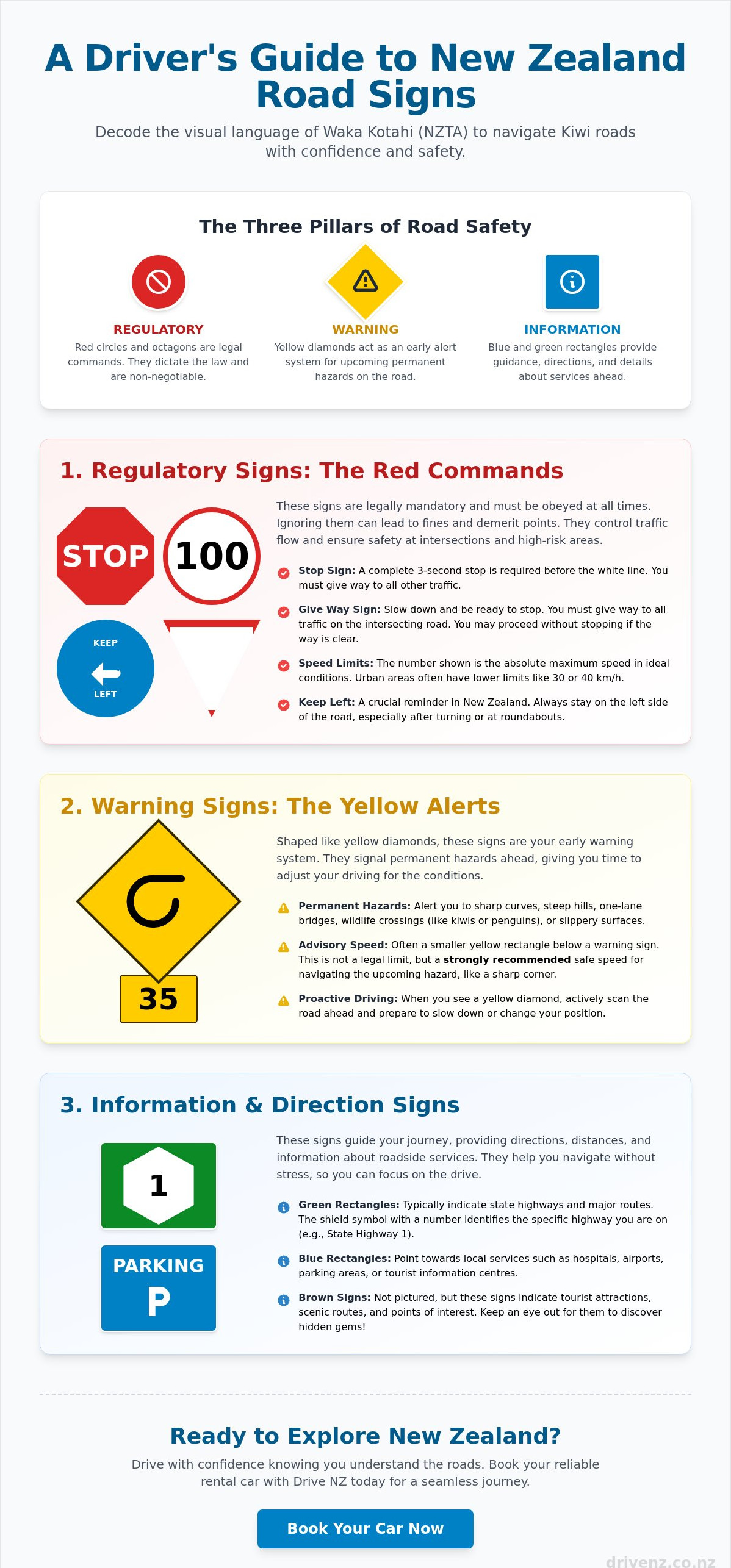
The visual language is split into three primary pillars. Red circles dictate the law, yellow diamonds provide essential warnings, and blue or green rectangles offer guidance. At Drivenz, we believe that empowering drivers with this knowledge is the first step toward a seamless, stress-free mobility experience. Whether you're using a long-term car subscription or a short-term hire, recognizing these cues instantly ensures you remain a safe and confident road user.
Regulatory Signs: The Red Circle Commands
Regulatory signs are the most critical category because they carry legal weight. You'll recognize them by their distinctive red borders or solid red backgrounds. These aren't suggestions; they're mandatory instructions. Speed limit signs are the most common example. If you see a red circle with "100" inside, that's the absolute maximum speed allowed under ideal conditions. In 2026, urban areas in Auckland and Christchurch frequently use 30km/h or 40km/h limits to protect pedestrians, and ignoring these can result in immediate fines or license demerit points.
Prohibitory signs also fall into this group. Signs like "No Entry," "No Left Turn," or "Wrong Way" are designed to prevent head-on collisions and manage traffic flow in complex city centers. For international visitors, the "Keep Left" sign is perhaps the most important command to master. It serves as a constant reminder of New Zealand's driving orientation, helping you stay on the correct side of the road at intersections and roundabouts.
Warning Signs: The Yellow Diamond Alerts
Yellow diamond signs act as your early warning system for permanent road features. They're designed to give you enough time to adjust your speed or position before you reach a potential hazard. These signs typically highlight upcoming sharp curves, steep descents, or narrow bridges. Because new zealand road signs are placed strategically to reflect the actual terrain, seeing a yellow diamond means you should actively scan the road ahead for changes in the surface or environment.
You'll often see a smaller yellow plate with a number below a curve sign. This is an advisory speed, which differs from the legal red-circle limit. The advisory speed sign serves as a safety recommendation for optimal cornering. While you won't get a ticket for exceeding it by a few kilometers, these numbers are calculated based on vehicle stability and road grip. Following them ensures your journey remains smooth and avoids unnecessary wear on your vehicle's tires and brakes.
Information and direction signs round out the system. Green rectangles typically mark state highways, while blue signs point toward local services, hospitals, or parking zones. This structured flow of information allows you to navigate the new zealand road signs system with ease, letting you focus on the road while our all-inclusive support packages handle the rest of your vehicle needs.
Compulsory and Priority Signs: Critical Rules for Auckland and Christchurch Motorways
Understanding new zealand road signs with red borders is essential because these indicate mandatory requirements. If you see a red circle or octagon, it's a legal command. At busy urban intersections in Auckland and Christchurch, the distinction between a Stop sign and a Give Way sign is vital for safety. A Stop sign requires your vehicle to come to a complete, 3-second halt before the line, even if no other traffic is visible. In contrast, a Give Way sign allows you to proceed without stopping, provided the junction is clear. Failing to respect these priorities is a leading cause of urban collisions in New Zealand's major cities.
Priority at Intersections
New Zealand's junction layouts often include unique "Give Way" rules that can surprise international visitors. When turning left at an intersection, you must give way to all traffic coming from your right. In Christchurch's CBD, the 2024 "An Accessible City" project introduced dedicated priority signals for buses and cyclists. You'll see small white "B" lights for buses or green cycle symbols that activate before the main traffic light turns green. Always check for these signals to avoid cutting off local transit.
Navigating multi-lane roundabouts in Auckland, such as the Panmure or Royal Oak circles, requires early lane selection. You must signal left as you approach the exit you intend to take. Understanding your NZ Road Code responsibilities ensures you manage these high-traffic zones with confidence. Remember, at any railway crossing, the 'Stop on Red' signal is absolute. In 2023, KiwiRail reported 148 near-miss incidents at crossings, highlighting why the 'Look for Trains' warning is never just a suggestion.
Urban Transit and Parking Signs
Auckland's motorway network relies heavily on T2 and T3 transit lanes to manage congestion. A T2 sign means the lane is reserved for vehicles carrying 2 or more people, while T3 requires 3 or more. These lanes are active during peak hours, typically 7:00 am to 9:00 am and 4:00 pm to 6:00 pm. Auckland Transport currently uses over 40 remote cameras to monitor these lanes. If you enter a transit lane with only a driver in the car, expect a fine in the mail.
Parking in city centers requires a sharp eye for 'P' signs. A sign marked 'P30' allows for 30 minutes of parking, while 'Residents Only' zones are strictly enforced. Clearway signs are the most critical to watch for in Auckland. These signs indicate that parking is prohibited during specific times to allow for extra traffic lanes. If you leave your car in a clearway, it'll likely be towed within minutes of the restriction starting. Using a flexible car subscription from Drivenz allows you to choose modern vehicles equipped with the latest navigation tech, helping you identify these zones and avoid costly infringements.
Bus and cycle lane signage is equally strict. In Christchurch, many lanes are painted green to denote cycle priority. You should only cross these lanes when turning and only when it's safe to do so. Staying informed about these new zealand road signs ensures your journey across the North and South Islands remains stress-free and legal.
Warning Signs and Rural Hazards: Navigating One-Lane Bridges and Alpine Passes
Leaving the urban centers of Auckland or Christchurch often means transitioning onto narrow, winding roads where conditions change quickly. Mastering new zealand road signs in these rural areas is essential for a stress-free journey. These yellow diamond-shaped signs warn you of permanent hazards, while rectangular signs often dictate specific protocols for infrastructure. Understanding these markings ensures you remain in control, even when the terrain becomes challenging.
One-Lane Bridge Protocol
One-lane bridges are a staple of the New Zealand landscape, particularly on the West Coast and throughout rural Canterbury. The signs governing these bridges use a simple visual system to determine right of way. If your side has a large black arrow, you have the right to cross first. If you see a smaller red arrow pointing in your direction, you must yield to oncoming traffic. It's a simple mnemonic to remember: "Big black arrow goes, small red arrow slows."
In some remote areas, you might find bridges without these specific signs. In these cases, the "first to the bridge" courtesy rule applies. Slow down as you approach and ensure the way is clear. You can find more detailed visual examples in the Official Guide to New Zealand Road Signs provided by Waka Kotahi. Always check for oncoming headlights or dust clouds before committing to the crossing, as visibility can be limited on approach.
Environmental and Wildlife Alerts
New Zealand's rural roads often double as paths for livestock. When you see a "Stock" sign featuring sheep or cattle, reduce your speed immediately. You may need to stop completely and wait for a farmer or a dog to clear the path. Don't sound your horn, as this can startle the animals and cause unpredictable movement. Simply stay patient and follow the farmer's lead.
Coastal roads near Oamaru or forested areas in Northland feature unique wildlife signs for Blue Penguins and Kiwi. These animals are often small and difficult to see from the driver's seat. Wildlife signs are most critical during dawn and dusk driving. If you encounter a "Loose Gravel" sign on an unsealed road, slow down to avoid losing traction or flicking stones at other vehicles' windscreens. Maintaining a lower speed on these surfaces is the best way to prevent a loss of control.
Winter and Alpine Signage
Driving through the Crown Range or Arthur's Pass requires specialized knowledge of alpine signage. Snow and ice signs appear when temperatures drop, indicating that the road surface may be treacherous. The "Fit Chains Now" sign is a mandatory instruction, not a suggestion. Ignoring this sign is dangerous and frequently leads to vehicles becoming stranded or sliding off the road in sub-zero conditions.
Preparation is the key to safety in these high-altitude regions. Before heading into the South Island high country, review the ultimate winter driving New Zealand checklist to ensure your vehicle is equipped for the conditions. Modern new zealand road signs also include electronic boards that provide real-time updates on pass closures. These digital alerts are vital for avoiding long detours during the winter months when passes can close with little notice.
Temporary and Information Signs: Finding Your Way from Auckland Airport to Christchurch
Driving from Auckland to Christchurch covers over 1,000 kilometers of diverse terrain and changing conditions. Understanding new zealand road signs ensures your journey stays on track and your vehicle remains in top condition. While permanent signs provide the foundation, temporary and service signage offers the real-time data you need for a seamless trip across the North and South Islands.
Roadworks and Temporary Hazards
Orange diamond-shaped signs indicate temporary changes to the road environment. These appear frequently as Waka Kotahi (NZ Transport Agency) manages over 1,000 active work sites across the national network at any given time. If you see a "Road Closed Ahead" sign, it's a mandatory instruction. You must follow the designated detour, as these routes are pre-vetted for safety and vehicle clearance. Ignoring these can lead to dead ends or hazardous conditions for your car.
Manual traffic control is common in rural areas between Hamilton and Taupo. You'll encounter workers using "Stop/Slow" paddles to manage one-way flow. In more complex zones, a "Pilot Vehicle" may lead a convoy through the site. It's essential to stay directly behind this vehicle and maintain the set pace. You should also watch for "Loose Metal" signs. These indicate fresh gravel that can easily fly up and chip a windscreen. Slowing down to the temporary limit, often 30km/h, is the best way to avoid a costly insurance claim for glass damage.
Navigational and Service Signs
The New Zealand highway system relies on a clear color-coded hierarchy. State Highways, such as SH1 which runs the length of the country, are identified by red shields with white numbering. Local roads typically use blue or white rectangular signs. Keeping an eye on these shields helps you stay on the major routes without constantly checking a GPS. Distance markers are another vital tool. These green signs list the kilometers to the next three major towns, helping you calculate fuel stops and rest breaks with precision.
- Blue signs: These identify essential services like fuel stations, public toilets, and hospitals.
- Brown signs: These point toward tourist attractions and "hidden gems" like scenic lookouts or historic sites.
- I-SITE symbols: Look for the lowercase "i" to find official visitor information centers for local maps and bookings.
If you're planning a long-distance trip, our all-inclusive car subscription provides the modern, reliable vehicle you need to explore every corner of New Zealand with confidence. We focus on providing a hassle-free experience so you can concentrate on the road ahead rather than the paperwork.
Emergency signs are equally straightforward. Symbols for police stations and emergency telephones are placed prominently near major intersections. In remote areas of the South Island, these signs often include the distance to the next available communication point, which is vital in areas with limited mobile reception. By paying attention to these cues, you'll find that navigating from the top of the North Island to the bottom of the South is a logical and well-supported process.
Mastering the NZ Road Code: Practical Tips for a Hassle-Free Rental Experience
Arriving at the Drive NZ rental desk in Auckland or Christchurch should be the start of a seamless adventure. To ensure your journey begins with confidence, it's vital to familiarize yourself with the local rules before you land. New Zealand roads are unique, and understanding new zealand road signs ahead of time removes the stress of split-second decision-making on the highway.
Pre-Trip Preparation
Success starts with digital resources. We recommend visiting the Waka Kotahi (NZ Transport Agency) website to review the latest 2026 sign updates and road code changes. This preparation ensures you aren't surprised by local nuances. For a smooth transition to local driving habits, read our guide on Mastering Driving on the Left in NZ. Additionally, a quick review of the ultimate 2026 safety checklist is essential for confirming you have all the necessary documentation and safety knowledge before departure.
Three specific signs frequently confuse international visitors. Recognizing these early prevents common mistakes:
- One-Lane Bridge Priority: A red circle with a black arrow means you must give way to oncoming traffic. A blue square with a white arrow means you have the right of way, though you should still proceed with caution.
- Broken Yellow Lines: These are painted near the curb and indicate a strict "No Stopping" zone at any time. Parking here often leads to immediate fines in busy areas like Christchurch’s CBD.
- Keep Left Arrows: Often found on traffic islands, these white arrows on a blue background are mandatory directions. Ignoring them can lead you into oncoming traffic.
How Drive NZ Supports Your Journey
We view ourselves as your mobility partner, not just a rental agency. Our fleet is curated to help you navigate new zealand road signs and terrain with ease. For instance, choosing a compact SUV offers an elevated driving position, which significantly improves your visibility of roadside signage and upcoming hazards on winding rural roads.
If your itinerary includes the South Island during the winter months, we provide snow chains and expert demonstrations on how to fit them. This commitment to safety ensures you're prepared for the 15% of alpine passes that may require them during a typical July cold snap. Our goal is to provide reliable, modern vehicles that make your travel experience feel like a flexible subscription to the best of New Zealand.
Before leaving the Auckland or Christchurch airport precincts, run through this final checklist:
- Adjust all mirrors to eliminate blind spots.
- Confirm your GPS or mobile map is set to "Avoid Unsealed Roads" if you aren't in a 4WD.
- Check that your headlights are set to "Auto" or "On" for better visibility in rain.
- Ensure you know how to operate the handbrake and wipers in your specific model.
By taking these practical steps, you turn a standard car hire into a secure, empowered exploration of everything New Zealand has to offer.
Hit the Road with Confidence in 2026
Mastering the visual language of the road is the first step toward a seamless journey across the North and South Islands. By following this 2026 guide, you'll recognize the three distinct categories of new zealand road signs that keep traffic flowing safely from urban motorways to remote alpine passes. You've learned how to navigate one-lane bridges and how to respond to compulsory priority signs in busy city centers like Auckland and Christchurch.
Since 2005, Drivenz has focused on removing the complexity from vehicle hire. We operate dedicated service hubs at both Auckland and Christchurch airports to ensure your transition from the terminal to the driver's seat is fast and efficient. Our fleet features modern compact SUVs, and we provide specialized winter safety gear for those tackling South Island routes. We pride ourselves on a transparent, hassle-free process that puts you in control of your travel itinerary.
Book your reliable NZ rental car today and drive with confidence. We're ready to help you explore every corner of Aotearoa with peace of mind.
Frequently Asked Questions
What do the yellow diamond signs mean in New Zealand?
Yellow diamond signs are warning signs that alert drivers to permanent hazards ahead like sharp curves, intersections, or narrowing roads. These signs help you prepare for changes in road conditions well in advance to ensure a smooth journey. According to Waka Kotahi, the NZ Transport Agency, these are distinct from temporary orange signs used for roadworks. Following these cues ensures a seamless trip across the 94,000 kilometers of managed roads in the country.
How do I know who has priority on a one-lane bridge in NZ?
You determine priority on a one-lane bridge by looking at the size and color of the arrows on the sign. If you see a small red arrow pointing your way inside a red circle, you must yield to oncoming traffic. Conversely, a large white arrow on a blue rectangular sign indicates you have the right of way. Over 100 of these bridges exist on the South Island alone, requiring focused attention for a safe crossing.
Are speed limit signs in New Zealand in miles or kilometers?
Speed limit signs in New Zealand are always displayed in kilometers per hour (km/h). This has been the national standard since the metric conversion in 1975. If you see a circular sign with a red border and the number 100, the maximum legal speed is 100 km/h. it's essential to monitor your speedometer closely, as many new zealand road signs now indicate lower limits of 30 km/h or 40 km/h in high-pedestrian urban zones.
What does a red circle with a white bar mean on NZ roads?
A red circle with a horizontal white bar means "No Entry" for all motor vehicles. You'll frequently encounter this sign at the exits of one-way streets or private access ways to prevent head-on collisions. Disregarding this sign is a serious traffic offense under the Land Transport (Road User) Rule 2004. Our subscription vehicles come with modern navigation tools to help you avoid these restricted zones effortlessly and keep your journey stress-free.
Can I turn left on a red light in New Zealand?
You cannot turn left on a red light in New Zealand unless a specific green arrow signal permits the movement. Unlike some regions in North America, a red light means a complete stop until the light changes to green. This rule applies across all 1,600 sets of traffic signals managed by Auckland Transport. Waiting for the correct signal ensures a reliable and predictable flow of traffic for everyone on the road.
What should I do if I see a 'Chains Required' sign but don't have them?
You must stop and not proceed past a "Chains Required" sign if your vehicle isn't equipped with snow chains. These signs are common on alpine passes like Arthur's Pass on State Highway 73 during the winter months from June to August. Driving without chains in these conditions can result in a fine or being stranded. For a hassle-free experience, check the weather forecast before heading into high-altitude areas in your rental.
Do New Zealand road signs use Maori and English?
Yes, New Zealand is increasingly using bilingual road signs that feature both Te Reo Māori and English. Waka Kotahi launched the Te Kura Huarahi program in 2023 to rollout 94 specific sign types with dual languages. You'll see "Kura" alongside "School" or "Taihoa" near "Slow" markings. Understanding these new zealand road signs helps you navigate the local culture while maintaining safety during your travels through Christchurch and beyond.
What is the 'Advisory Speed' sign and is it legally binding?
An advisory speed sign is a yellow square with black text that suggests a safe speed for a specific curve or hazard. While these aren't the legal maximum speed limit, they indicate the maximum comfortable speed for a standard vehicle in dry conditions. If you exceed this speed and cause an accident, police may cite you under the 1998 Land Transport Act for driving at an unsafe speed. It's a helpful guide for maintaining control.


