

Did you know that a 100-kilometer drive through the New Zealand countryside can often take twice as long as the same distance on a typical highway back home? While the landscapes are world-class, the reality of narrow, winding roads and unique one-lane bridge etiquette can be a shock for first-time visitors. Planning a new zealand road trip itinerary for 2026 requires more than just a map; it requires an understanding of local conditions that turn a stressful drive into a seamless adventure.
We understand that navigating left-side driving and keeping up with the latest entry requirements, like the $100 International Visitor Conservation and Tourism Levy, can feel overwhelming. This guide simplifies the process, promising you a stress-free experience from the moment you land in Auckland or Christchurch. You will gain complete clarity on license rules, including the 12-month validity period starting November 2026, and how to choose between a compact hatchback or a sturdy SUV for alpine passes.
We will walk you through the essential safety protocols, explain the current NZeTA fees, and help you master the nuances of Kiwi roads. From managing petrol costs to fitting snow chains for winter safety, you will have all the modern tools needed to drive with quiet confidence and enjoy every moment of your journey.
Key Takeaways
- Understand the unique "Kiwi Mile" to accurately estimate travel times across New Zealand’s winding rural terrain and one-lane bridges.
- Ensure legal compliance by determining if you require an International Driving Permit or an approved English translation for your current license.
- Match your vehicle to your specific new zealand road trip itinerary by choosing between a compact hatchback for city-hopping or a compact SUV for extra luggage space.
- Prepare for seasonal challenges with essential snow chain hire and practical tips for managing black ice on high-altitude passes.
- Simplify your arrival with efficient airport-adjacent vehicle pickups in Auckland or Christchurch to get your journey started without delay.
The Reality of New Zealand Roads: What to Expect in 2026
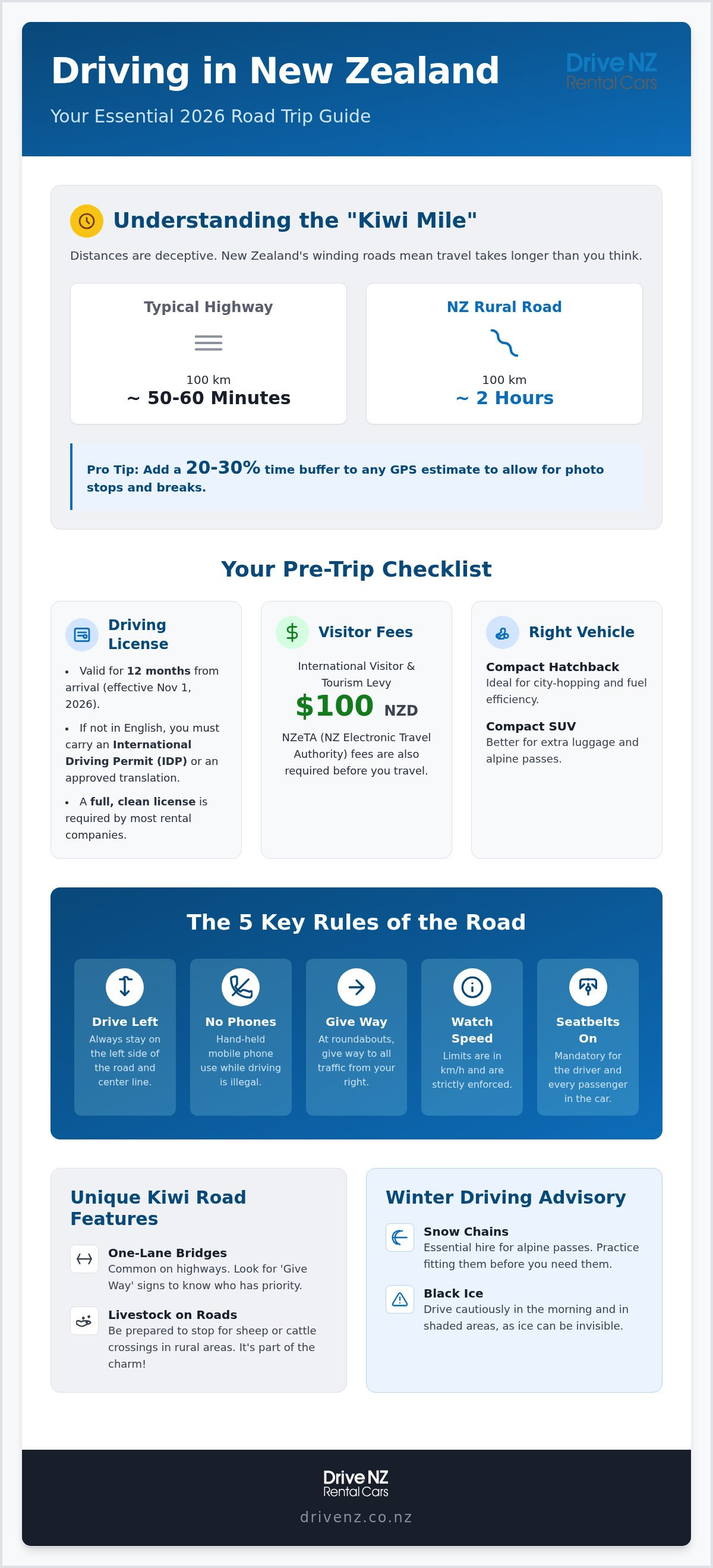
Distance is deceptive in New Zealand. While a 100-kilometer stretch on a European motorway or an American interstate might take 50 minutes, in rural New Zealand, it's often a two-hour commitment. This phenomenon, known locally as the "Kiwi Mile," is the foundation of any successful new zealand road trip itinerary. You aren't just driving; you're navigating a landscape that demands constant attention and a slower pace.
Your journey will likely transition from the multi-lane motorways of Auckland to the tight, hair-pin turns of the Southern Alps. In 2026, we're seeing more variable weather patterns affecting road surfaces, which means visibility and grip can change in minutes. The "Slow is Fast" mantra is the unofficial rule for tourist drivers. By maintaining a steady, cautious speed, you avoid the stress of mechanical strain and the danger of misjudging a sharp corner.
Why New Zealand Roads are Unique
Many visitors are surprised by how narrow our secondary roads are. It's common to encounter unsealed gravel sections or steep gradients that require steady handling, especially if you're behind the wheel of a compact hatchback or intermediate sedan. One-lane bridges are a frequent feature on South Island highways. You must know who has the right of way before you reach the bridge deck. Familiarizing yourself with the New Zealand Road Code is essential for understanding these priority rules. Don't be shocked if your only roadblock is a flock of sheep being moved between paddocks; it's just part of the local charm.
Estimating Your Travel Times Correctly
Digital maps often underestimate the "winding factor" of our regional highways. We recommend adding a 20-30% buffer to any GPS-estimated arrival time. This extra space in your new zealand road trip itinerary allows for regular rest stops, which are vital to combat driver fatigue on our demanding, high-concentration roads. These buffers also ensure you can pull over safely for scenic photo opportunities without feeling rushed. Always use designated lookouts for photos. Stopping on a narrow shoulder can block local traffic and create safety risks for other drivers. Planning for these pauses ensures your trip remains a holiday rather than a race against the clock.
Essential Road Rules and License Requirements for Tourists
Mastering the local rules is the first step toward a successful new zealand road trip itinerary. The most critical instruction is simple: always keep left. It sounds straightforward, but when you're tired or turning into an empty rural road, muscle memory from home can take over. New Zealand police maintain a zero-tolerance policy for speeding and drink-driving. The breath-alcohol limits are extremely low, so it's best to plan for zero alcohol if you're the designated driver.
From November 1, 2026, you can drive on your overseas car license for up to 12 months from your last arrival date. If your license isn't in English, you must carry an International Driving Permit (IDP) or an official NZTA-approved translation. A common concern for younger travelers is the "Restricted License" policy. While NZ law has specific license tiers, most rental providers require a full, clean license to secure a vehicle. Confirm your license status with your provider before you arrive to ensure a smooth pickup.
The 'Big Five' Rules to Memorize
Safety on Kiwi roads depends on a few non-negotiable habits. While conditions are generally excellent, you should review Winter driving safety tips if your new zealand road trip itinerary includes alpine passes. Memorize these core requirements:
- Drive Left: Always stay on the left side of the center line at all times.
- Seatbelts: These are mandatory for every passenger in the car.
- Mobile Phones: No hand-held use is permitted while the engine is running.
- Roundabouts: Always give way to traffic coming from your right.
- Speed Limits: Look for circular signs with red borders; these indicate the maximum speed in km/h.
One-Lane Bridge Etiquette
New Zealand's highway network features many one-lane bridges. These are managed by specific "Give Way" signs that dictate who crosses first. If you see a circular sign with a red border, you must stop and give way to oncoming traffic. A rectangular blue sign with a large white arrow indicates you have the right of way. Even with the big arrow, always slow down and check that the bridge is clear. If you meet a heavy truck or a bus, the polite and safest choice is to let them through first; they take much longer to stop and restart than a compact hatchback.
Selecting the Right Rental Car for Your NZ Itinerary
Choosing the right vehicle is a pivotal decision for your new zealand road trip itinerary. It's not just about the daily rate; it's about how the car handles the specific topography of your route. While the roads are well-maintained, the transition from urban motorways to steep alpine passes requires a car that matches your comfort level and luggage needs. Before you book, ensure you meet the NZ Transport Agency driving requirements for 2026, including having a valid English-language license or an approved translation.
Your choice should reflect the realities of Kiwi travel. With petrol prices averaging around NZ$3.05 per liter for regular 91 octane in early 2026, fuel efficiency is a major factor for budget-conscious travelers. However, saving a few dollars on fuel shouldn't come at the expense of safety or physical comfort during long driving days.
Compact Hatchback vs. Intermediate Sedan
In urban hubs like Auckland or Christchurch, a compact hatchback is the ultimate city-hopper. These vehicles are incredibly easy to park in tight city spaces and offer the best fuel economy for shorter hops between regional towns. They're perfect for solo travelers or couples with light luggage.
If your plan involves 4+ hour drives across the South Island, an intermediate sedan is often the superior choice. The longer wheelbase provides a smoother ride on open highways, reducing driver fatigue. Luggage capacity is the "hidden" factor here; a sedan offers a secure, separate trunk that keeps your valuables out of sight while you're away from the car on a short walk. This added security is a simple way to ensure a stress-free journey.
The Case for a Compact SUV
For those heading into the heart of the Southern Alps or exploring the rugged coastlines of the Coromandel, a compact SUV provides a significant confidence boost. The higher seating position offers better visibility over winding coastal roads and hilly terrain. While most tourist routes are sealed, many trailheads for popular hikes are located at the end of gravel roads. An SUV's increased ground clearance helps you manage these sections with ease.
You can view the specific dimensions and engine power of these options in the Drive NZ Rental Cars fleet guide. Matching your car to your specific new zealand road trip itinerary ensures you have the power needed for mountain climbs without paying for more vehicle than you actually need.
Mastering Seasonal Challenges: Winter Driving and Snow Chains
Driving in New Zealand between June and August transforms the landscape into a winter wonderland, but it also introduces variables that can alter your new zealand road trip itinerary. High-altitude passes in the South Island frequently experience snow and black ice. Black ice is particularly treacherous because it often looks like a simple wet patch on the road while offering zero traction. To stay safe, you must monitor real-time updates from Waka Kotahi (NZTA). Their digital platforms provide the most accurate information on road closures and hazard warnings, which is essential when a sudden storm hits.
Fuel management is another critical safety factor during the colder months. In rural regions, petrol stations can be over 100 kilometers apart. We recommend never letting your tank drop below a quarter. Being stranded in freezing temperatures because you underestimated the distance to the next pump is a preventable stress. While 91 octane prices averaged NZ$3.05 in early 2026, it's better to pay for a top-up than to risk being caught without heat in a remote area.
Using Snow Chains Safely
On many alpine routes, carrying snow chains is a legal requirement. Signs will clearly indicate if chains must be fitted or simply carried in the vehicle. If you're heading into the Southern Alps, Drive NZ provides snow chains as an essential accessory for our South Island fleet. Fitting chains in the cold can be difficult if you haven't practiced. We suggest doing a dry run in a dry, flat area before you reach the snow line. This ensures you can secure them quickly and safely when the weather turns.
Navigating Remote Areas
Connectivity is a known challenge in New Zealand's wilderness. While urban centers have excellent coverage, many national parks and mountain passes are mobile dead zones. You cannot rely on live streaming maps in these areas. Always download offline maps while you have reliable Wi-Fi in Auckland or Christchurch. For a more detailed look at staying safe in these environments, consult our driving in new zealand for tourists safety checklist. Being prepared for a lack of signal ensures you stay on track even when your phone's data connection wavers.
Hire snow chains with your vehicle to ensure you're fully prepared for the Southern Alps during your 2026 adventure.
Stress-Free Logistics: Pickups in Auckland and Christchurch
Landing in a new country after a long-haul flight can be daunting, but choosing a provider with airport-adjacent locations simplifies your arrival. Whether you're starting your new zealand road trip itinerary in the North or South Island, your first priority is a seamless vehicle handover. Our dedicated locations in Auckland and Christchurch are designed to get you away from the terminal and onto the road with minimal friction.
Auckland vs. Christchurch Starts
Starting in Auckland allows you to experience the North Island's vibrant urban center before heading into the rural heartland. Auckland's motorway system is modern and well-signposted, but it can be fast-paced for first-timers. We recommend planning your exit outside of peak commute times to keep your first hour of driving stress-free. In contrast, Christchurch serves as the immediate gateway to the South Island's expansive plains and alpine routes. For those beginning their journey in the south, our car hire christchurch guide provides specific tips for navigating the region's unique geography.
Before you drive away, take five minutes to conduct a thorough vehicle inspection. Check the tire tread, ensure all lights are functional, and document any existing marks on the bodywork. New Zealand's rural roads often feature loose metal or gravel, which can cause minor stone chips. Understanding your insurance excess and how it applies to gravel road damage provides essential peace of mind when your new zealand road trip itinerary takes you toward remote trailheads or coastal lookouts.
The Drive NZ Rental Experience
As a locally owned operator founded in 2005, we prioritize transparency and reliability. We understand that modern travelers prize speed and flexibility, so we've eliminated hidden fees and complex contracts. This local expertise means we can offer practical advice that global chains might overlook. We also ensure that younger explorers aren't left behind; if you're a student or a traveler under the age of 25, check our guide on under 21 car rental nz to see how we make hiring accessible and straightforward.
Returning your compact SUV or intermediate sedan is designed to be just as efficient. Both Auckland and Christchurch airports have several fueling stations within a five-minute radius of our drop-off points. To avoid the premium prices sometimes found at the very last pump, we recommend fueling up in the neighboring suburbs just before you reach the final airport precinct. This simple step ensures you return the car with a full tank as required, keeping your final logistics as smooth as the rest of your 2026 adventure.
Ready for Your 2026 Kiwi Adventure?
A successful new zealand road trip itinerary relies on the perfect balance of preparation and flexibility. By respecting the unique "Kiwi Mile" and choosing a vehicle that matches your specific route, you transform a potentially stressful journey into a seamless exploration of our world-class landscapes. Whether you are navigating the urban motorways of the North Island or the rugged alpine passes of the South, the right tools and local knowledge make all the difference.
As a 100% NZ-owned and operated business since 2005, we are committed to making your logistics as efficient as possible. With dedicated pickup points at both Auckland and Christchurch Airports, you can transition from the terminal to the driver's seat without delay. We also provide specialist snow chain hire to ensure your Southern Alps crossing remains safe and compliant during the winter months.
Your 2026 journey is waiting. Explore our fleet and book your New Zealand rental car today to secure a reliable partner for your travels. We look forward to seeing you on the road soon.
Frequently Asked Questions
Can I drive in New Zealand with a US or UK driver’s license?
Yes, you can drive with a US or UK license as long as it is current and written in English. From November 1, 2026, tourists are permitted to drive on an overseas car license for up to 12 months from their last arrival date. If your license is in another language, you must carry an International Driving Permit or an official translation. Always keep your physical license on you while exploring your new zealand road trip itinerary.
Is it difficult to switch to driving on the left side of the road?
Switching to the left side of the road requires high concentration, especially during the first few days of your trip. A helpful tip is to remember that the driver should always be positioned toward the center of the road. Most visitors find the transition manageable after a few hours of quiet driving. Take extra care at intersections and when pulling out of rest areas, as these are the moments when old habits can resurface.
What happens if I encounter a one-lane bridge in New Zealand?
You must follow the specific signage located at the bridge entrance to determine who has priority. A circular sign with a red border means you must stop and give way to oncoming traffic. Conversely, a blue rectangular sign indicates you have the right of way. Even if you have the priority arrow, always slow down and ensure the bridge is clear. If you meet a heavy vehicle, it's safest to let them cross first.
Do I really need to hire snow chains for a winter trip?
Yes, snow chains are essential if you plan to cross alpine passes in the South Island during winter. Many roads have legal requirements to carry them between June and August. Drive NZ provides snow chain hire specifically for these conditions. We recommend practicing the fitting process in a dry area before you reach the snow line. This ensures you can secure them quickly and safely when temperatures drop and traction decreases on the road.
Are there many toll roads in New Zealand for tourists to worry about?
New Zealand has only three toll roads, all located in the North Island: the Northern Gateway, Tauranga Eastern Link, and Takitimu Drive. These are clearly signposted with "Toll Road" warnings and offer bypass routes if you prefer to avoid them. There are no physical toll booths; instead, cameras scan your license plate. You can pay online within five days of using the road to avoid administrative fees or late penalties.
What is the speed limit on New Zealand open roads?
The standard speed limit on open roads is 100km/h, while urban areas are typically 50km/h. However, many rural roads have lower limits due to winding terrain or narrow surfaces. Always look for the circular signs with red borders for the legal maximum. New Zealand police enforce these limits strictly with a zero-tolerance approach. Adjusting your speed for the conditions is the best way to ensure a safe, stress-free journey through the countryside.
Can I rent a car in New Zealand with a restricted license in 2026?
Most rental companies, including Drive NZ, require a full and valid driver's license to secure a vehicle. While New Zealand law has specific tiers for local drivers, the insurance requirements for rental fleets usually exclude those on restricted or learner permits. It's vital to check the specific terms of your provider before finalizing your new zealand road trip itinerary. Having a full license ensures you are legally covered for all road conditions and vehicle types.
How often should I refuel when driving through the South Island?
You should aim to refuel whenever your tank reaches the quarter-mark, especially in remote parts of the South Island. While major towns have 24-hour stations, rural stretches can have gaps of over 100 kilometers between pumps. Some remote stations may also have limited operating hours. Maintaining a healthy fuel reserve protects you against unexpected road closures or detours. With petrol prices averaging NZ$3.05 in 2026, staying topped up is a practical safety priority.


