

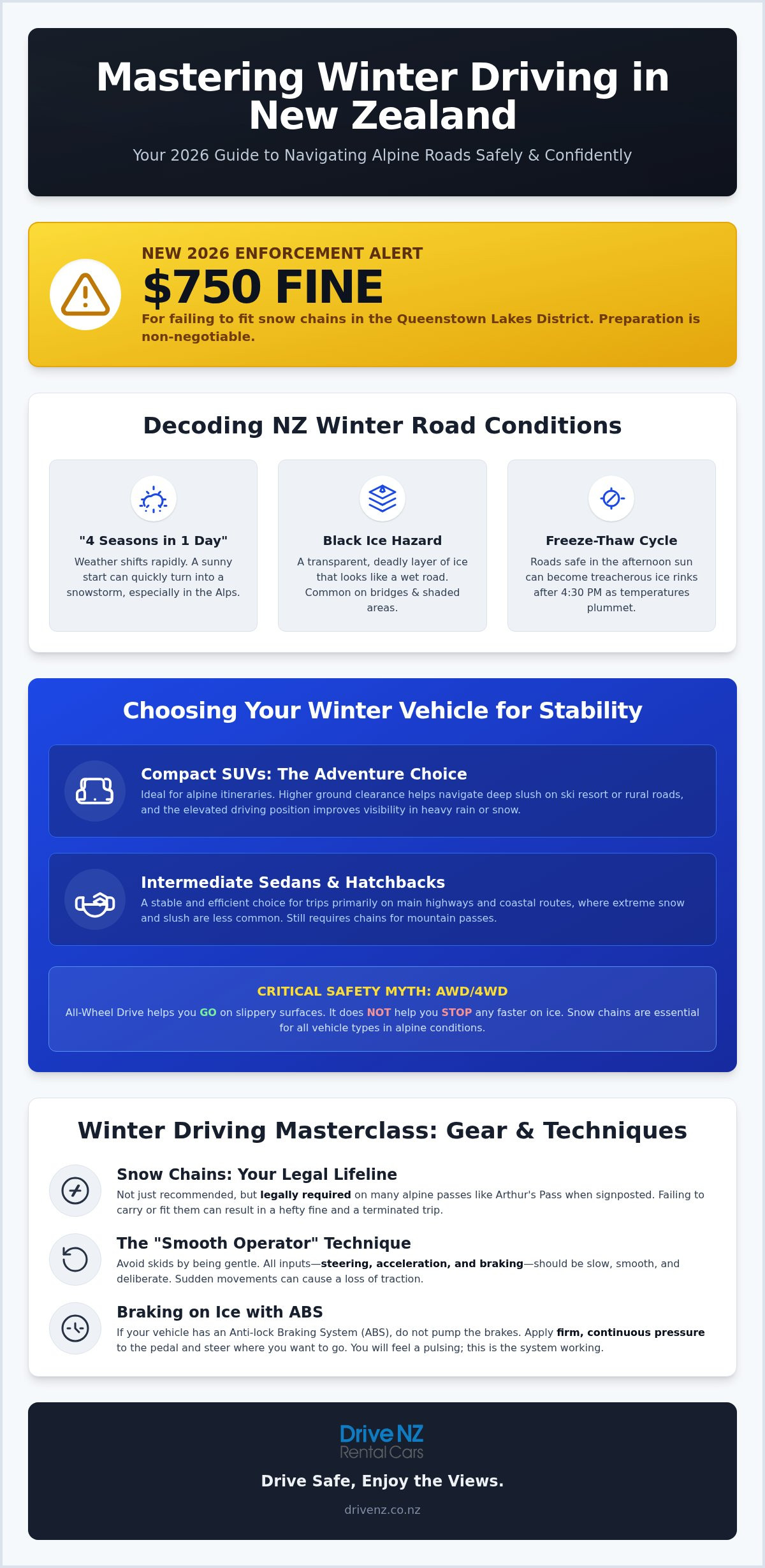
Did you know that failing to fit snow chains in the Queenstown Lakes District can now result in an immediate $750 fine? This strict enforcement, introduced for the 2026 season, highlights why thorough preparation is essential for winter driving New Zealand. It's natural to feel a sense of anxiety when you're facing a steep alpine pass or worrying about hidden black ice on a shaded bend. The South Island's landscapes are spectacular, but they require a specific set of skills and the right equipment to navigate safely.
We understand that you want your trip to be about the views, not the stress of vehicle logistics. That's why we've put together this guide to help you master the unique challenges of our winter roads with expert tips and local knowledge. You'll gain the confidence to handle any conditions, from crisp morning frosts to heavy mountain snowfall. We will walk you through choosing the best rental vehicle for your route, whether it's a nimble compact SUV or a sturdy intermediate sedan. You'll also learn exactly when and how to use snow chains and discover the essential safety protocols that keep you and your passengers protected throughout your journey.
Key Takeaways
- Learn how to identify black ice and manage the unpredictable "four seasons in one day" weather that defines the local landscape.
- Understand why choosing a compact SUV or intermediate sedan provides the necessary stability and traction for crossing alpine passes like Arthur's Pass.
- Master the legal requirements for snow chains and learn our simple process for adding them to your booking to ensure you're prepared for winter driving New Zealand.
- Discover the "Smooth Operator" technique to prevent skidding and understand the correct way to brake on icy surfaces using modern ABS systems.
- Get specific regional advice for navigating different routes, from the wet roads of the central plateau to the frost-prone plains near Christchurch.
What to Expect: New Zealand Winter Road Conditions in 2026
Winter driving New Zealand is defined by the famous "four seasons in one day" phenomenon, which becomes significantly more volatile during the colder months. You might start a journey under clear blue skies in Christchurch only to encounter a localized snowstorm or heavy freezing rain as you climb into the Southern Alps. This rapid shifting means you must remain alert to road surface changes at all times. The weather can turn in minutes, transforming a dry highway into a slippery challenge that requires immediate adjustments to your speed and following distance.
To manage these conditions, the New Zealand Transport Agency often spreads road grit, also known as shingle, on icy stretches. While this provides essential traction, it can feel like driving on marbles if you carry too much speed into a corner. Additionally, daylight hours are short during our winter season. By 4:30 PM, visibility drops sharply as the sun disappears behind the mountain ranges. Planning long-distance travel requires leaving early to ensure you reach your destination before the temperature plummets and the light fades completely.
Temperature Drops and the Freeze-Thaw Cycle
Roads that appear perfectly safe and dry at 2:00 PM can become lethal by 5:00 PM as the freeze-thaw cycle takes hold. As the sun dips, any moisture on the tarmac quickly solidifies into ice. Shaded gullies and bridge decks are particularly high-risk areas because they stay colder than the surrounding road for longer periods. Black Ice is a transparent coating of ice that blends with the road surface. Because it looks like a simple wet patch, it's easily the most dangerous hazard on our roads. Understanding these nuances is a core part of the New Zealand Road Code, which every visitor should review before starting their engine.
Visibility Challenges: Fog, Rain, and Snow
The South Island is frequently hit by "southerly busters," intense cold fronts that bring sudden drops in visibility and heavy precipitation. In these moments, your safety depends on recognizing your limits. If the snow is falling faster than your wipers can clear it, or if fog makes it impossible to see the road markers, it's time to pull over in a safe area. Before you set off, it's vital to check the NZ Road Code to ensure you understand the specific signs and signals used during winter weather events. Staying informed helps you stay in control and ensures your winter trip remains a positive experience.
Choosing the Right Rental Vehicle for Winter Stability
Selecting the right car is about more than just finding a comfortable seat. For winter driving New Zealand, your vehicle's physical characteristics directly impact how it handles snowy alpine passes like Arthur's Pass. Weight distribution and ground clearance are the two factors that determine whether you'll stay planted on the road or struggle with slush. While it's tempting to focus solely on fuel economy, prioritizing safety features and stability is a smarter investment for mountain travel. A heavier vehicle often provides better traction on packed snow, while higher clearance prevents the undercarriage from scraping on uneven ice ridges.
Many travelers believe an AWD or 4WD vehicle is a magic shield against ice. This is a dangerous myth. While all-wheel drive helps with initial traction, it doesn't help you stop any faster on a frozen surface. Even the most capable AWD systems require snow chains in deep snow or on steep gradients. Mastering these hardware choices is a key part of successful winter driving New Zealand. We provide snow chains across our entire fleet to ensure you're never caught off guard by sudden weather shifts.
Compact SUVs: The Adventure Choice
A compact SUV is often the preferred choice for those heading into the heart of the South Island. The primary benefit is ground clearance. When ski resort car parks or rural roads become bogged down with heavy slush, that extra height prevents the vehicle from getting stuck. You also benefit from a higher driving position, which significantly improves your visibility during the heavy rain common in late-winter fronts. If you're planning an alpine itinerary, you can explore our Drive NZ Rental Cars Fleet to find an SUV that suits your group size.
Intermediate Sedans and Hatchbacks
If your route stays primarily on coastal highways or main arterial roads, an intermediate sedan or compact hatchback offers distinct advantages. These vehicles have a lower center of gravity, which provides a more planted feel when navigating the winding, cambered roads of the North Island or the Otago coast. They are also highly efficient and easier to maneuver in urban environments like Auckland or Christchurch. For younger travelers, these models are often the most accessible option. If you are a younger driver, our Under 21 Car Rental guide explains how to manage restricted license requirements while still securing a reliable vehicle. Regardless of your choice, you can view our current availability to ensure you get the best fit for your winter adventure.
Essential Gear: The Drive NZ Guide to Snow Chain Hire
When you see a sign stating "Chains Must Be Carried," it isn't a suggestion. In alpine regions and across the South Island, local authorities frequently mandate that all vehicles carry fitting equipment regardless of the current weather. Conditions for winter driving New Zealand can shift from clear tarmac to deep slush in the time it takes to climb a single pass. If you're caught without them on a restricted road, you face significant fines and, more importantly, the risk of becoming stranded. We've made the hire process seamless at our Auckland and Christchurch locations, allowing you to add snow chains to your compact SUV or intermediate sedan booking with a single click.
We strongly recommend performing a "dry run" in our rental lot before you depart. It's much easier to learn the tensioning system in a flat, dry environment than it is on the side of a mountain during a blizzard. When you do need to fit them on the road, always look for designated chain-fitting bays. These are widened shoulder areas designed to keep you away from moving traffic. Never stop in the middle of the driving lane or on a blind corner, as visibility for other drivers will be severely compromised in snowy conditions.
How to Correctly Fit Snow Chains
The first step is identifying which wheels provide the power. Most of our compact hatchbacks and intermediate sedans are front-wheel drive, meaning the chains must go on the front tyres. For our compact SUVs, check with our team at pickup to confirm the primary drive wheels. Once you've identified the correct tyres, lay the chains out on the ground to remove any tangles or twists in the links. Drape the chain over the top of the tyre, connect the internal and external fasteners, and drive forward approximately two meters. This allows the chain to settle so you can perform a final tensioning check to ensure a snug fit.
Driving with Chains: Speed and Handling
Once your chains are fitted, your maximum speed should never exceed 40km/h. Speed is the enemy of chain integrity; driving too fast can cause the metal links to snap or damage your vehicle's wheel arches. Listen closely to the sound of your car. A healthy set of chains produces a consistent hum, but a rhythmic "thwack" against the bodywork indicates a loose link that needs immediate adjustment. As soon as you reach clear, black tarmac, pull over and remove the chains promptly. Driving on dry roads with chains on will quickly wear down the metal and can negatively affect your vehicle's braking performance during winter driving New Zealand.
Winter Driving Techniques: Avoiding the Slide
Adopting a "Smooth Operator" approach is the most effective way to stay safe during winter driving New Zealand. Sudden steering, heavy braking, or aggressive acceleration can easily break the limited traction you have on icy or wet roads. Think of your vehicle controls as having a slight delay; every input should be gradual and deliberate. By avoiding jerky movements, you keep the weight of the car balanced, which is essential for maintaining grip on unpredictable surfaces.
Following distances require a major adjustment during the colder months. On a dry summer day, a two-second gap is standard, but in winter, you must increase this to at least four seconds. This extra buffer provides the time needed to react to hazards without slamming on the brakes. If your rental car is equipped with an Anti-lock Braking System (ABS), and most modern vehicles in our fleet are, the correct technique on ice is to apply firm, steady pressure. Don't be alarmed if the pedal vibrates; that is the system working to prevent a lock-up. If you do feel the car start to skid, stay calm, look where you want to go, and steer gently in that direction while easing off the pedals.
Uphill and Downhill Management
Managing elevation changes requires proactive gear selection. When you begin a long descent, shift into a lower gear to use engine braking. This helps control your speed without relying solely on your brakes, which can overheat or cause a slide on steep gradients. When heading uphill, the goal is to maintain steady momentum. If you stop on a snowy incline, it can be very difficult to get moving again without spinning your wheels. A key piece of local etiquette to remember is that on narrow mountain passes, the vehicle traveling downhill should generally give way to the vehicle coming up, as the uphill driver needs to maintain their momentum to stay safe.
The Importance of Visibility
Visibility is often the first thing to fail during a southern storm. Always drive with your dipped headlights on, even in broad daylight, to ensure other motorists can see you through the spray and fog. Inside the car, use the air conditioning to dehumidify the cabin and prevent window fogging. One crucial tip for winter driving New Zealand is to clear every bit of snow from the roof of your vehicle before you start your journey. If left there, that snow can slide forward during braking and completely block your windscreen, or fly off and hit the car behind you. To ensure you have a vehicle equipped for these conditions, book your winter-ready rental car today and travel with peace of mind.
Planning Your Winter Route: Auckland vs. Christchurch
Planning a successful road trip requires more than just picking a destination; it involves understanding how geography dictates road conditions. The "Golden Rule" for winter driving New Zealand is to allow at least 50% more time than Google Maps suggests. While digital maps calculate speed based on legal limits, they often fail to account for the slow crawl required during heavy sleet or the time needed to fit snow chains. Before you turn the key, always check the NZTA Journey Planner for real-time road closures or warnings. This tool is your best defense against unexpected detours and ensures you don't head toward a pass that has already been closed by local authorities.
Whether you start your journey from our Auckland or Christchurch locations, your route will present distinct challenges. The North Island's hazards are often hidden in rain and wind, while the South Island demands respect for its high-altitude alpine passes. We provide snow chains for hire across our entire fleet at both hubs, ensuring you have the necessary equipment regardless of which island you choose to explore.
South Island Hotspots: Lindis Pass and Crown Range
If you're departing from the Garden City, your route toward Queenstown or Wānaka will likely include the Lindis Pass or the Crown Range. These are often the first sections of road to require snow chains due to their high elevation. The Crown Range, in particular, is steep and winding; if the weather looks questionable, we often recommend taking the longer, flatter route via the Kawarau Gorge. While it adds a few kilometers to your trip, it's often a much more relaxed experience for those new to winter driving New Zealand. For more inspiration on navigating the mainland, check out our Car Hire Christchurch guide for detailed South Island itinerary ideas.
North Island Hazards: Desert Road and Tongariro
Travelers starting in Auckland often underestimate the cold once they head south toward the Central Plateau. While Auckland itself remains relatively mild with heavy rain and wind, the Desert Road section of State Highway 1 reaches altitudes where snow and black ice are common. This high-altitude stretch can catch drivers off guard, especially when moving from the humid coastal air into the sub-zero temperatures of Tongariro National Park. It's essential to have a vehicle that handles well in wet and icy conditions. Our Car Rental Auckland guide provides more tips on preparing for these North Island transitions, ensuring your trip from the city to the snow is as smooth as possible.
Secure Your New Zealand Winter Adventure
Navigating the frost-covered landscapes of Aotearoa is an unforgettable experience when you've got the right tools and local knowledge. By choosing a vehicle built for the terrain and adopting a disciplined driving mindset, you'll turn potential road stress into a confident journey. Remember that successful winter driving New Zealand depends on respecting the conditions, whether you're crossing the Desert Road or climbing the South Island's alpine passes. It's about being prepared for the environment before you even turn the key.
Our team is here to support you with convenient Auckland and Christchurch Airport pickups and expert local advice at every counter. Every hire includes 24/7 Roadside Assistance to ensure your peace of mind across every kilometer of your trip. Book your winter-ready rental car and snow chains with Drive NZ today. We're ready to help you explore the unique beauty of our backyard with total confidence and safety.
Frequently Asked Questions
Do I really need to hire snow chains in New Zealand?
Yes, especially if you plan to travel through alpine passes or explore the South Island. In 2026, the Queenstown Lakes District enforces a $750 fine for failing to fit chains when required by local signage. We offer snow chains for hire across our entire fleet in Auckland and Christchurch. Carrying them is a legal requirement on many mountain roads, even if the weather looks clear when you set off.
What happens if a road is closed due to snow?
You must find an alternative route or wait for road crews to clear the path. Use the NZTA Journey Planner to check for real-time updates before you depart. If a major pass like the Desert Road or Arthur's Pass is closed, local authorities will set up checkpoints. Don't attempt to bypass these closures, as conditions are genuinely unsafe for travel until the "road closed" status is officially lifted.
Is it difficult to drive on the left side of the road in winter?
It requires extra concentration, particularly when visibility is low or road markings are covered by snow. Most visitors adapt quickly, but the challenge increases during winter driving New Zealand when you're also managing slippery surfaces. Keep your focus on the road and use the "left is life" mantra. If you feel overwhelmed by the combination of new rules and winter weather, pull over in a safe area to rest.
Can I drive a compact hatchback to the ski fields?
Yes, you can drive a compact hatchback to most major ski fields as long as you carry snow chains. While a compact SUV offers more ground clearance for unsealed or slushy car parks, our hatchbacks are well-maintained and capable of the climb. Always check the daily mountain report, as some access roads may require chains to be fitted even for 4WD vehicles during heavy snow events.
What should I do if I hit black ice?
Stay calm and avoid any sudden movements with the steering wheel or pedals. If your car starts to slide, ease your foot off the accelerator and steer gently in the direction you want to go. Don't slam on the brakes, as this can cause the wheels to lock and worsen the skid. Most of our intermediate sedans and SUVs feature ABS, which helps you maintain control during these critical moments.
Are winter tyres common on New Zealand rental cars?
No, most rental fleets in New Zealand use high-quality all-season tyres rather than dedicated winter tyres. Studded tyres are actually illegal on our roads. Instead, we rely on a combination of reliable tyre tread and the use of snow chains for extreme conditions. We ensure all our vehicles meet high safety standards, but the responsibility for fitting chains remains with the driver when the conditions demand it.
How much extra time should I allow for winter driving?
You should allow at least 50% more time than your GPS or Google Maps initially estimates. Winter driving New Zealand involves slower speeds, potential stops to fit chains, and shorter daylight hours. A trip that takes three hours in summer can easily take five hours in July or August. Starting your journey early ensures you reach your destination before the temperature drops and visibility fades in the late afternoon.
What emergency supplies should I keep in my rental car?
Keep a basic kit that includes warm blankets, a torch with spare batteries, and a small shovel for snow. It's also wise to carry high-energy snacks and plenty of water in case of a road closure. Ensure your mobile phone is fully charged before you leave Auckland or Christchurch. While we provide 24/7 roadside assistance, having these essentials on hand makes waiting for help much more comfortable in cold weather.


