

What if the most intimidating part of your journey north actually became the highlight of your entire New Zealand holiday? Many travelers feel a spike of anxiety when thinking about the winding Brynderwyn Hills or navigating the left side of the road for the first time. It's a common concern, but with the right preparation, the auckland to bay of islands drive is a straightforward 230km journey that rewards you with some of the most stunning coastal views in the Southern Hemisphere.
We're here to ensure your trip is as efficient and stress-free as possible. This guide covers everything from managing the $2.60 Northern Gateway toll to choosing between a fuel-efficient Compact Hatchback or a versatile Compact SUV for those hidden gravel beach access roads. We'll preview the best local pitstops and confirm that the SH1 Brynderwyn section is fully open and ready for your 2026 adventure. By the time you reach Paihia, you won't just be arriving; you'll be relaxed and ready to explore.
Key Takeaways
- Plan your 230km journey with expert tips on city bypasses and managing the electronic toll road system without the stress.
- Identify the top 10 essential stops, including hidden gems in Puhoi and Warkworth, to turn your transit into a scenic adventure.
- Get the latest 2026 updates on the Brynderwyn Hills road status to ensure a safe and predictable drive through Northland terrain.
- Learn why a Compact Hatchback or Compact SUV is often the superior choice for the auckland to bay of islands drive compared to larger alternatives.
- Simplify your arrival in Paihia with practical logistics on waterfront parking and the ferry crossing to Russell.
Planning Your Auckland to Bay of Islands Route
The 230km journey from the city to the subtropical North is more than just a transit; it's the beginning of your holiday. While the distance is roughly 143 miles, the time it takes depends heavily on your route choice and Auckland's notorious traffic. Most of your auckland to bay of islands drive takes place on New Zealand's State Highway 1. This road is the primary artery connecting the country. It transitions from a multi-lane motorway in the city to a winding, two-lane highway as you move into the Northland region.
If you're starting directly from Auckland International Airport, don't head straight for the city center. You'll save significant time and stress by taking State Highway 20. This route bypasses the CBD and connects you to the northern motorway via the Waterview Tunnel. It's a much smoother experience in a fuel-efficient Compact Hatchback, allowing you to clear the urban sprawl and find your rhythm on the open road quickly.
The Direct Path: SH1 and the Toll Road
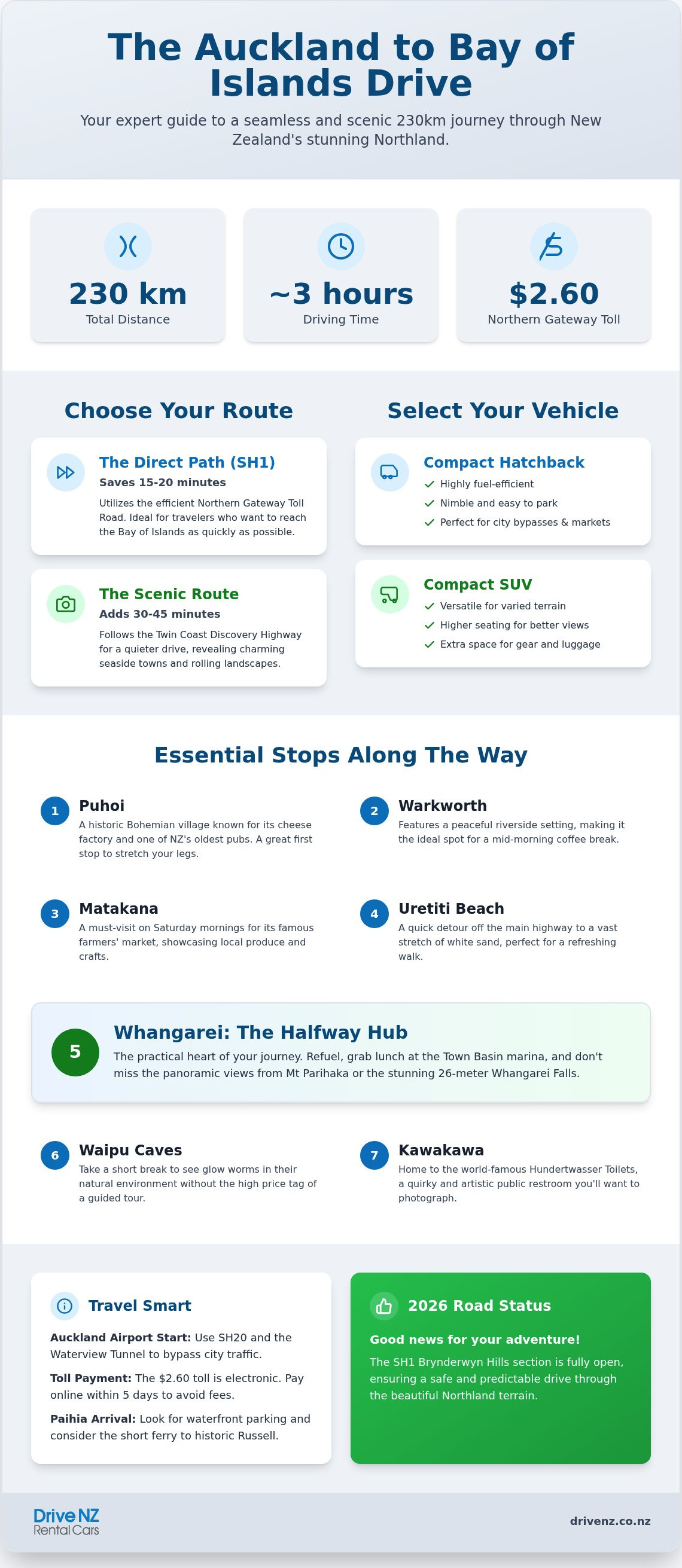
The Northern Gateway Toll Road is a 7.5km stretch of highway that cuts through the hills north of Orewa. It's a modern, time-saving essential that shaves about 15 to 20 minutes of stop-start driving off your trip. Because the system is fully electronic, there are no toll booths to slow you down. Cameras scan your plate as you pass under the gantries, and you can pay the $2.60 fee online. We recommend paying before you leave or within five days of your journey to avoid late fees. This efficiency is perfect for travelers who want to reach the Bay of Islands as fast as possible.
The Coastal Scenic Route
If you aren't in a rush, follow the 'Twin Coast Discovery Highway' signs. This path leads you through the Hibiscus Coast or via State Highway 16 through the rural Northwest. While these alternatives add about 30 to 45 minutes to your travel time, they offer a quieter experience away from heavy motorway traffic. A Compact SUV is an excellent partner for this route. The higher seating position gives you a better view of the rolling farm landscapes and coastal vistas. Choosing this slower pace lets you discover small seaside towns that the main highway bypasses entirely.
10 Essential Stops on the Drive to Paihia
The auckland to bay of islands drive is filled with opportunities to step out of the car and experience local Northland culture. Breaking up the three-hour journey makes the experience far more enjoyable and helps you stay fresh behind the wheel. Your first point of interest is Puhoi. This historic Bohemian village is famous for its artisanal cheese factory and one of New Zealand's oldest pubs. It's a great spot to stretch your legs just 45 minutes north of the city. Continuing north, Warkworth offers a peaceful riverside setting. It's the ideal place for a mid-morning coffee before the road begins to wind toward the coast.
If your trip falls on a Saturday morning, a short detour to Matakana is essential. The farmers' market is a regional highlight, offering everything from fresh local produce to handmade crafts. It's a busy spot, so having a nimble Compact Hatchback makes finding a parking space much easier during the weekend rush.
Beaches and Nature Breaks
For those who prefer salt air and forest trails, the coastline offers several quick escapes. Uretiti Beach provides a vast stretch of white sand right off the main highway. It's perfect for a five-minute walk to refresh your focus. Further inland, the Waipu Caves offer a rare chance to see glow worms in their natural environment without a high price tag. If you want a quick dip, Piroa Falls is a short walk from the road. The track leads to a picturesque swimming hole that's often much quieter than the major tourist hubs.
Whangarei: The Halfway Hub
Whangarei serves as the practical heart of your journey. It's the best place to refuel and grab lunch at the Town Basin. This marina area is modern and pedestrian-friendly, making it a great break for families. Before you leave, drive up to the Mount Parihaka lookout for panoramic views of the Hatea River and the city below. Don't miss Whangarei Falls; the 26-meter waterfall is easily accessible via a short loop walk. Picking up a Compact SUV from Drive NZ Rental Cars gives you the extra cargo space needed for towels and hiking gear as you explore these natural stops.
Your final unique stop before reaching the bay is Kawakawa. This small town is home to the world-famous Hundertwasser Toilets. Designed by the Austrian artist Friedensreich Hundertwasser, these are likely the only public restrooms you'll ever want to photograph. They represent the quirky, artistic spirit that defines much of the Northland region.
Navigating the Brynderwyns and Northland Road Conditions
Many travelers consider the Brynderwyn Hills the most demanding section of the auckland to bay of islands drive. While its reputation for being difficult is well-known, the reality in 2026 is much more manageable. Major resurfacing and repair work following earlier storm damage was successfully completed in late 2025. The road is now fully open, providing a smoother surface for your journey north. Despite these improvements, the steep gradients and sharp bends still require a focused approach behind the wheel.
The Brynderwyn Hills Challenge
Success on these hills comes down to technique rather than speed. When you begin the steep descent, avoid riding your brakes constantly. This can cause them to overheat and lose effectiveness. Instead, use engine braking. If you're driving an Intermediate Sedan or a Compact SUV, simply shift into a lower gear or use the 'low' mode to let the engine control your speed. This keeps your vehicle stable and your brakes cool. Lane discipline is equally important. The corners are tight, so stay centered in your lane to avoid encroaching on oncoming traffic. If you encounter a heavy truck, stay back and wait for the designated passing lanes. There's no need to rush; the views from the top are worth the extra few minutes of patient driving.
Beyond the hills, Northland's rural nature means you need to manage your resources carefully. While petrol prices are approximately $3.14 per liter as of September 2026, the real challenge is the distance between service stations. We recommend never letting your fuel tank drop below a quarter. This safety margin is essential if you decide to take a scenic detour or find yourself in a slow-moving queue due to seasonal traffic.
Northland Road Safety Checklist
Driving in rural New Zealand involves specific rules that might be new to international visitors. One-lane bridges are common throughout the region. Always look for the 'Give Way' signs; a small red arrow indicates you must stop for oncoming vehicles. You should also watch for 'loose metal' signs, which indicate unsealed gravel roads. These surfaces can be slippery, so reduce your speed immediately. Most importantly, always keep to the left side of the road. It's a simple rule that requires constant vigilance, especially when pulling out of rest areas or turning at quiet junctions. For more detailed advice, refer to our Driving in New Zealand for Tourists guide to ensure your trip remains safe and stress-free.
Choosing the Best Rental Vehicle for the Northland Journey
Many travelers mistakenly believe that a large motorhome is the only way to see New Zealand. However, for the auckland to bay of islands drive, these bulky vehicles can be more of a hindrance than a help. They're slow on the winding hills and notoriously difficult to park in the narrow streets of Paihia. Choosing a practical rental vehicle ensures you have the agility to explore hidden lookouts and the efficiency to manage your travel budget effectively.
Fuel efficiency is a major consideration for this 230km trip. With gasoline prices averaging around $3.14 per liter in September 2026, a smaller, more modern vehicle helps keep your costs predictable. You also need to consider your luggage. While a solo traveler might manage with a single suitcase, families often carry beach gear, towels, and coolers. Ensuring your chosen vehicle has the right boot capacity is vital for a comfortable journey without feeling cramped.
Compact Hatchback vs. Intermediate Sedan
A Compact Hatchback is often the smartest choice for couples or solo adventurers. These cars are incredibly fuel-efficient and easy to handle on Northland's winding roads. Their small footprint makes parallel parking on the Paihia waterfront a breeze, even during the peak summer season. If you prefer a bit more comfort and legroom for the 3.5-hour drive, an Intermediate Sedan is a better fit. Sedans offer a smoother ride on the highway and generally provide better visibility through the rear window when navigating scenic coastal turnoffs. Both options are far more maneuverable than larger alternatives, giving you total control over your itinerary.
The Case for a Compact SUV
If your plans include visiting more remote locations, a Compact SUV is the superior option. These vehicles provide extra ground clearance. This is essential if you're accessing hidden bays via gravel roads or uneven beach car parks. The higher driving position is another major benefit. It allows you to see over the tall hedgerows and fences that often line rural Northland roads, ensuring you don't miss any of the stunning coastal vistas. For a full breakdown of your options, see our Drive NZ Rental Cars Fleet guide. Ready to start your adventure? Explore our reliable rental car range and enjoy a stress-free journey north.
Arrival in the Bay of Islands: Paihia and Russell Logistics
Completing your auckland to bay of islands drive brings you into the heart of Paihia, the region's primary tourism hub. As you enter the town, the main waterfront strip on Marsden Road serves as the central point for most activities. Parking here can be competitive during the summer months. If you're driving a Compact Hatchback, you'll find it much easier to slip into the smaller metered spots along the beach. For those in an Intermediate Sedan or Compact SUV, we recommend looking at the larger public car parks located just one block back from the wharf to avoid the congestion of the main strip.
Most visitors find that Paihia is the perfect base for exploring the wider area. The Waitangi Treaty Grounds are a mere two-minute drive north, offering plenty of easy-access parking for rental vehicles. If you're planning to head further afield to Kerikeri, it's a straightforward 20-minute journey inland where you can visit the historic Stone Store and local citrus orchards.
The Russell Car Ferry
While a passenger ferry runs directly from the Paihia wharf, taking your vehicle to historic Russell requires a short trip to the Opua terminal. This is located approximately 10 minutes south of Paihia. The car ferry operates on a continuous loop throughout the day, and the crossing to Okiato takes about 15 minutes. Using the ferry is significantly faster than driving the 'old road' around the coast, which is narrow, unsealed in places, and can take over an hour. When boarding, follow the marshals' instructions closely. Your rental vehicle is well-suited for the ramps, but it's always best to approach at a slight angle to ensure a smooth transition onto the deck.
Beyond the Bay: Kerikeri and Cape Reinga
For many, the auckland to bay of islands drive is just the first leg of a larger Northland exploration. Kerikeri is a must-visit for its artisanal food scene and colonial history. If you're considering a day trip to Cape Reinga, be prepared for a long day. It's a three-hour drive one-way from Paihia. Ensure your tank is full before leaving, as service stations become sparse once you pass Kaitaia. Before you start your return journey, double-check your drop-off details. Whether you're doing a round trip or a one-way hire, planning your route back to Auckland for your car return ensures your holiday ends as smoothly as it began.
Ready for Your Northland Road Trip
The 230km journey from the city to the coast is one of the most rewarding routes in the country. By now, you understand how to navigate the Northern Gateway toll system, manage the winding Brynderwyn Hills, and select the best coastal stops to break up your travel. You're prepared to choose a vehicle that balances fuel efficiency with the space you need for a comfortable holiday. The auckland to bay of islands drive is a transition into a slower pace of life, and having a clear plan ensures you don't miss a single view along the way.
We're committed to making your journey as smooth as possible with our professional, reassuring local service. Our efficient fleet of hatchbacks, sedans, and SUVs is maintained to the highest standards, and we're always happy to share our expert North Island travel advice. Book your Auckland rental car with Drive NZ today and take the first step toward an unforgettable adventure. Northland is waiting for you; we'll see you on the road.
Frequently Asked Questions
How long is the drive from Auckland to the Bay of Islands?
The drive from Auckland to the Bay of Islands covers approximately 230 kilometers. Without any stops, you can expect the journey to take about 3 hours and 15 minutes. However, traffic leaving the city and the winding nature of the Northland roads often extend this time. We suggest allowing at least four hours to account for a comfortable pace and a quick coffee break along the way.
Is there a toll road on the way to Northland?
Yes, you'll encounter the Northern Gateway Toll Road on State Highway 1 just north of Orewa. As of September 2026, the toll for a standard car is $2.60. There are no physical booths, so the system captures your plate automatically. You can pay online either before your trip or within five days of travel. If you prefer to avoid the fee, follow the signs for the toll-free route through Orewa.
Is the Auckland to Paihia drive difficult for beginners?
The auckland to bay of islands drive is manageable for most drivers, though it requires steady focus. The most technical section involves the Brynderwyn Hills, which features steep gradients and sharp corners. While the road surface was fully repaired in late 2025, beginners should take these bends slowly. Staying left and maintaining a safe following distance will ensure your first Northland road trip remains a stress-free and positive experience.
What is the best time of day to leave Auckland to avoid traffic?
To avoid the worst of Auckland's congestion, we recommend leaving either before 7:00 am or after 10:00 am. Weekday morning rush hour can significantly delay your exit from the city. If you're picking up your rental car from the airport, heading north during the mid-morning lull allows you to clear the urban motorway quickly. This timing ensures you reach the scenic sections of the drive while the sun is still high.
Can I take my rental car on the Russell ferry?
You can certainly take your rental car on the vehicle ferry that runs between Opua and Okiato. This service is the most efficient way to reach Russell with your vehicle. The crossing takes approximately 15 minutes and operates on a continuous shuttle basis. It's a much safer and faster alternative to the long, winding coastal road. Most of our customers find this short ferry trip to be a fun highlight of their journey.
Where is the best place to stop for lunch on the way to Paihia?
Whangarei is the most practical and scenic spot for a lunch break. The Town Basin marina offers a variety of cafes and restaurants in a relaxed, pedestrian-friendly setting. It's located roughly halfway through the trip, making it the perfect place to refuel both yourself and your vehicle. After lunch, a quick visit to the nearby Whangarei Falls provides a refreshing nature walk before you complete the final leg to Paihia.
Is it worth driving to the Bay of Islands for a day trip?
While a day trip is technically possible, it involves over six hours of driving in a single day. You'd have very little time to actually enjoy the boat tours or historic sites that make the region famous. To get the most out of your auckland to bay of islands drive, we strongly recommend staying at least one or two nights. This allows you to explore the islands without feeling rushed or overly tired.
Do I need a 4WD for the drive to Northland?
You don't need a 4WD vehicle for this journey. The entire route from Auckland to Paihia consists of well-maintained, sealed highways. A Compact Hatchback or Intermediate Sedan is perfectly suitable for the terrain. If you plan on visiting remote beaches via unsealed access roads, a Compact SUV offers helpful extra ground clearance. However, for the main highway and town centers, a standard two-wheel-drive vehicle is efficient and easy to manage.


