

You've just landed in Auckland, picked up your compact SUV, and reached your first multi-lane intersection. Suddenly, the simple act of turning right feels like a high-stakes puzzle. It's a common feeling for many visitors, but mastering driving on the left nz doesn't have to be a source of anxiety. While the perspective shift feels significant at first, it's a skill you can build quickly with the right mental cues and a bit of local guidance.
We understand that the fear of turning into the wrong lane or navigating a complex roundabout can cast a shadow over your holiday plans. We want you to feel empowered and well-supported instead of overwhelmed by technicalities. This 2026 guide is designed to replace hesitation with quiet confidence. You'll learn the essential right-of-way rules, practical muscle-memory hacks to prevent "autopilot" mistakes, and how to handle our unique rural roads. From understanding the latest license regulations to mastering one-lane bridges, we'll ensure you're fully prepared for a stress-free journey from the moment you leave the terminal in Auckland or Christchurch.
Key Takeaways
- Understand the spatial mechanics of the road, including why keeping the driver closest to the center line is your primary safety indicator.
- Learn to navigate complex intersections and multi-lane roundabouts with confidence by mastering the "give way to the right" rule.
- Master driving on the left nz using simple mental cues like the "steering wheel to the center" mantra to stay safely in your lane.
- Gain the skills to manage unique local road features, such as narrow rural passes and the specific right-of-way rules for one-lane bridges.
- Discover why choosing a compact SUV or hatchback can improve your visibility and make lane positioning easier for your first trip.
Mastering the Transition: Why New Zealand Drives on the Left
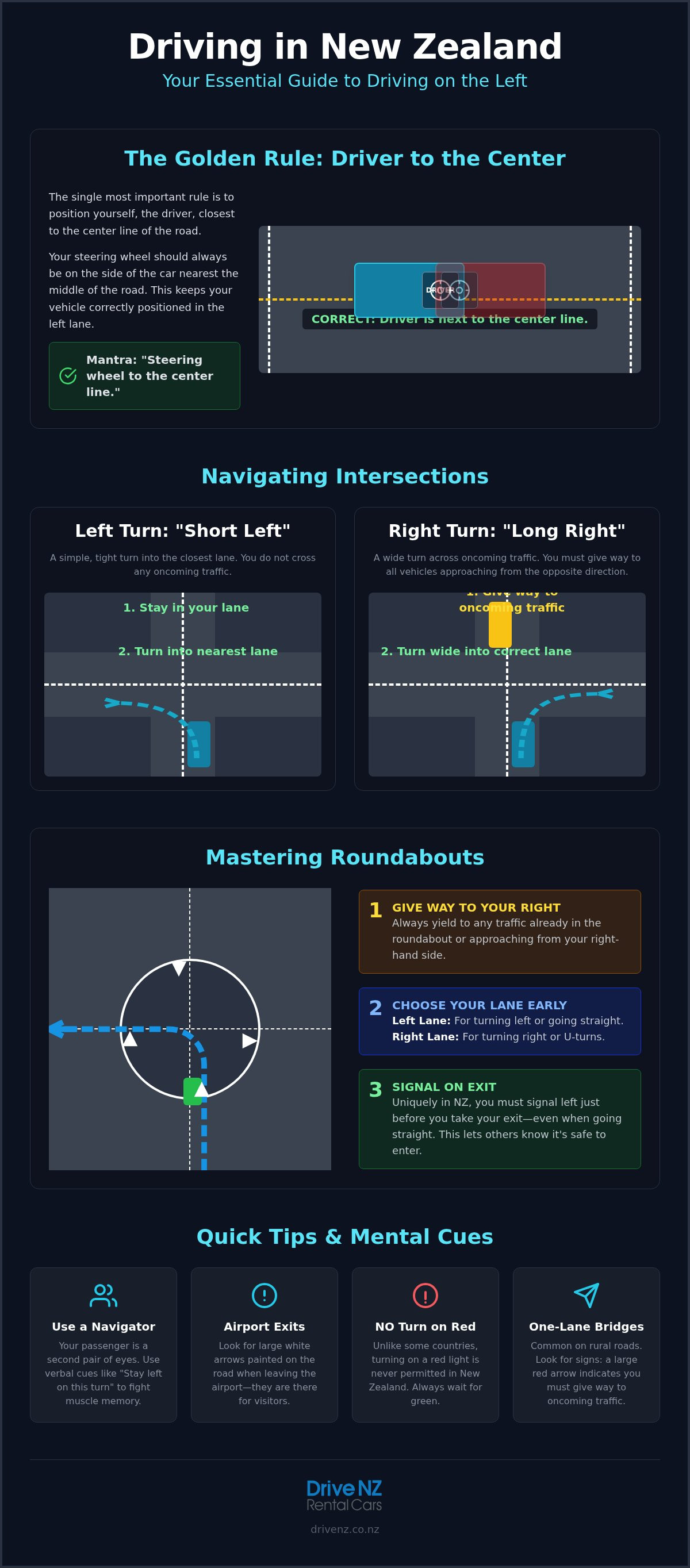
New Zealand is one of roughly 75 countries that drive on the left-hand side, a convention that often feels backward to those from the Americas or Europe. This system places the steering wheel on the right side of your rental vehicle, a legacy found within the history of left-hand traffic in NZ. It's a setup that ensures the driver remains closest to the center of the road. This positioning is the most important factor to remember when driving on the left nz. The "center-line rule" defines the driver’s body as the primary spatial anchor, meaning you should always be positioned toward the middle of the roadway rather than the shoulder. If you're used to driving on the right, your brain expects the curb to be near your shoulder. In New Zealand, seeing the curb that close usually means you've drifted into the wrong lane.
The First 15 Minutes: Exiting Auckland or Christchurch Airport
The initial kilometers after picking up your car are the most critical. Fatigue from a long flight often triggers "autopilot" habits, causing drivers to drift toward the right side of the road out of instinct. When you leave a Drive NZ depot in Auckland or Christchurch, take a moment to reset your mental map before hitting the main road. Look for the large white arrows painted on the tarmac at airport exits. These are designed specifically to remind international visitors to stay left. Focus on the position of the center line relative to your seat. If the line is on your right, you're in the correct spot. Many tourists find that following a local vehicle out of the airport helps them settle into the rhythm of the traffic flow without overthinking every turn.
The Passenger Role: Being the "Left-Side Navigator"
Safety is a team effort. The front-seat passenger acts as a vital second pair of eyes, especially during complex maneuvers like entering a multi-lane motorway. We recommend using a simple verbal cue: "Left, Left, Left." Saying this aloud during every turn helps the driver override their muscle memory from home. The passenger should also monitor the "blind side" of the vehicle. Since you're sitting on the right, the left side of the car can feel further away than you're used to. Your navigator can help confirm you have enough clearance from the curb. They also provide essential support when checking traffic while merging into busy Auckland motorways, making the transition to driving on the left nz much smoother.
Navigating Intersections and Roundabouts Safely
Intersections represent the moment where theoretical knowledge meets split-second decision-making. When driving on the left nz, your most critical rule of thumb is "Short Left, Long Right." A left turn is a tight, immediate arc into the nearest lane. Conversely, a right turn requires you to cross oncoming traffic lanes before settling into the far side of the new road. According to the official NZ Road Code, if you are turning right, you must also give way to oncoming vehicles that are turning left into the same road. Unlike some other countries, New Zealand does not allow a "turn on red" under any circumstances. You must wait for a green light or a clear gap. Pay close attention to road markings: a solid yellow line means stop, while a white line indicates a "Give Way" requirement.
The Geometry of a Right-Hand Turn
Right-hand turns are statistically the most challenging for visitors because they require you to look in multiple directions while crossing the path of oncoming vehicles. To execute this safely, visualize a wide arc. You shouldn't cut the corner. Instead, drive further into the intersection before beginning your turn, aiming to land with the center line on your right-hand side. If you turn too sharply, you risk entering the wrong lane or clipping the curb. Many drivers find that a compact SUV offers the elevated seating position needed to judge these distances and spot the center line more effectively during the turn.
Roundabout Etiquette for Tourists
Roundabouts are a staple of New Zealand’s infrastructure, and they operate on one golden rule: always give way to traffic coming from your right. If the roundabout is multi-lane, select your lane early. Use the left lane if you intend to go left or straight, and the right lane if you are turning right or performing a full U-turn. A unique requirement in New Zealand is the "exit signal." Even if you are traveling straight through, you must signal left as you pass the exit before the one you intend to take. This tells other drivers they can safely enter the roundabout behind you. Don't simply follow the car ahead of you, as their destination or lane choice may differ from yours. Take your time, stay in your lane, and keep your eyes moving to the right.
Adapting to New Zealand’s Unique Road Conditions
New Zealand's geography dictates its road design. You'll find that state highways are often single lanes in each direction with minimal shoulder space. This narrowness can be intimidating when driving on the left nz, especially when a large truck passes from the opposite direction. A common mistake for new drivers is "left-side hugging." This happens when you subconsciously steer too far toward the edge to maximize the gap with oncoming traffic. Doing so increases the risk of slipping into a soft verge or a roadside ditch. Keep your focus on the center line to maintain a safe, consistent position within your lane.
One-lane bridges are frequent on tourist routes. Look for the signs: a large red circle means you must give way to oncoming traffic, while a blue square indicates you have the right of way. Regardless of the sign, always slow down and check. If you find a queue forming behind you, look for "Slow Vehicle Bays." These are short extra lanes designed for you to pull over safely. Using them allows locals and faster drivers to pass, which reduces stress for everyone on the road.
Corrugations and Gravel Roads
Many scenic spots require travel on unsealed roads. These gravel surfaces reduce traction and often feature a "camber," where the road slopes down toward the edges for drainage. This slope can pull your vehicle toward the ditch if you aren't careful. Staying left is harder here because the center of the road usually has the best grip. When you encounter oncoming traffic on gravel, slow down significantly and move to the left well in advance. For more detailed advice, check out our driving in New Zealand for tourists guide.
Winter Driving and Snow Chains
Winter conditions add another layer of complexity, particularly in the South Island. Black ice can make left-hand bends extremely treacherous, as your car may slide toward the outer edge of the road. We strongly recommend snow chain hire if you plan to cross mountain passes like Arthur's Pass or Lindis Pass. When fitting chains, find a flat, safe area well off the roadway. Ensure your car is visible to others and that you aren't blocking the lane while working on the tires. This preparation ensures you maintain control even when the surface becomes unpredictable.
Practical Mental Hacks to Keep You on the Left
Adapting to driving on the left nz requires more than just knowing the rules. It involves rewiring your brain’s spatial habits. One of the most effective mantras is "Steering Wheel to the Center." Since the driver sits on the right side of the vehicle, your body should always be closest to the middle of the road. If you find yourself positioned near the curb, you’re likely on the wrong side. To help with this, we provide "Keep Left" dash stickers at our depots. These serve as a constant visual anchor during those first few hours of your trip. When you reach an intersection, use the sequence: Look Right, Look Left, and Look Right again. Traffic coming from your right is your immediate priority, and this double-check prevents the instinct to look the wrong way first.
Another useful hack is establishing a "Left-Side Anchor" using your passenger-side mirror. Periodically glance at this mirror to check your distance from the white line or the road edge. It’s a quick way to verify you aren't drifting too far into the center or too close to the shoulder. If you're feeling a bit nervous about the transition, book a compact hatchback to make these spatial adjustments feel even more manageable and less intimidating on the road.
The Empty Road Trap
Busy city streets are actually safer for beginners because you can simply follow the flow of traffic. The real danger lies on quiet rural roads where there are no other cars to guide you. This is the "Empty Road Trap." It’s easy to slip into autopilot and drift to the right side after pulling out from a scenic photo stop or a rest area. Every time you restart your engine, say "Keep Left" out loud. This simple verbal reset breaks the autopilot cycle and brings your focus back to the task at hand before you even put the car in gear.
Muscle Memory Drills for Day One
Expect to turn on your windshield wipers when you meant to use the indicator. Most New Zealand rentals have these controls swapped compared to North American or European models. Don't let it frustrate you. It’s just part of the learning curve. Before you hit the open highway, spend ten minutes in a quiet parking lot practicing wide right turns. Unlike left turns, which are tight, right turns require a much larger arc to reach the correct lane. Use your rear-view mirror during these drills to confirm your car is centered. Seeing the road lines trailing behind you provides instant feedback on whether your positioning is accurate.
How Your Rental Choice Impacts Safety on NZ Roads
Most visitors focus on price or luggage space when picking a car. However, the physical dimensions of your vehicle play a massive role in how quickly you adapt to driving on the left nz. A wide vehicle leaves less margin for error on our narrow state highways. If you're nervous about lane positioning, choosing a model from the Drive NZ Rental Cars fleet that prioritizes visibility can significantly lower your stress levels. Whether you prefer the agility of a hatchback or the composure of an intermediate sedan, the right fit makes those first few turns feel natural. Picking the right vehicle isn't just about comfort; it's about spatial confidence.
Compact Hatchbacks: The Beginner’s Choice
Narrower body width is a major advantage for first-time visitors. It gives you more room to breathe within the lane, reducing the risk of clipping a curb or crossing the center line. These cars offer excellent corner-to-corner visibility. You can easily see exactly where the front left corner of the car is, which is crucial when judging clearance in tight spots. They are particularly well-suited for the urban environments of Auckland and Christchurch, where parking spaces and side streets are often quite snug. If your itinerary involves a lot of city driving, a hatchback keeps things simple and stress-free.
Compact SUVs: Height and Confidence
If you're heading to the South Island, a compact SUV might be your best ally. The higher seating position provides a superior vantage point. You'll be able to see oncoming traffic over the crests of rolling hills and around winding coastal bends much earlier than in a lower vehicle. This extra visibility makes it easier to spot the center line and maintain your position when driving on the left nz. When you look at how to rent a car in NZ, consider how much that elevated perspective adds to your peace of mind. These vehicles handle the varied terrain with quiet confidence, ensuring you stay focused on the scenery rather than struggling with the car's dimensions.
Start Your New Zealand Adventure with Confidence
Mastering the art of driving on the left nz is the first step toward an unforgettable road trip. By focusing on the "center-line rule" and using simple mental cues like the "steering wheel to the center" mantra, you'll quickly build the muscle memory needed for our unique roads. Whether you're navigating the busy streets of Auckland or the winding passes of the South Island, your choice of vehicle and your preparation are your best safety tools.
At Drive NZ, we're dedicated to making your journey as smooth as possible. Every rental comes with free "Keep Left" safety guides and the peace of mind that comes from 20 years of local expertise. Our fleet of compact, easy-to-handle hatchbacks and SUVs is specifically optimized for New Zealand's terrain, and our teams in Auckland and Christchurch are always here to provide expert support. Book your safety-ready rental car with Drive NZ today and get ready to explore our beautiful country with quiet confidence. We'll see you on the road!
Frequently Asked Questions
Is it hard to switch to driving on the left in NZ?
Most visitors adapt within the first two hours of driving, especially when following other vehicles in traffic. The transition is more about mental focus than physical skill. While city driving provides helpful visual cues from other cars, quiet rural roads require more vigilance to avoid drifting. We recommend starting your journey in a compact hatchback to make lane positioning feel more manageable while you adjust to the new perspective.
What happens if I accidentally drive on the right side of the road?
If you realize you're on the wrong side, stay calm and signal to pull over to the left as soon as it's safe. Don't try to cross the road immediately if there's oncoming traffic. Once stopped, take a moment to reset your orientation. New Zealand roads are often narrow with limited shoulders, so a quick, safe stop is the best way to correct your position and regain focus.
Are the pedals swapped in a New Zealand car?
No, the pedal layout remains the same as in right-hand drive countries. The accelerator is on the far right, with the brake in the middle. However, the control stalks for your indicators and windshield wipers are usually reversed. You'll likely turn on the wipers by mistake a few times when driving on the left nz. It's a common part of the adjustment process that most drivers master by the second day.
Do I need a special license to drive on the left in NZ?
You don't need a special license, but you must carry a valid overseas license or an International Driving Permit. From November 1, 2026, the period you can drive on an overseas license changes to 12 months from your last entry date. If your license isn't in English, an accurate translation is mandatory. Our teams in Auckland and Christchurch will check your documentation during pickup to ensure you're legally compliant.
What is the most common mistake for tourists driving in NZ?
The most frequent error is "left-side hugging," where drivers stay too close to the edge of the road to avoid oncoming traffic. This often leads to tires slipping into soft gravel verges or roadside ditches. Another common mistake is turning into the wrong lane at quiet intersections. Always use the center line as your guide to stay correctly positioned within your lane, rather than focusing on the road's outer edge.
How do roundabouts work when driving on the left?
You must enter the roundabout in a clockwise direction and always give way to traffic coming from your right. Select your lane early: use the left lane for turning left or going straight, and the right lane for turning right. When driving on the left nz, you must signal left just before you exit the roundabout. This tells other drivers it's safe for them to enter, keeping the traffic flowing efficiently.
Are there "Keep Left" signs on all New Zealand roads?
While major highways and airport exits feature "Keep Left" signs and painted arrows, they aren't present on every rural road. You shouldn't rely on signage alone for your lane positioning. To help you stay on track, Drive NZ provides free "Keep Left" stickers for your dashboard. These act as a constant visual reminder, especially in remote areas where road markings might be less visible or absent during your trip.
Can I practice driving on the left before I leave the airport?
Yes, the service roads surrounding our Auckland and Christchurch airport depots are perfect for a short practice run. We suggest taking ten minutes to drive around these quieter streets to get a feel for the vehicle's dimensions and the reversed control stalks. Our local staff can recommend a low-traffic route nearby where you can practice wide right turns and roundabouts before you join the main highway system.


