

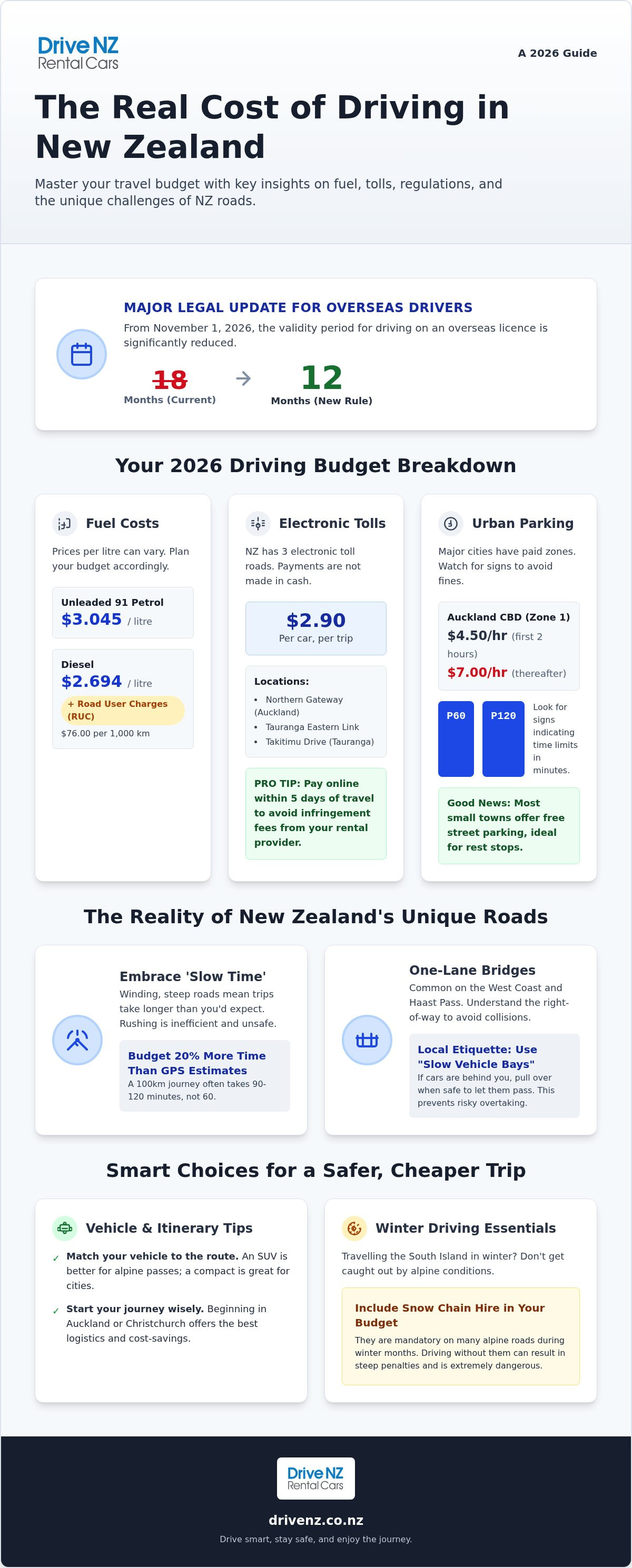
From November 1, 2026, the time you can legally drive on an overseas licence in New Zealand drops from 18 months to just 12. This change, combined with petrol prices averaging $3.045 per litre, means that understanding the total cost of driving in new zealand is more critical than ever. It's easy to feel overwhelmed by shifting regulations, toll road fees, and the unique fuel demands of our mountainous terrain. You want a journey defined by breathtaking views, not by unexpected bills or compliance stress.
This guide will empower you to master your travel budget with expert insights into fuel costs, insurance, and the latest 2026 regulatory changes. We'll provide a realistic daily driving budget and help you choose the most efficient vehicle for your itinerary. You'll also learn how to navigate Auckland's parking zones and alpine passes with confidence, ensuring your focus stays exactly where it should be: on the open road.
Key Takeaways
- Plan for "slow time" where 100km trips often take up to two hours, as this unique geography directly impacts your daily fuel budget and schedule.
- Navigate New Zealand's three electronic toll roads with ease by understanding the automated billing options that prevent unexpected infringement fees.
- Master the cost of driving in new zealand by matching your vehicle choice, from compact hatchbacks to SUVs, to the specific demands of your route.
- Stay compliant with the 2026 licence regulations by confirming your international permits and approved translations meet the new 12-month validity threshold.
- Protect your South Island travel budget by including snow chain hire in your winter plans to avoid steep penalties on alpine roads.
The Reality of New Zealand Road Costs: Beyond the Rental Price
Many travelers focus solely on the daily rental rate, but the true cost of driving in new zealand is shaped by the land itself. Unlike the straight, flat highways found in many other countries, New Zealand's road network is famously winding and steep. This geography doesn't just change the view; it directly impacts your fuel consumption and your daily schedule. To keep your budget on track, you need to account for logistical variables like airport surcharges, one-way fees, and the cost of inter-island ferry bookings. Most savvy travelers find that beginning their journey in Auckland or Christchurch provides the most logical logistical foundation for a cost-saving itinerary.
Topography and Real-World Fuel Consumption
The South Island's alpine passes, such as Arthur’s Pass and the Crown Range, demand much more from a vehicle than a coastal cruise. When you're climbing steep gradients, your engine works harder, which can significantly increase your fuel spend for that leg of the trip. It's a common mistake to assume a 100km journey will take an hour. In reality, these trips often take 90 to 120 minutes due to the terrain. You'll also encounter unsealed gravel roads in more remote areas. These surfaces require slower speeds and intense concentration, which naturally lowers your fuel efficiency. A core concept to master is 'Slow Time', which is the necessity to budget 20% more time than GPS estimates for every leg of your journey. Budgeting for this delay ensures you aren't rushing, which is safer and more fuel-efficient for your vehicle.
One-Lane Bridges and Rural Etiquette
New Zealand is home to many one-lane bridges, particularly along the West Coast and through the Haast Pass. Misunderstanding the right-of-way signage at these points can lead to more than just a delay; it can result in costly collisions. Always look for the red and white circles or blue squares that indicate which direction has priority. Beyond the formal rules, there's a local etiquette that helps manage the cost of driving in new zealand by reducing stress and road wear. If you notice a line of cars forming behind you on a narrow road, look for a safe "slow vehicle bay" or a wide shoulder to pull over. This simple act of courtesy prevents risky overtaking maneuvers and keeps the traffic flowing smoothly for everyone, including the locals who know these roads best.
Financial Breakdown: Fuel, Tolls, and Parking in 2026
Managing your 2026 travel budget requires looking past the daily rental rate to the operational expenses that fluctuate based on your route. As of August 2026, the average price for Unleaded 91 petrol sits at $3.045 per litre. If you choose a diesel vehicle, the pump price is lower at $2.694 per litre, but you must account for Road User Charges (RUC). Currently, light diesel vehicles are charged $76.00 per 1,000 kilometres. These numbers mean the total cost of driving in new zealand can vary significantly depending on whether you're touring the flat plains of Canterbury or the steep inclines of the Coromandel. To establish a solid baseline for your core expenses, refer to our how much to rent a car in NZ 2026 pricing guide.
Navigating Toll Roads and Payment Systems
New Zealand currently operates three electronic toll roads: the Northern Gateway north of Auckland, and the Tauranga Eastern Link and Takitimu Drive in the Bay of Plenty. For a standard car, these tolls cost $2.90 if you don't have a pre-paid tag. The system is entirely electronic, so you won't find any cash booths. You can pay online through the NZTA website within five days of your trip. Ignoring these tolls is a common mistake that leads to administrative fees from your rental provider, which often exceed the toll itself. While taking the "scenic" free route is an option, the extra fuel used on winding backroads often costs more than the toll. Understanding these small details is a key part of Driving in New Zealand as a Visitor without incurring unnecessary penalties.
Parking and Infringement Risks
Urban parking requires careful attention to signage to avoid hefty fines. In Auckland's Zone 1, expect to pay $4.50 per hour for the first two hours, with the rate jumping to $7.00 for every hour after that. Look for signs like 'P60' or 'P120', which indicate a time limit in minutes. In contrast, most small towns offer free street parking, making them ideal spots for lunch breaks. Be cautious with speed; New Zealand uses a mix of fixed and mobile cameras, and even 'creeping' 5km/h over the limit can result in a fine. If you're planning to sleep in your vehicle, only do so in designated areas. Freedom camping in prohibited spots now carries significant fines. Choosing a fuel-efficient compact hatchback or sedan can help offset these urban costs while keeping your footprint small.
Vehicle Selection: Matching Your Car to Your NZ Itinerary
Choosing the right vehicle is the single most effective way to manage the cost of driving in new zealand. It isn't just about the daily hire rate; it's about how much you'll spend at the pump and how much stress you'll face in tight spaces. A common mistake is over-packing, which forces you into a larger, more expensive vehicle category than you actually need. By traveling light, you open up the option of more fuel-efficient car classes. The Drive NZ Rental Cars fleet is specifically curated to offer these practical, cost-effective solutions without sacrificing reliability or comfort.
The Compact Advantage for North Island Travel
If your itinerary focuses on the North Island, a compact hatchback is often the smartest choice for your wallet. These nimble cars are ideal for navigating Auckland’s busy city traffic and the notoriously tight, winding corners of the Coromandel Peninsula. On the popular Thermal Explorer highway, which connects Auckland to the geothermal wonders of Rotorua and the vineyards of Napier, a compact car offers superior fuel economy compared to larger alternatives. You'll also find parking much easier at congested tourist hotspots like Hobbiton or the Rotorua lakefront, where space is often at a premium and larger vehicles can struggle to fit into standard bays.
Intermediate Sedans and SUVs for the South Island
For those tackling the vast distances and varied terrain of the South Island, an intermediate sedan or a compact SUV provides a different set of benefits. Sedans are the "Goldilocks" choice for the long, straight stretches of the Canterbury Plains. They offer a smooth, stable ride that balances comfort with efficiency, making them perfect for the multi-hour drives between Christchurch and Dunedin. If your plans include the unsealed backroads of Central Otago or the rugged West Coast, a compact SUV offers the extra ground clearance needed to handle gravel surfaces and steep driveways with confidence.
Comparing fuel costs over a typical 10-day South Island loop makes the difference between car classes clear. While a compact hatchback might save you significant money at the pump, an intermediate sedan provides better stability in the high winds often encountered on alpine passes like Arthur's Pass. Choosing the right fit ensures you aren't paying for space you don't use or power you don't need. This strategic selection is the best way to keep the total cost of driving in new zealand within your planned budget while ensuring your vehicle is up to the task of the journey ahead.
Legal Compliance: The 2026 Licence Validity Shift
Staying legal on the road is just as important as managing your fuel budget when calculating the total cost of driving in new zealand. A significant regulatory change takes effect on November 1, 2026. From this date, visitors can only drive on their overseas licence for 12 months from their last arrival date, down from the previous 18-month allowance. If you plan to stay longer, you'll need to convert to a local licence to avoid heavy fines or insurance issues. Remember that NZ Police require you to carry your physical licence at all times. Digital versions or photocopies are not legally accepted, so keep your original document safe and accessible in the vehicle.
Younger travelers also need to account for age-related expenses. If you're under 25, most rental companies apply a daily surcharge to cover higher insurance premiums. For those specifically looking for under 21 car rental in NZ, it's vital to check which vehicle categories are available to you, as some high-performance models may be restricted. These surcharges are a standard part of the industry but vary between providers, so factor them into your initial budget to avoid surprises at the rental desk.
International Driving Permits (IDP) and Translations
You don't always need an International Driving Permit, but your licence must be in English. If it isn't, you must carry an NZTA-approved English translation at all times. This isn't just a suggestion; it's a legal requirement for your rental agreement and insurance coverage to remain valid. Obtaining a translation usually costs between $50 and $90 through an authorized service. If your home country's licence is a "provisional" or "restricted" version, you must still follow all the conditions of that licence while driving in New Zealand, such as passenger restrictions or night-driving bans.
Converting to an NZ Licence
Working holiday visa holders and digital nomads staying beyond the 12-month mark must navigate the conversion process. If you're from an exempt country like Australia, Canada, or the UK, you can often swap your licence without sitting a new test. However, drivers from non-exempt countries must pass a theory test and, in some cases, a practical driving test. This process involves application fees and time at a licensing center, so start the transition early. Understanding these legal hurdles is a critical component of the overall cost of driving in new zealand for long-term visitors. Staying compliant ensures your journey remains stress-free. For a reliable vehicle that meets all local safety standards, book your rental car today to secure our best rates.
Similarly, if you are settling into the region for a longer stay, you can discover Auckland Air Solutions to ensure your new home or office has the right heating and ventilation systems for the local environment.
Seasonal Safety Costs: Winter Driving and Equipment
New Zealand’s weather is famously unpredictable. The "four seasons in one day" phenomenon means you might start your drive in bright sunshine and end it in a mountain snowstorm. This variability directly impacts the cost of driving in new zealand, as your vehicle works harder to maintain traction and cabin temperature. Cold starts and constant heater use during the winter months can increase your fuel consumption by up to 15% compared to mild summer cruising. To stay prepared for these rapid shifts without incurring the high cost of an accident or a mechanical breakdown, we recommend reviewing our driving in New Zealand for tourists safety checklist before you set off.
Mastering Snow Chains in the Southern Alps
If you're traveling through the South Island between June and September, snow chains are a non-negotiable expense. On high-altitude routes like the Lindis Pass or the Crown Range, carrying chains is often a legal requirement. Road crews can turn you back or you may face fines up to $750 in specific areas like Milford Sound if you aren't properly equipped. While you could purchase a set, hiring snow chains is a far more cost-effective solution for short-term visitors. We always suggest a fitment check at our Christchurch rental hub before you head south. Practicing in a dry, flat parking lot is much easier than trying to fit chains for the first time on a freezing, slushy roadside in the dark.
Managing Fatigue and Recovery Costs
The hidden costs of a road trip often involve human factors like fatigue. We strongly advise following the "first-day" rule by staying near Auckland or Christchurch airports after a long-haul flight. Driving while jet-lagged on the left side of the road is a primary cause of accidents for international visitors, especially when navigating the complex intersections of our major cities. You should also budget for regular breaks every two hours. These coffee stops aren't just for refreshments; they are essential for maintaining the high level of alertness required for our winding, narrow roads. Regarding your insurance options, you'll need to decide between a standard excess and a full waiver. While a waiver increases your daily spend, it protects you from the high costs of stone chips or minor scrapes on gravel roads. This proactive approach ensures the cost of driving in new zealand remains predictable and stress-free throughout your entire journey.
Take Control of Your 2026 New Zealand Journey
Mastering the cost of driving in new zealand is about more than just checking fuel prices. It requires staying ahead of the November 2026 licence validity shift and understanding how our unique topography affects your daily budget. By planning for "slow time" and selecting a vehicle that matches your specific itinerary, you can avoid the common pitfalls of hidden fees and unexpected fuel spikes. Whether you're navigating the tight corners of the Coromandel in a compact hatchback or crossing the Southern Alps with snow chains, being prepared ensures your focus remains on the incredible scenery.
We've been proudly NZ owned and operated since 2005, specializing in practical travel solutions from our convenient Auckland and Christchurch Airport hubs. You won't find any hidden fees or surprises when you book with us; we provide straightforward service designed for the modern traveler. Book your practical and reliable NZ rental car with Drive NZ Rental Cars today to secure your 2026 adventure. The open road is waiting for you, and with the right preparation, you're ready to explore every corner of Aotearoa with confidence.
Frequently Asked Questions
Do I need an International Driving Permit to drive in New Zealand in 2026?
You only need an International Driving Permit (IDP) if your current driver's licence is not printed entirely in English. If your licence is in English, it's perfectly valid for use here. For those with non-English licences, you must carry either a formal IDP or a certified English translation at all times while operating a vehicle. This ensures you remain compliant with both local law and your insurance policy requirements.
What is the 12-month licence rule change coming in late 2026?
Starting November 1, 2026, the time visitors can drive using an overseas licence will be reduced from 18 months to 12 months. This change applies from the date you last entered the country. If you plan to stay and drive beyond this one-year threshold, you'll need to apply for a New Zealand driver's licence. This regulatory shift aims to ensure long-term visitors are fully integrated into the local road safety system sooner.
Are there many toll roads in New Zealand and how do I pay them?
New Zealand has only three toll roads, all located in the upper North Island. These are the Northern Gateway Toll Road, the Tauranga Eastern Link, and the Takitimu Drive Toll Road. All three use electronic plate recognition, so there are no booths to stop at. You can pay your tolls online via the NZTA website within five days of your trip to avoid additional administration fees and infringement notices.
How much does fuel cost in New Zealand for a typical road trip?
Fuel is a major factor in the cost of driving in new zealand, with 91 Octane petrol averaging $3.045 per litre as of August 2026. Diesel is slightly cheaper at the pump at roughly $2.694 per litre, though diesel vehicles must also pay Road User Charges. Prices can fluctuate significantly between urban centers and remote rural areas. We recommend using a fuel-tracking app to locate the most competitive prices along your planned route.
Is it cheaper to rent a car in Auckland or Christchurch?
Rental rates are generally comparable between Auckland and Christchurch, as both serve as major international gateways. The total price usually depends more on seasonal demand and vehicle availability than the specific city. To keep your budget low, consider a loop itinerary that starts and ends at the same hub. This strategy helps you avoid the one-way relocation fees that often apply when crossing between the North and South Islands.
Can I drive in NZ with a restricted or learner's licence from overseas?
You can drive on a restricted overseas licence, but you must strictly adhere to all the original conditions of that licence. If your home licence has night-driving restrictions or passenger limits, those rules still apply while you're in New Zealand. Most rental companies, however, won't hire vehicles to anyone holding a learner's permit. Always check the specific terms of your rental agreement regarding licence types before you arrive at the depot.
What happens if I get a speeding ticket in a New Zealand rental car?
If a speed camera captures your vehicle, the infringement notice is sent directly to the rental provider. The company will then charge the fine amount to your nominated credit card, usually adding a separate administrative fee for processing the paperwork. If you're stopped by a police officer, they'll issue the ticket to you personally. Paying these fines promptly is essential to avoid further legal complications or issues with future travel.
Do I really need to hire snow chains for the South Island in winter?
Hiring snow chains is essential for any South Island road trip between June and September. Many alpine passes, including the Crown Range and Lindis Pass, frequently have "chains must be carried" signs during winter storms. Failing to carry them when required can lead to fines of up to $750 in certain regions. Having chains in your boot provides the necessary safety margin to navigate icy or snowy conditions without getting stranded.


