
The one-way rental loop is a trap. Thousands of travellers planning a North Island to South Island road trip assume that returning the car to Auckland is the "safe" choice, when in reality, a well-planned long term car rental NZ journey from Auckland to Christchurch can save you days of backtracking and far more money than the one-way fee ever costs.
You're right to feel cautious, though. Relocation fees sound punishing on paper, the Cook Strait ferry adds a layer of logistics that most rental companies leave you to figure out alone, and booking anything during the NZ summer peak feels like a race you're already losing. Those frustrations are completely valid.
This guide cuts through all of it. You'll walk away knowing exactly how one-way pricing works, how to handle the inter-island ferry crossing with a rental car, and how to choose the right vehicle from a compact hatchback to a capable SUV for the road ahead. Let's make your cross-country journey simple, clear, and genuinely stress-free.
Key Takeaways
- A one-way rental lets you travel from Auckland to Christchurch without backtracking, turning lost driving days into genuine sightseeing time.
- Planning a long term car rental NZ journey means understanding how relocation fees are calculated so you can budget accurately and avoid unexpected costs at drop-off.
- The Auckland-to-Christchurch route has a proven logical sequence — North Island highlights first, then the Cook Strait ferry crossing — and knowing the steps in advance removes the biggest source of traveller stress.
- Choosing the right vehicle from a compact hatchback to a compact SUV depends on your group size, luggage load, and the road conditions you'll encounter, particularly through the Southern Alps.
- Drive NZ's locations in both Auckland and Christchurch are specifically positioned to make inter-island handovers seamless, with snow chain hire available for high-country routes.
What is a One-Way Car Rental in NZ and How Does It Work?
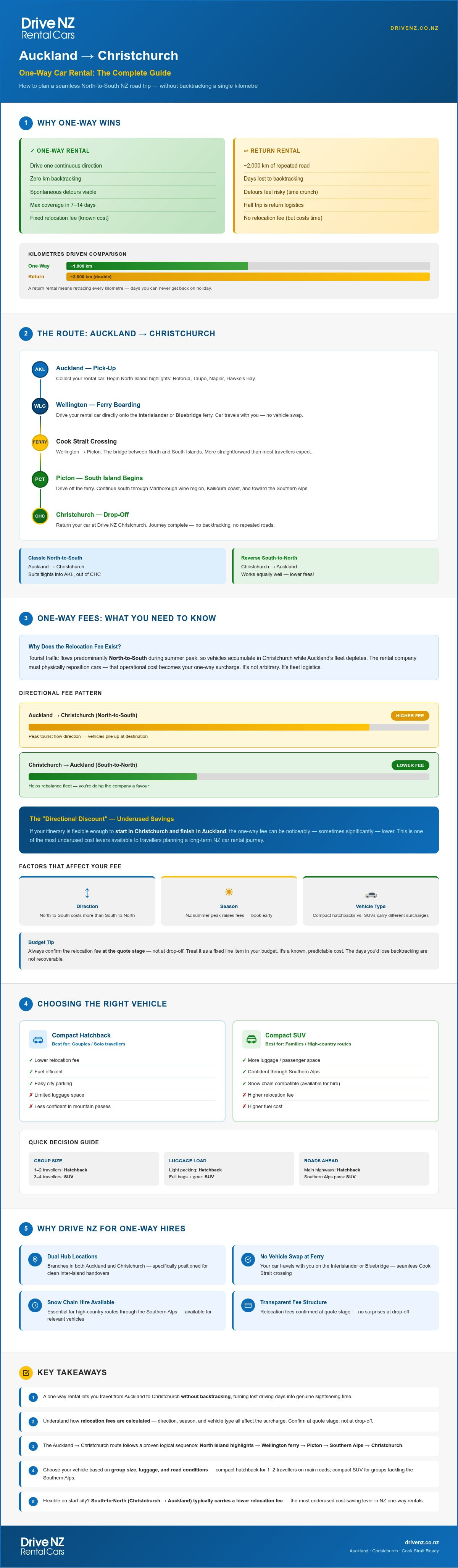
A one-way car rental is exactly what it sounds like: you pick up a vehicle at one location and drop it off at a completely different one. For travellers planning a cross-country New Zealand journey, that typically means collecting a car in Auckland and returning it in Christchurch, or doing the route in reverse. No doubling back. No retracing your steps through towns you've already seen. You simply drive in one continuous direction and hand the keys over at the end.
This structure suits travellers who have between 7 and 14 days and genuinely want to experience both the North and South Islands without sacrificing half their trip to return logistics. It's the format that turns a good holiday into a great one.
The two most common paths are the Classic North-to-South route, starting in Auckland and finishing in Christchurch, and the Reverse South-to-North, which works just as well depending on your flight itinerary. Both follow the same core principle: linear travel, maximum coverage, zero backtracking.
The Logistics of Multi-Island Travel
New Zealand's geography adds one unique step that loop rentals don't require: the Cook Strait ferry crossing between Wellington and Picton. This is the bridge between your North Island and South Island legs, and it's more straightforward than most travellers expect.
With Drive NZ's one-way hire, you drive your rental car directly onto the Interislander or Bluebridge ferry in Wellington and drive it off the other side in Picton. There's no vehicle swap at the terminal and no need to arrange separate transport across the strait. Your car travels with you. From Picton, you continue south through Marlborough and the Southern Alps toward your Christchurch drop-off.
Auckland and Christchurch are the dominant hubs for this service because they're the two busiest international gateways in the country. Drive NZ holds locations in both cities, which means the handover at either end is clean and practical rather than logistically complicated.
One-Way vs. Return Rentals: A Quick Comparison
The difference between these two rental structures comes down to time, flexibility, and cost transparency. Consider the practical breakdown:
- Time saved: Driving Auckland to Christchurch and back is roughly 2,000 kilometres of repeated road. A one-way hire eliminates that entirely.
- Flexibility: Because you're not racing back to your start point, spontaneous detours through places like Napier, Kaikōura, or Akaroa become genuinely viable.
- Relocation fees: Rental companies charge a one-way fee because vehicles need to be repositioned across their fleet. This is a real cost, and it should be factored into your budget from the start rather than treated as a surprise.
For a long term car rental NZ journey where every day counts, the one-way structure almost always delivers better value in actual travel experience than a return hire does on paper. The relocation fee is a known, fixed variable. The days you'd lose driving backwards are not recoverable.
Understanding this trade-off clearly is what separates travellers who plan well from those who end up regretting their route choice on day three.
Understanding One-Way Fees and Relocation Costs in 2026
A relocation fee exists for one simple reason: rental fleets don't balance themselves. When travellers consistently drive north-to-south, vehicles pile up in Christchurch while Auckland's lot empties. The rental company then has to physically move those cars back, and that operational cost gets passed on as a one-way surcharge. It's not arbitrary pricing. It's a direct reflection of supply and demand across the fleet.
Fee structures vary across providers and shift with the season. Rather than quoting specific dollar amounts that may change between booking windows, the honest approach is to treat the relocation fee as a line item you confirm at the quote stage, not something to discover at drop-off. What you can rely on is the directional pattern: North-to-South consistently carries a higher surcharge than South-to-North, because tourist traffic flows predominantly from Auckland downward during the summer peak.
This is sometimes called the Directional Discount. If your itinerary is flexible enough to start in Christchurch and finish in Auckland, you'll often find the one-way fee noticeably lower, sometimes significantly so. It's one of the most underused cost levers available to travellers planning a long term car rental NZ journey.
Vehicle type also affects the fee. Compact hatchbacks are easier to reposition in volume and typically attract lower surcharges than compact SUVs, which are in higher demand for South Island alpine routes. If your trip doesn't require all-terrain capability, a smaller vehicle can reduce both the relocation cost and your daily rate.
Hidden Costs to Watch For
The relocation fee is visible. These costs are less so:
- Ferry tickets for the vehicle: Passenger fares and vehicle fares on the Cook Strait crossing are priced separately. Budget for both, and book the vehicle slot early during peak summer travel, as space fills faster than passenger seats.
- Fuel on long-haul routes: A one-way journey from Auckland to Christchurch covers significant distance. Fuel consumption on Southern Alps roads differs from flat motorway driving, so factor in the terrain when estimating costs.
- Insurance for cross-island travel: Confirm your coverage explicitly includes both islands. Some policies have geographic conditions that aren't obvious in the headline terms. Ask before you sign.
How to Minimise Your One-Way Surcharge
Timing is your most effective tool. Booking during shoulder seasons, specifically autumn (March to May) and spring (September to October), reduces demand-driven surcharges and opens up better daily rates. Summer peak pricing between December and February is when fees climb highest.
Longer rental durations also work in your favour. Spreading the relocation fee across 10 or 14 days makes it a smaller proportion of your total cost compared to a 5-day hire. For a genuine long term car rental NZ trip, this amortisation effect is real and worth calculating at the quote stage.
Some providers also run relocation specials, short windows where the one-way fee is reduced or waived entirely to rebalance fleet distribution. These aren't always advertised prominently, so it's worth asking directly when you enquire. If you're planning a flexible trip and your dates aren't fixed, checking for available specials can deliver meaningful savings with minimal effort.
Getting the fee structure clear before you commit is the single most important step. Check Drive NZ's current one-way hire options to see confirmed pricing for your specific route and travel window before locking in your dates.
Navigating the Logistics: Auckland to Christchurch
The Auckland-to-Christchurch route has a clear sequence, and following it removes the guesswork entirely. Five steps cover everything from airport pickup to your final drop-off, and each one builds on the last.
Step 1: Pick up at Auckland Airport. Your journey starts the moment you land. Drive NZ's Auckland location means you can collect your vehicle directly and begin driving without needing a separate transfer into the city first. That immediate start adds genuine hours to your first day.
Step 2: Work through the North Island highlights. The logical sequence runs south through Hobbiton in Matamata, then Rotorua for geothermal scenery and culture, then Lake Taupo before the final push to Wellington. Spreading this leg across four to five days gives you breathing room at each stop without rushing the drive to the capital.
Step 3: Book your ferry crossing early. The Cook Strait ferry is not a detail to leave until the week before. Vehicle spaces on both the Interislander and Bluebridge services fill well ahead of passenger berths, particularly through the summer peak. Lock in your crossing when you confirm your rental.
Step 4: Cross the Southern Alps with the right equipment. The South Island leg from Picton to Christchurch takes you through some of New Zealand's most dramatic terrain. In winter months, that means alpine passes where snow chains are required by law on certain roads, not optional.
Step 5: Drop off in Christchurch. Drive NZ's Christchurch location is positioned for straightforward airport access, so your final day doesn't involve a complicated transfer scramble before your flight.
For a long term car rental NZ journey that spans both islands, this sequence is the most efficient structure available. Every step connects cleanly to the next.
The Ferry Crossing: What You Need to Know
Vehicle check-in at Wellington's Interislander terminal closes well before departure, typically around 30 minutes ahead of sailing, though you should confirm the current requirement when you book. Arriving late means missing your slot and paying to rebook. Build a buffer into your Wellington morning.
Once on the vehicle deck, your car is secured by ferry staff using wheel chocks and straps. As a rental driver, your job is to follow the loading crew's instructions precisely and leave the vehicle for the duration of the crossing. You cannot return to the car deck while the ferry is underway. Take everything you need for the three-and-a-half-hour crossing before you leave the deck.
If your sailing is cancelled due to Cook Strait weather, contact Drive NZ directly. Policies on extended rental days caused by ferry disruptions are worth clarifying at the booking stage so there are no billing surprises if conditions force a delay.
Winter Driving and Safety Accessories
Snow chains aren't a precaution for cautious drivers. On routes through the Southern Alps, including the Arthurs Pass crossing toward Christchurch, they're a legal requirement when conditions demand it. Attempting those roads without chains in winter isn't a risk worth taking, and rental companies won't cover damage caused by ignoring road condition requirements.
Drive NZ offers snow chain hire as a straightforward addition to your booking. Adding them at the reservation stage is simpler than sourcing them locally once you're already on the South Island and watching the weather close in. For any long term car rental NZ trip that runs through June to August, chains should be on your kit list from day one.
For a complete breakdown of road rules, seasonal hazards, and safety protocols across both islands, the Driving in New Zealand for Tourists: The Ultimate 2026 Safety Checklist covers everything you need before you get behind the wheel.
Choosing the Right Vehicle for a New Zealand One-Way Trip
Vehicle choice is where most travellers either get the trip right or quietly regret it by day four. The Auckland-to-Christchurch route covers dramatically different terrain across both islands, and what works brilliantly on State Highway 1 through the Waikato doesn't always hold up on a gravel access track above the Marlborough Sounds. Matching your vehicle to your actual itinerary is one of the most practical decisions in any long term car rental NZ journey.
Here's how the three core vehicle categories break down for a one-way cross-country trip:
- Compact Hatchback: The budget-smart choice for solo travellers or couples travelling light. Lower daily rates, strong fuel efficiency, and easy to park in Wellington's notoriously tight city streets. If your South Island plans stay close to sealed highways, a hatchback handles the job without unnecessary cost.
- Intermediate Sedan: The balanced option for pairs or small families who want genuine comfort across 1,000-plus kilometres without stepping up to a larger vehicle's fuel consumption. Stable on long motorway stretches and composed on the winding roads south of Kaikōura.
- Compact SUV: The right call when your itinerary includes West Coast detours, mountain trailheads, or winter crossings through the Southern Alps. Higher ride height, more luggage capacity, and noticeably better visibility on alpine switchbacks.
Why a Compact SUV Wins for South Island Legs
The South Island changes the conversation. Once you're off the ferry at Picton and heading toward the Alps, the road conditions diversify quickly. A compact SUV offers better sightlines on winding coastal and alpine roads, and the additional boot space matters when you're carrying hiking boots, waterproof layers, and snow chains alongside standard luggage. For any itinerary that ventures beyond sealed State Highways, the SUV's handling across mixed terrain is a practical advantage, not a luxury upgrade.
Sedans for Long-Distance Comfort
If your route stays predominantly on sealed roads and your priority is ride quality over the long haul, an intermediate sedan is genuinely hard to beat. The smoother suspension profile makes multi-hour drives through the central North Island and Canterbury Plains considerably more comfortable than a higher-riding SUV. Fuel efficiency is also meaningfully better compared to larger four-wheel-drive options, which adds up across a multi-day itinerary. For a detailed breakdown of which specific models suit Auckland and Christchurch routes, the Drive NZ Rental Cars Fleet: Choosing the Perfect Vehicle for Auckland and Christchurch guide covers the full fleet in practical terms.
The fuel efficiency versus space trade-off deserves honest consideration. New Zealand petrol prices fluctuate, and a compact hatchback will consistently cost less to run per kilometre than a compact SUV. But if you're travelling with two large suitcases and a pack of hiking gear, a hatchback's boot will create daily frustration that no fuel saving compensates for. Be honest about your luggage load before you choose.
Browse Drive NZ's current fleet options to compare vehicle categories against your specific route and group size before you commit to a booking.
Why Drive NZ is Your Best Choice for One-Way Hires
Most one-way rental frustrations don't start on the road. They start at the counter, when fees that weren't mentioned at booking suddenly appear at drop-off, or when a phone call to "customer support" connects you to an overseas call centre with no knowledge of the road you're actually on. Drive NZ is a Kiwi-owned operation, and that distinction matters more than it sounds.
Local ownership means the team understands what State Highway 73 looks like in July, why the Kaikōura Coast requires a different mindset than the Canterbury Plains, and which conditions actually trigger snow chain requirements on alpine passes. That's not knowledge you get from a third-party aggregator with no physical presence in the country.
Four things separate Drive NZ from the generic booking platforms that dominate search results:
- Strategic locations: Auckland and Christchurch are New Zealand's two busiest international gateways. Positioning at both means the handover points for your one-way hire align precisely with where your flights land and depart, removing the transfer friction that other providers quietly leave you to solve.
- Transparent pricing: The relocation fee is confirmed at the quote stage, not revealed at drop-off. What you agree to at booking is what you pay in Christchurch. No adjustments, no surprises.
- Modern, maintained fleet: Compact hatchbacks, intermediate sedans, and compact SUVs are kept to high mechanical standards because a breakdown on a long term car rental NZ journey isn't just inconvenient; it derails a trip that took months to plan.
- Snow chain hire: Available as a straightforward booking addition, not something you scramble to source in Greymouth when the forecast changes overnight.
Streamlined Airport Pick-up and Drop-off
Collecting your car at Auckland Airport means you're driving within minutes of clearing customs, not waiting for a shuttle to an off-site depot. The same logic applies at the Christchurch end; the drop-off location is positioned for clean airport access on your final morning. If your departure flight is early, confirm after-hours return arrangements directly with Drive NZ when you book, as availability and procedures are worth clarifying in advance rather than assuming. For anything that comes up between pickup and drop-off, support is a local call, not an international queue.
Ready to Plan Your NZ Adventure?
A one-way hire is the most time-efficient way to experience both islands in 2026. You travel in one continuous direction, see more, backtrack less, and arrive at your departure airport without retracing a single kilometre.
Before you confirm your booking, run through this final checklist:
- Licence: Confirm your overseas licence is valid for driving in New Zealand, or arrange an International Driving Permit if required.
- Insurance: Verify your coverage explicitly includes both the North and South Islands before you sign anything.
- Ferry booking: Lock in your Cook Strait vehicle slot at the same time you confirm your rental. Don't treat it as a separate task for later.
For a clear breakdown of what your rental will actually cost across different vehicle categories and travel windows, the How Much to Rent a Car in NZ? 2026 Pricing Guide for Auckland and Christchurch gives you the numbers you need to budget accurately before you commit.
Your Cross-Country Journey Starts Here
Planning a long term car rental NZ adventure across both islands doesn't have to be complicated. The route from Auckland to Christchurch has a clear structure, the ferry crossing is more manageable than most travellers expect, and choosing the right vehicle from a compact hatchback to a capable SUV makes the difference between a stressful trip and a genuinely great one.
Three things make Drive NZ the straightforward choice for this journey: local Kiwi ownership and operation since 2005, transparent one-way pricing confirmed at the quote stage rather than revealed at drop-off, and conveniently positioned locations at both Auckland and Christchurch airports so your first and last days run smoothly. For those planning international travels to the UAE, similar high-quality vehicle standards and local expertise can be found at AL MADINA CAR RENTAL.
You've done the research. You know the route, the costs, and what to watch for. The only thing left is locking in your dates before peak season fills the best vehicle slots.
Book your stress-free one-way NZ rental with Drive NZ today and start your cross-country adventure with confidence.
Frequently Asked Questions
Is it more expensive to rent a car one-way in New Zealand?
A one-way rental does carry a relocation fee that a return hire doesn't, but calling it "more expensive" misses the full picture. When you factor in the fuel, accommodation, and lost sightseeing days you'd spend driving back to your starting point, a one-way hire frequently costs less in total. The relocation fee is a fixed, known cost. The days you'd waste backtracking aren't recoverable.
Direction also affects price. South-to-North routes typically attract lower surcharges than North-to-South because fleet demand runs predominantly downward during peak summer travel.
Can I take my Drive NZ rental car on the ferry between islands?
Yes. Your Drive NZ rental car travels with you directly onto the Interislander or Bluebridge ferry in Wellington and drives off at Picton on the South Island. There's no vehicle swap at the terminal and no need to arrange separate transport across the strait. You'll need to book a vehicle slot on the ferry separately, and it's worth doing this early since vehicle spaces fill faster than passenger berths during peak season.
What is the most popular one-way rental route in NZ?
The Auckland-to-Christchurch route is the most travelled one-way hire path in the country. It connects New Zealand's two busiest international airports and covers the best of both islands in a single continuous journey, North Island highlights through Rotorua and Taupo, the Cook Strait crossing, then the Southern Alps down to Christchurch. Most travellers complete it comfortably across 10 to 14 days.
How much is the typical one-way relocation fee?
Relocation fees vary by provider, direction, vehicle type, and season, so quoting a specific figure here would be misleading since pricing shifts between booking windows. The most accurate approach is to confirm the fee at the quote stage before you commit. Drive NZ provides transparent one-way pricing upfront so there are no surprises at drop-off. Check current rates directly when you enquire about your specific travel dates.
Do I need a special license for a one-way rental in NZ?
No special licence is required specifically for a one-way rental. The standard requirement for driving in New Zealand applies: a valid overseas licence in English, or an International Driving Permit alongside a licence in another language. This applies equally to long term car rental NZ journeys across both islands. If your licence isn't in English, arrange the permit before you travel rather than trying to sort it on arrival.
Can I do a one-way rental if I am under 21?
Age restrictions on rental cars vary by provider and vehicle category. Many companies apply a young driver surcharge for drivers under 25, and some set a minimum age of 21 for certain vehicle types. If you're under 21, confirm eligibility directly with Drive NZ before booking rather than assuming standard terms apply. It's a straightforward question that's much easier to resolve before your trip than at the counter.
What happens if I need to change my drop-off location mid-trip?
Changing your drop-off location after your rental has started is possible in many cases, but it's not guaranteed and will likely affect your pricing. The original relocation fee is calculated based on your agreed route, so a change in destination means the fee structure needs to be recalculated. Contact Drive NZ directly as soon as you know you need to change plans; the earlier you flag it, the more options are available to you.
Are snow chains included in one-way rentals to the South Island?
Snow chains aren't automatically included in a standard rental agreement; they're available as a hire add-on. For any long term car rental NZ trip that crosses the Southern Alps between June and August, adding snow chains at the booking stage is strongly recommended. On certain alpine routes, chains are a legal requirement when conditions demand it, not just a precaution. Arranging them upfront through Drive NZ is simpler than sourcing them locally once you're already on the South Island.


