

Imagine returning to your rental car in downtown Auckland only to find a $750 fine tucked under the wiper because you accidentally blocked a mobility space or parked facing the "wrong" way. It is a stressful scenario that catches many visitors off guard, especially since the government recently implemented significant fee increases for common mistakes. Mastering the new zealand parking rules is the best way to protect your holiday budget and ensure your trip stays on track.
We know that deciphering "P" signs and time limits in busy city centers like Christchurch can feel overwhelming. You want to focus on the scenery, not the anxiety of expensive towing fees or council penalties. This guide provides a clear roadmap to the 2026 parking landscape, from mastering local road markings to navigating the latest digital payment apps. We will show you exactly how to park legally and confidently, including why a compact hatchback is often your best friend in the Auckland CBD. You will learn the essential do's and don'ts so you can enjoy your journey without any unwanted surprises from local authorities.
Key Takeaways
- Master the "Direction of Travel" rule and the 6-meter intersection requirement to ensure your vehicle is always legally positioned.
- Learn to identify critical road markings like broken yellow lines and white triangles to stay compliant with new zealand parking rules.
- Decode "P" time limits and discover which mobile apps make paying for council parking in Auckland and Christchurch a breeze.
- Understand the differences between public council spots and private operators to avoid unexpected towing risks.
- Discover why selecting a compact hatchback or intermediate sedan can simplify your search for a spot in busy urban centers.
The Fundamentals: Direction of Travel and Basic Prohibitions
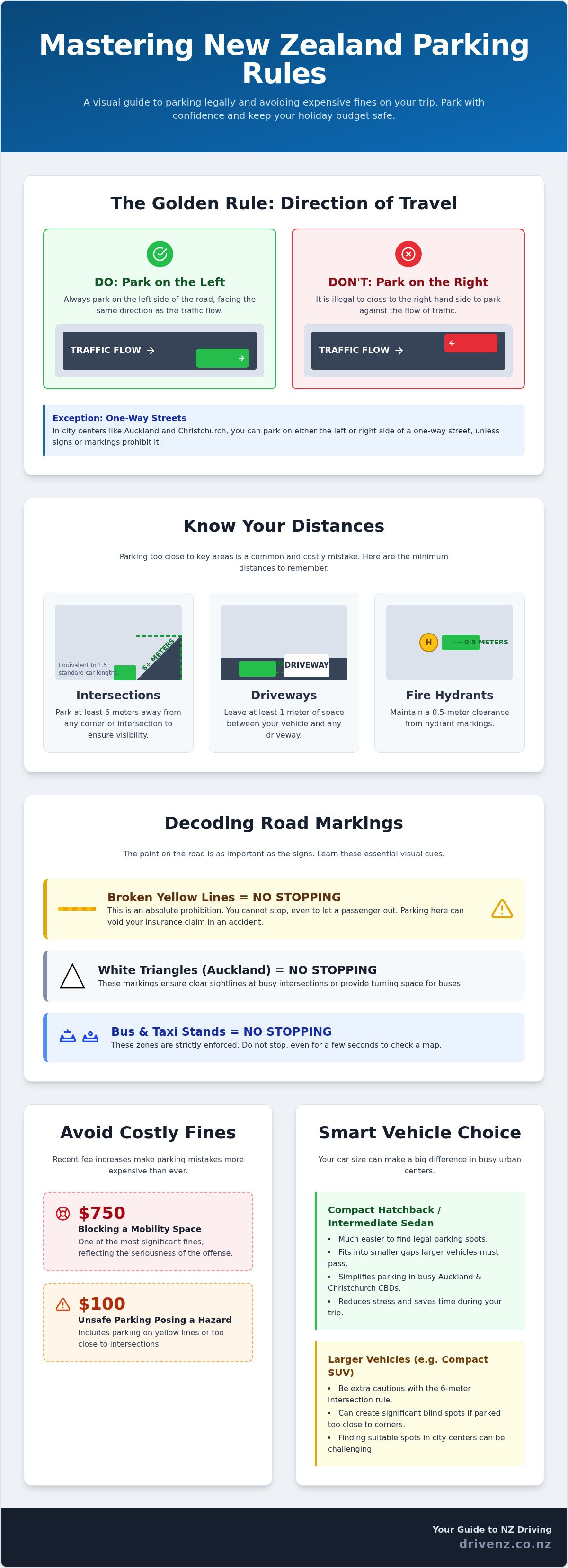
The most critical mistake international drivers make involves the direction of travel. Under new zealand parking rules, you must always park your vehicle on the left hand side of the road, facing the same way as the traffic flow. Crossing the road to park against the traffic on the right is illegal. This rule exists to prevent dangerous maneuvers where drivers must pull out into oncoming traffic with limited visibility. Failure to follow this can lead to an immediate fine, even if you are only stopping for a few minutes.
Beyond the direction of travel, several basic prohibitions keep the roads functional. You must leave at least one meter of space between your vehicle and any driveway or vehicle entrance. Blocking access to a home or business is a quick way to get towed. Double parking, or stopping your car next to another parked vehicle, is strictly prohibited. It creates bottlenecks and hazards for other motorists, particularly in high traffic areas.
Parking on One-Way Streets
Exceptions to the left hand parking rule exist primarily in urban centers. In the Auckland and Christchurch CBDs, you will encounter one way street grids. On these roads, you can legally park on either the right or left side, provided there are no restrictive markings. Always look for official New Zealand parking signs to confirm a spot is valid. When you pull out from a right hand park, take extra care. Your mirrors are positioned for left side driving, so a physical shoulder check is essential to see approaching traffic.
The 6-Meter Intersection Rule
Intersections require maximum visibility for all road users. You are legally required to park at least 6 meters away from any corner or intersection. While you likely don't have a measuring tape in your glovebox, you can estimate this distance using car lengths. A standard Intermediate Sedan is roughly 4.8 meters long. If you cannot fit a full car and a half between your bumper and the intersection, you are too close.
This rule is vital for safety. If you park a larger vehicle like a Compact SUV too close to a corner, you create a significant blind spot for others. Use local landmarks to help. Often, councils place lamp posts, trees, or specific road markings exactly where the legal parking zone begins. If the curb starts to curve, you should already be well clear of it.
Decoding NZ Road Markings: Yellow Lines and Triangles
Road markings often communicate more than signs. In New Zealand, the paint on the curb or asphalt dictates where your rental car can safely rest. Understanding these visual cues is a core part of new zealand parking rules. Following these standards regarding road paint ensures your holiday budget isn't wasted on avoidable infringements.
The Danger of Broken Yellow Lines
Broken yellow lines painted near the curb mean "no stopping." This is an absolute prohibition. You cannot park there, and you cannot even stop to let a passenger out. These lines are frequently found at scenic lookouts or narrow coastal roads where a stopped car would create a hazard. While a fine is the most likely outcome, the risks go deeper. If your car is hit while parked on a yellow line, your insurance provider may void your claim because you were parked illegally. This makes them a significant financial risk beyond the standard council penalty. These zones are part of the official NZ parking prohibitions that every visitor should memorize.
Fire Hydrant Etiquette
Fire hydrants in New Zealand are marked by a yellow rectangle or circle on the road, often with a yellow "H" painted nearby. You must maintain a 0.5-meter clearance from these markings. However, there is a helpful exception. You can stop near a hydrant if a licensed driver stays with the vehicle and can move it immediately if a fire engine arrives. This flexibility doesn't apply to other restricted zones. If you leave the car unattended, even for a minute, you risk a fine or having the vehicle towed to clear access for emergency services.
In Auckland, you will notice white triangles painted on the road surface. These unique markings indicate a "No Stopping" area, often used to ensure buses have enough room to turn or to keep sightlines clear at busy intersections. Similarly, bus and taxi stands are strictly enforced. Even a 30-second stop to check a map can lead to a fine. As of October 2024, fines for unsafe parking that poses a hazard have increased to $100. It's always safer to find a designated parking bay rather than risking a stop on a marked zone. If you're worried about finding space in the city, choosing a Compact Hatchback makes it much easier to fit into legal gaps that larger vehicles must pass by.
Interpreting New Zealand Parking Signs
Mastering new zealand parking rules often comes down to reading the fine print on a standard 'P' sign. The letter 'P' stands for parking, while the number next to it indicates the maximum time allowed in minutes. A P30 sign allows you to stay for 30 minutes, while a P120 gives you two hours. These limits typically apply during business hours, usually 8:00 am to 6:00 pm. Always look at the bottom of the sign for specific days and times. If you arrive outside these hours, parking is often free and unrestricted, but double check the sign to be certain.
Paid parking zones require either a physical ticket from a 'Pay and Display' machine or a digital payment via a mobile app. In Auckland, the AT Park app is the standard, while other regions may use PayStay. As of late 2024, the fine for not paying in a metered space increased to $70. Overstaying your time limit also carries graduated fines, starting at $20 for the first 30 minutes. Mobility parking spaces, marked with a blue wheelchair symbol, are strictly for permit holders. Misusing these spots results in a $750 fine, a significant increase implemented to ensure accessibility for those who truly need it.
Peak Hour Clearways
Clearways are a major trap for drivers in Auckland and Christchurch. During specified peak hours, these zones transform from parking spaces into active traffic lanes to manage congestion. If you are still parked in a clearway when the restricted time begins, your vehicle will be towed immediately. This is different from a standard parking ticket; you will face both an infringement fee and a heavy towing recovery cost. Look for the 'Clearway' sign with a car on a hook symbol to identify these zones. For more local advice on handling city traffic, read our guide to 2026 Car Rental Auckland.
Resident and Permit Zones
In historic suburbs with narrow streets, you will often see 'Resident Only' or 'Permit Holders Only' signage. These spots are reserved for locals who have registered their vehicles with the council. Your rental car does not qualify for these spaces, even if you are staying at an Airbnb in the area. Councils now use license plate recognition technology to enforce these zones efficiently. If you are visiting a residential area, search for 'P' signs that do not mention permits or look for a dedicated off-street parking building to keep your vehicle secure and ticket-free.
Public vs. Private Parking: A Guide for Tourists
Understanding the difference between council owned spaces and private lots is vital for anyone navigating new zealand parking rules. Council parking is managed by local government bodies like Auckland Transport (AT) or the Christchurch City Council. When you park on the street or in a council building, you are subject to statutory laws. If you break a rule, you receive an "infringement notice," which is a legal fine. In contrast, private operators like Wilson Parking or Care Park manage many off-street lots. These companies issue "breach notices" based on a contract you enter by driving onto their property. These notices are technically claims for damages rather than government fines, though they are still strictly enforced.
Supermarkets and shopping malls offer another layer of complexity. Most provide free parking for customers, typically limited to 90 or 120 minutes. These areas often use license plate recognition cameras to track your entry and exit. If you overstay or leave the site to shop elsewhere, you may find a notice on your windshield. Always check the signage at the entrance to confirm the specific "customer only" requirements. Retailers are increasingly strict about these limits to ensure spaces remain available for genuine shoppers.
Essential Parking Apps for 2026
Digital payments are now the standard across the country. AT Park is the essential app for anyone visiting Auckland, allowing you to pay only for the exact minutes you use. For private lots nationwide, ParkMate is the most common platform. While most urban areas have modernized, keeping a few gold coins in your center console is a smart "Plan B" for rural towns where older meters might still be in service. Using these apps removes the stress of returning to your car to top up a physical meter. It gives you total control over your parking session from your smartphone.
What to Do if You Get a Ticket
If you receive a council infringement notice, you can usually pay it online via the council's website using a credit card. Dealing with private breach notices is similar, though the payment portal will be specific to the operator. If a ticket goes unpaid, the authority will eventually contact us as the vehicle owner. Our policy at Drive NZ involves an administration fee to process these infringements on your behalf, so it is always faster and cheaper to settle any notices directly before you return your car. To ensure you have a vehicle that is easy to maneuver into any tight city spot, book a compact hatchback today for your New Zealand adventure.
Drive NZ Tips: Choosing the Right Car for NZ Parking
Selecting the right vehicle is a strategic choice that directly affects how easily you can follow new zealand parking rules. While your primary focus might be luggage space or fuel economy, the physical dimensions of your car dictate your success in busy urban centers. A smaller footprint often means the difference between snagging a tight street spot in Auckland or circling the block for twenty minutes. At Drive NZ Rental Cars, we maintain a modern fleet designed to handle both the open highway and the narrowest city corridors.
Compact Hatchbacks are the undisputed kings of the Auckland CBD. Their short wheelbase makes them exceptionally easy to maneuver into parallel spots that larger vehicles must skip. This agility is particularly helpful when you need to stay exactly one meter clear of driveways or six meters from intersections. Intermediate Sedans offer a refined balance for those traveling between cities. They provide the comfort needed for long South Island drives while still fitting comfortably within standard council parking bays. For those who prefer a higher seating position, a Compact SUV offers great visibility, which is a major asset when navigating the multi-level parking buildings in Christchurch.
Matching Your Fleet to Your Destination
Your destination should dictate your car choice. If your itinerary focuses on Auckland's "shared zones" like High Street or Elliott Street, a smaller car significantly reduces the stress of navigating around pedestrians and tight curbs. Our Drive NZ Rental Cars Fleet Guide provides a detailed breakdown of which model suits your specific travel plans. To further support your compliance with local regulations, our modern rental fleet comes equipped with rearview cameras. These tools are invaluable for ensuring you aren't overhanging a broken yellow line or encroaching on a fire hydrant zone when backing into a space.
Ready for a Stress-Free Road Trip?
Before you leave our rental lot in Auckland or Christchurch, take a moment to run through a final checklist. Ensure you have downloaded the necessary parking apps and have a basic grasp of the local signage we have covered. For a broader look at staying safe on our roads, check out our Driving in New Zealand for tourists guide. Once you feel confident with the new zealand parking rules and your vehicle's controls, you are ready to explore. Planning ahead is the best way to ensure your holiday is remembered for the stunning scenery rather than an expensive council fine. Secure your ideal car today and prepare for a seamless journey across Aotearoa.
Start Your Stress-Free Journey Today
Mastering the new zealand parking rules is about more than just avoiding a ticket; it's about giving yourself the freedom to explore without looking over your shoulder. By remembering the direction of travel, decoding local road markings, and choosing a vehicle that fits your urban destination, you've already cleared the biggest hurdles to a smooth trip. Whether you are navigating the tight streets of the Auckland CBD or finding a spot near a Christchurch park, you now have the tools to park like a local. These small details ensure your holiday budget stays focused on experiences rather than unexpected council fines.
With over 20 years of local expertise since 2005, Drive NZ is here to support your adventure from the moment you land. We provide convenient airport pickups in both Auckland and Christchurch, offering fleet options optimized for every unique terrain you might encounter. Our team is dedicated to making your rental experience as efficient and transparent as possible. Ready to hit the road with total peace of mind? Book your safe and reliable rental car with Drive NZ today. We'll help you get behind the wheel of a vehicle that makes every park and every turn feel effortless. Enjoy the incredible sights that Aotearoa has to offer.
Frequently Asked Questions
Can I park on the right-hand side of the road in New Zealand?
No, you must not park on the right-hand side of the road facing oncoming traffic unless you are on a one-way street. This "direction of travel" rule is strictly enforced to ensure safety when you re-enter the flow of traffic. Parking against the flow makes it difficult to see approaching vehicles and is a common mistake for international visitors from right-hand drive countries.
What do broken yellow lines mean on NZ roads?
Broken yellow lines indicate a total "No Stopping" zone at all times. You cannot park, stop to drop off passengers, or wait in your car even for a few seconds. These markings are usually placed in areas where visibility is crucial or where a stopped vehicle would cause a dangerous bottleneck for other road users, such as near intersections or narrow corners.
How much are parking fines in Auckland in 2026?
Following the 2024 nationwide increase, not paying for a metered space now costs $70. Overstaying your time limit begins at $20 for the first 30 minutes and can reach $97 for stays exceeding six hours. These updated new zealand parking rules aim to manage high demand in city centers like Auckland and Christchurch more effectively by encouraging turnover in popular spots.
Can my rental car be towed for a parking violation?
Yes, your rental car will likely be towed if you park in a peak-hour clearway or block a vehicle entrance. Towing is also common for vehicles that pose a hazard to pedestrians or other motorists. If this happens, you will be responsible for both the council fine and the private towing company’s recovery fees, which often exceed the cost of the initial fine.
Do I have to pay for parking on Sundays and public holidays?
Many on-street parking spaces are free on Sundays and public holidays, but you must always check the sign first. Some high-demand areas in city centers still require payment or enforce time limits seven days a week. If a sign does not specifically state "Excluding Public Holidays," assume the standard new zealand parking rules and fees apply to avoid a surprise infringement.
What does a "P30" sign mean?
A "P30" sign means you have a maximum parking limit of 30 minutes. This time restriction typically applies during the hours listed on the sign, such as 8:00 am to 6:00 pm. If you need more time for a meal or a meeting, you should look for a "P60" or "P120" zone instead, as parking wardens monitor these short-stay areas frequently.
Is it legal to park on a footpath in New Zealand?
No, it is illegal to park any part of your vehicle on a footpath, and doing so carries a $70 fine. This rule ensures that pedestrians, including those with strollers or wheelchairs, have clear and safe access to the walkway. Even if you only put two wheels on the curb to clear a narrow street, you are still liable for a ticket.
How do I pay for a parking ticket on a rental car?
You can pay most council fines online via their official website using the infringement number printed on the ticket. It is best to settle these immediately. If you return the car with an unpaid fine, Drive NZ will process it on your behalf, which involves an additional administration fee as outlined in your rental agreement to cover the processing costs.


