

Did you know that drifting just 11 km/h over the marked pace could result in an $80 fine before you've even finished your first day of travel? It's a common worry for many visitors who feel anxious about managing speed limits in New Zealand while simultaneously adapting to driving on the left. You want to enjoy the incredible Southern Alps or the Coromandel coastline, not spend your holiday budget on unexpected speeding tickets or worrying about complex road signage.
We understand that navigating a new country's road rules can feel overwhelming, especially with recent 2026 changes to school zones and urban limits. This guide is designed to remove that stress by providing a clear, modern roadmap to local driving laws. You'll learn how to distinguish between mandatory and advisory signs, understand the latest enforcement rules, and discover why a compact SUV or hatchback might be your best ally on winding rural roads. By the time you finish reading, you'll have the confidence to explore every corner of the country safely and legally.
Key Takeaways
- Identify the default speed limits in New Zealand for urban and open roads to stay compliant from the moment you leave the airport.
- Learn the crucial difference between mandatory speed signs and yellow advisory speeds to navigate winding rural terrain with confidence.
- Stay informed on 2026 enforcement policies, including the 'Anywhere, Anytime' camera strategy and the latest fine structures.
- Gain tips on how to read 'End of Limit' signage so you never have to guess the legal maximum on a changing road.
- Understand why selecting a practical compact SUV or sedan can improve your stability and speed control on diverse Aotearoa landscapes.
The Fundamental Speed Limits in New Zealand: Urban vs. Open Road
Driving in Aotearoa is a highlight for many travelers, but the transition between quiet rural stretches and bustling townships requires sharp attention. Understanding the core speed limits in New Zealand is your first step toward a stress-free journey. Unlike some countries where limits change based on lane width alone, New Zealand relies on a clear distinction between urban environments and the open road. The default speed limit in urban, residential, and business areas is 50 km/h. You'll notice this change as soon as you enter a town; the road often narrows, and buildings appear closer to the curb. It's a psychological shift that demands you drop your speed immediately to protect pedestrians and local traffic.
Once you leave the town boundaries, the limit typically increases to 100 km/h for cars and motorcycles. A common sight on these stretches is the "Open Road" sign, which features a white circle with a black diagonal stripe. While this sign indicates that the 100 km/h limit applies, it's vital to remember this is a maximum ceiling, not a required target. For a deeper look at how these rules evolved and the specific legal frameworks involved, you can explore the history of New Zealand speed limit regulations. On many rural highways, the terrain is too demanding for the maximum limit, making vehicle choice essential. A compact SUV provides the necessary stability to handle these transitions with ease.
School Zones and High-Risk Areas
Safety around our youngest citizens is a top priority in 2026. By July 1, 2026, all local streets outside schools must have a 30 km/h variable speed limit during peak student pick-up and drop-off times. These zones are clearly marked with electronic signs that activate when the lower limit is in force. Outside of these times, the limit may revert to 50 km/h, but you must remain vigilant. These areas are among the most strictly enforced in the country, often monitored by mobile laser units to ensure total compliance in community hubs.
The 110 km/h Expressway Exception
While 100 km/h is the standard for most highways, New Zealand has introduced 110 km/h limits on specific, high-quality "Roads of National Significance." You'll find these higher limits on sections of the Waikato Expressway and the Tauranga Eastern Link. These roads are designed with median barriers and multiple lanes to safely accommodate higher speeds. However, don't assume every multi-lane road allows this; always look for the specific 110 km/h sign. If you don't see it, the limit remains 100 km/h, even if the road looks "fast" or modern.
Decoding Speed Limit Signage and Cockpit Awareness
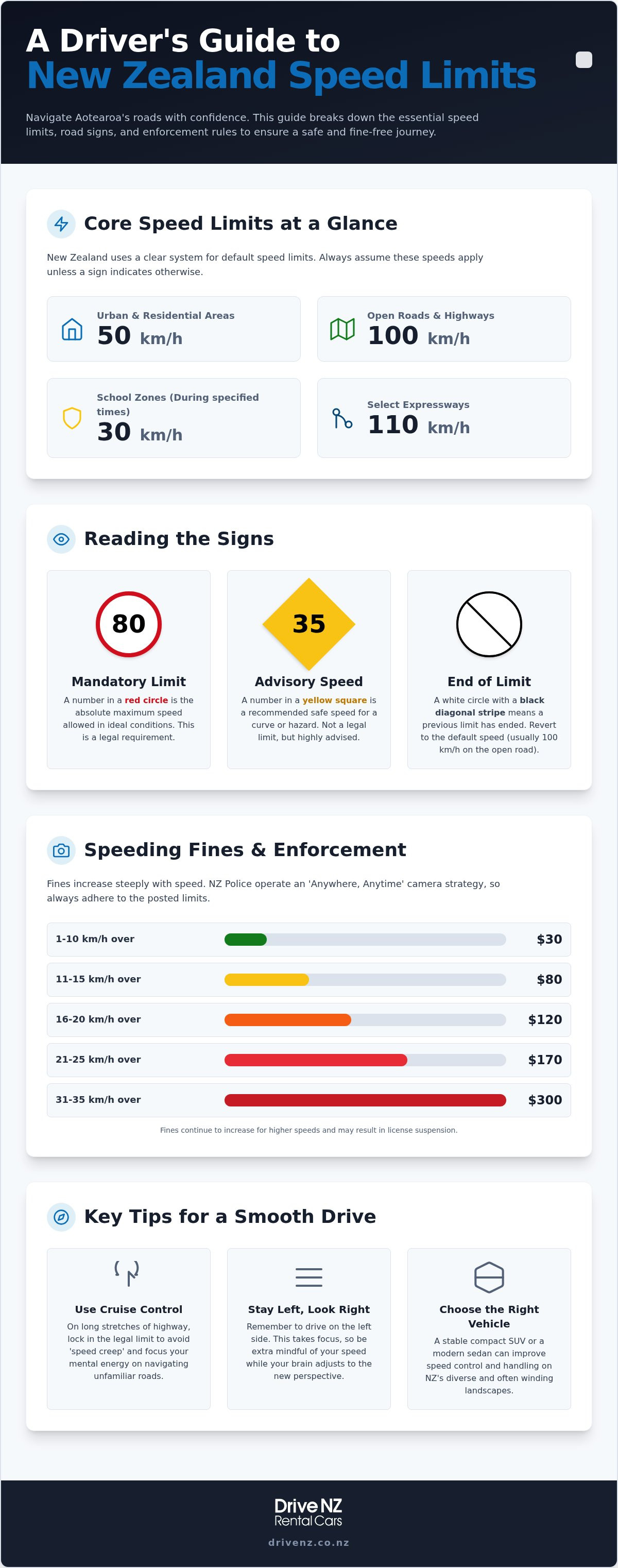
Recognizing the legal speed limits in New Zealand is straightforward once you know what to look for. Every mandatory limit is displayed within a bold red circle. Whether it's 30, 50, or 80, this number is the absolute maximum allowed under ideal conditions. You will also frequently encounter the 'End of Limit' sign, which is a white circle with a black diagonal bar. This signifies that a previous restriction has ended and the road has reverted to the default open road limit of 100 km/h. Understanding these visual cues quickly is essential for maintaining a steady pace without constantly second-guessing the law.
The cockpit of your rental car presents its own set of challenges, particularly for those used to driving on the right side of the road. In New Zealand, you'll be sitting on the right, which shifts your perspective of the road's center and its edges. This adjustment requires significant mental energy. For those interested in how health and cognitive focus play a role in managing such tasks, drnancyallen.com offers expert advice on maintaining mental clarity. Additionally, ensure your speedometer is set to kilometers per hour (km/h). While most modern rentals feature digital displays that make this clear, older analog dials can be confusing if you're accustomed to miles. Staying focused on the correct units is the best way to avoid accidental speeding fines.
Managing Speed While Driving on the Left
Switching sides creates a heavy mental load. When your brain is busy processing lane positioning and checking mirrors in reverse, speed management often takes a backseat. Many drivers experience 'speed creep,' where they unknowingly accelerate on long, straight stretches of highway. To combat this, we recommend using cruise control. It's a simple, modern tool that allows you to lock in the legal limit, freeing up your mental bandwidth to focus on the terrain ahead. This is especially helpful in an intermediate sedan, where the smooth ride can make high speeds feel slower than they actually are.
The Wiper vs. Indicator Struggle
It's a classic tourist mistake: reaching for the indicator and accidentally turning on the windshield wipers. In many New Zealand vehicles, these controls are swapped compared to European or American models. This small fumble is more than just an embarrassment; it's a distraction that can cause your speed to fluctuate as you look down to correct the error. Before you leave the airport, take five minutes to sit in the driver's seat and practice these controls. You can also review our driving in New Zealand safety checklist to ensure you're fully prepared for the road. Maintaining focus inside the cabin is just as important as watching the signs outside.
Advisory Speeds vs. Legal Limits: Navigating Unique Road Features
While the red-bordered signs we've covered dictate the law, yellow speed signs act as your local guide to the terrain. These are known as advisory speeds. You'll typically see them before sharp curves, hairpins, or winding descents. Unlike the mandatory speed limits in New Zealand, these yellow signs suggest a safe speed for a standard vehicle in dry conditions. If you see a yellow sign for 35 km/h, it's a clear warning that the upcoming corner is too tight for the default open road limit. Ignoring these suggestions is a common mistake for visitors, but the physics of New Zealand's high-camber roads makes them essential for your safety.
The reality of driving in Aotearoa is that the legal limit is often a ceiling you'll rarely reach on rural highways. Many secondary roads carry a 100 km/h limit, yet the narrow lanes and frequent blind bends make such speeds dangerous. This is especially true on gravel or "unsealed" roads. On these surfaces, the legal limit remains 100 km/h unless otherwise posted, but driving at that pace would likely result in a loss of control. For these rugged stretches, a compact SUV offers the necessary stability and traction to navigate safely at much lower, more realistic speeds.
The Yellow Sign Protocol
Advisory speeds are carefully calculated based on vehicle stability and road surface grip. When you approach a corner, follow the "Short Left, Long Right" rule. This means staying tight to the left on left-hand bends and taking a wider, more visible line on right-hand turns. If the road is wet or you've fitted snow chains for a mountain pass, you should aim to drive at least 10 km/h below the posted yellow advisory speed. These signs assume perfect conditions, so always adjust downward when the weather turns.
One-Lane Bridges and Roundabouts
New Zealand's landscape is dotted with one-lane bridges, which require a specific speed etiquette. As you approach, look for the priority signs. A big white arrow on your side means you have the right of way, while a small red arrow means you must yield to oncoming traffic. Slow down early to assess the situation. Similarly, when navigating the multi-lane roundabouts in Auckland or Christchurch, maintain a steady, predictable speed. Don't feel pressured to speed up to "beat" other drivers at narrow points; the goal is a smooth, consistent flow that keeps everyone safe on the road.
Enforcement and Fines: Guide for International Drivers
New Zealand Police maintain a proactive approach to road safety through an "Anywhere, Anytime" speed enforcement policy. This means you should expect speed monitoring not just in high-traffic areas, but also on quiet rural roads and remote highways. Enforcement is designed to be consistent and firm. If you're stopped by an officer, understand that they're performing a standard safety check. While they're professional and helpful, arguing about a ticket rarely results in a warning; the focus is strictly on maintaining the safety of all road users. Staying within the posted speed limits in New Zealand is the only way to ensure your holiday remains fine-free.
The financial consequences for speeding are structured to discourage even minor creep. As of July 2026, the fine schedule is strictly applied based on how much you exceed the limit:
- 10 km/h or less over: $30
- 11-15 km/h over: $80
- 16-20 km/h over: $120
- 21-25 km/h over: $170
- 26-30 km/h over: $250
- 31-35 km/h over: $400
- 36-40 km/h over: $600
If you exceed the limit by more than 40 km/h, you face immediate roadside license suspension for 28 days and court prosecution. For those driving a compact hatchback from Drive NZ Rental Cars, these penalties can effectively end your trip on the spot.
Speed Camera Types in 2026
Modern technology has expanded how speeds are monitored across Aotearoa. You'll encounter fixed cameras mounted on grey poles, which are often preceded by warning signs. However, mobile laser units operated from unmarked vans can be parked anywhere along your route. New for 2026 is the wider rollout of point-to-point average speed monitoring, which calculates your speed between two distant gates rather than at a single flash point. During high-volume holiday periods, the police apply a strictly reduced speed tolerance that leaves virtually no room for error.
The Rental Car Fine Process
If a speed camera captures your vehicle, the infringement notice is sent directly to the owner, which in this case is the rental agency. Drive NZ Rental Cars is legally required to nominate the driver responsible for the vehicle at that specific time. Once the police receive this information, they'll re-issue the fine in your name. Most rental agencies charge an administrative fee to cover the cost of processing these legal documents. It's vital to settle these fines promptly; ignoring a New Zealand traffic infringement can result in debt collection and significant complications with Immigration New Zealand during future visits.
Driving at the Right Speed with Drive NZ Rental Cars’ Reliable Fleet
Managing your pace isn't just about watching the signs; it's about how your vehicle responds to the road. Whether you are navigating a rental or maintaining high-performance electric bikes with Cooneys Bike Care, understanding how a vehicle handles at various speeds is crucial for safety. When you're following the speed limits in New Zealand, the physical size and handling of your car play a massive role in your confidence. A car that feels too large for a narrow lane can cause you to brake unnecessarily, while a car that's too light might feel unsettled at 100 km/h. Drive NZ Rental Cars specializes in easy-to-drive categories that remove this friction, ensuring you feel in total control whether you're in a busy city or on a remote highway.
For urban explorers, a compact hatchback is the ultimate tool for navigating 50 km/h zones. These vehicles offer excellent visibility and a tight turning radius, making it much easier to maintain your lane position in Auckland's busy city center or Christchurch's evolving streetscapes. On the other hand, if your itinerary involves the long, sweeping straights of the Canterbury Plains, an intermediate sedan provides the weighted stability you need for a comfortable 100 km/h cruise. Matching your car to your route is the simplest way to avoid the stress of accidental acceleration on the open road.
Choosing the Right Vehicle for the Terrain
Different landscapes demand different strengths. Many of our customers find that Drive NZ Rental Cars’ compact SUVs are the perfect fit for the winding routes of the North Island's thermal regions. The elevated driving position gives you a better view of upcoming advisory signs, allowing you to adjust your speed gradually rather than reacting at the last second. Smaller cars often feel more manageable on narrow 80 km/h rural routes where lane space is at a premium. It's also vital to consider vehicle weight; heavier sedans and SUVs offer consistent braking distances at highway speeds, giving you peace of mind when approaching unexpected intersections or livestock crossings.
The Drive NZ Rental Cars Advantage
We've spent over 20 years helping international visitors master the unique conditions of Aotearoa. With convenient bases at both Auckland and Christchurch airports, you can start your journey with expert local advice on current road conditions and 2026 safety updates. Our service model focuses on transparency and modern efficiency, ensuring you have the right tools for every season. If you're heading into alpine passes where speed is often restricted by ice, we provide snow chains and the guidance to fit them correctly. Don't let the complexity of local regulations slow down your adventure. Book your New Zealand rental car today and experience the freedom of the open road with a partner you can trust.
Ready for Your Aotearoa Road Trip?
Mastering speed limits in New Zealand is the final piece of the puzzle for a successful holiday. You now know that 100 km/h is a legal limit, not a required target, and those yellow advisory signs are essential guides for our unique terrain. By staying informed about the 2026 fine schedule and the strict variable limits near school zones, you're prepared to focus on the scenery rather than worrying about enforcement.
We've spent over 20 years refining our service to support international drivers. Our specialized fleet of compact hatchbacks, sedans, and SUVs is chosen specifically for its ease of handling on local roads. With convenient pickup locations at Auckland and Christchurch Airports, your journey starts the moment you land. Drive NZ Rental Cars provides the modern reliability and local expertise you need to feel empowered behind the wheel. Start your stress-free NZ adventure with Drive NZ Rental Cars today. Don't leave your safety to chance; we're here to help you explore Aotearoa with total confidence.
Frequently Asked Questions
What is the general speed limit on New Zealand open roads?
The default speed limit on open roads, expressways, and motorways is 100 km/h for cars and motorcycles. You'll see this marked by a red-bordered "100" sign or a white circle with a black diagonal stripe, which signifies the start of the open road zone. While some designated "Roads of National Significance" allow for 110 km/h, you must never exceed 100 km/h unless a higher limit is specifically posted.
Are speed limits in New Zealand strictly enforced for tourists?
Yes, speed limits in New Zealand are strictly enforced for everyone, with no exceptions for international visitors. The police use a mix of fixed cameras, unmarked mobile vans, and point-to-point average speed monitoring to ensure compliance. If you're caught speeding, the infringement is issued to the vehicle owner, and the rental agency will then reassign the fine to your name, often adding an administrative processing fee.
What do the yellow speed signs mean on New Zealand corners?
Yellow speed signs indicate a recommended advisory speed for safely navigating a specific corner or hazard. These aren't the legal speed limits in New Zealand, but they're based on what a standard vehicle can handle in dry conditions. If you're driving a compact SUV or a sedan, it's highly recommended to follow these suggestions. If the road is wet or icy, you should aim to drive at least 10 km/h below the yellow advisory speed.
Is there a speed 'tolerance' before I get a ticket in NZ?
You shouldn't expect any speed tolerance when driving in Aotearoa. While officers may use slight discretion in some areas, the official policy is that any speed over the limit is an offense. During high-volume holiday periods, the police often announce a strict zero-tolerance policy where even exceeding the limit by 1 km/h can result in a fine. It's much safer to keep your speedometer exactly on the legal limit.
How much are speeding fines in New Zealand for 2026?
As of July 2026, speeding fines are tiered based on how far you exceed the limit. Exceeding the pace by 10 km/h or less results in a $30 fine, while 11 to 15 km/h over costs $80. The penalties climb quickly, reaching $400 for 31 to 35 km/h over and $600 for 36 to 40 km/h over. Traveling more than 40 km/h above the limit triggers an immediate 28-day license suspension and court prosecution.
Can I turn left on a red light in New Zealand?
No, you cannot turn left on a red light in New Zealand. You must remain stopped until the light turns green or a green left-turn arrow appears. This rule is strictly enforced to protect pedestrians and cyclists who may have a crossing signal at the same time. Many intersections in Auckland and Christchurch use cameras to monitor red-light compliance, so always wait for the legal signal before moving.
What is the speed limit for towing a trailer or driving a heavy vehicle?
The maximum speed limit for any vehicle towing a trailer, or heavy vehicles over 3,500kg, is 90 km/h on the open road. This applies even if the posted limit for other cars is 100 km/h or 110 km/h. This lower limit accounts for the increased braking distance and reduced stability of heavier loads. In urban 50 km/h zones, the standard limit applies to all vehicles unless a lower limit is specifically marked.
How do I pay a speeding fine if I am in a rental car?
If an officer stops you, they'll issue the ticket directly to you, and you can pay it online via the New Zealand Police website. For camera-based fines, the notice is sent to the rental agency. They'll nominate you as the driver, and the police will then mail the fine to your home address or email. Most rental companies will also charge a separate administrative fee to your credit card for the processing of these legal documents.


