

Imagine you're driving your rental SUV through the stunning Southern Alps when you suddenly round a corner to find a one-lane bridge or a flock of sheep blocking your path. For many international visitors, the specific symbols and rules of new zealand road signs can feel like a foreign language, especially when you're also adjusting to driving on the left side of the road. It's natural to feel anxious about missing a speed transition or accidentally breaking a local law that results in a $150 fine.
We understand that your priority is a stress-free journey from Auckland to Christchurch without the worry of infringements or safety risks. This 2026 guide helps you master the road so you can focus on the scenery instead of the speedometer. You'll learn how to identify critical warning signs for unsealed roads, understand the new mandatory 30 km/h school zones effective as of July 2026, and navigate the increasingly common bilingual signage. We'll give you the local knowledge needed to handle everything from winter snow chain requirements to the essential give-way rules at every intersection.
Key Takeaways
- Identify the three main categories of new zealand road signs by their shapes and colors to react quickly to changing road conditions.
- Navigate one-lane bridges with confidence by understanding priority arrows and the critical 'Give Way' rules used across the country.
- Stay compliant with 2026 regulations, including the mandatory 30 km/h speed limits near schools and the latest bilingual signage.
- Learn how to adjust your driving for unsealed roads and find the best vehicle features, such as a compact SUV, for gravel surfaces.
- Prepare for alpine conditions in the South Island by knowing when to use snow chains and how to interpret winter warning symbols.
Understanding the Basics: NZ Road Sign Shapes and Colors
Getting behind the wheel in a new country can feel like a challenge, but the system of new zealand road signs is designed for instant recognition and ease of use. Most designs follow international conventions established between 1987 and 1990, which you can explore in more detail through this guide to New Zealand Road Signs on Wikipedia. The primary goal is safety through simplicity. By learning just a few shapes and colors, you'll know exactly how to react before you can even read the text on the sign.
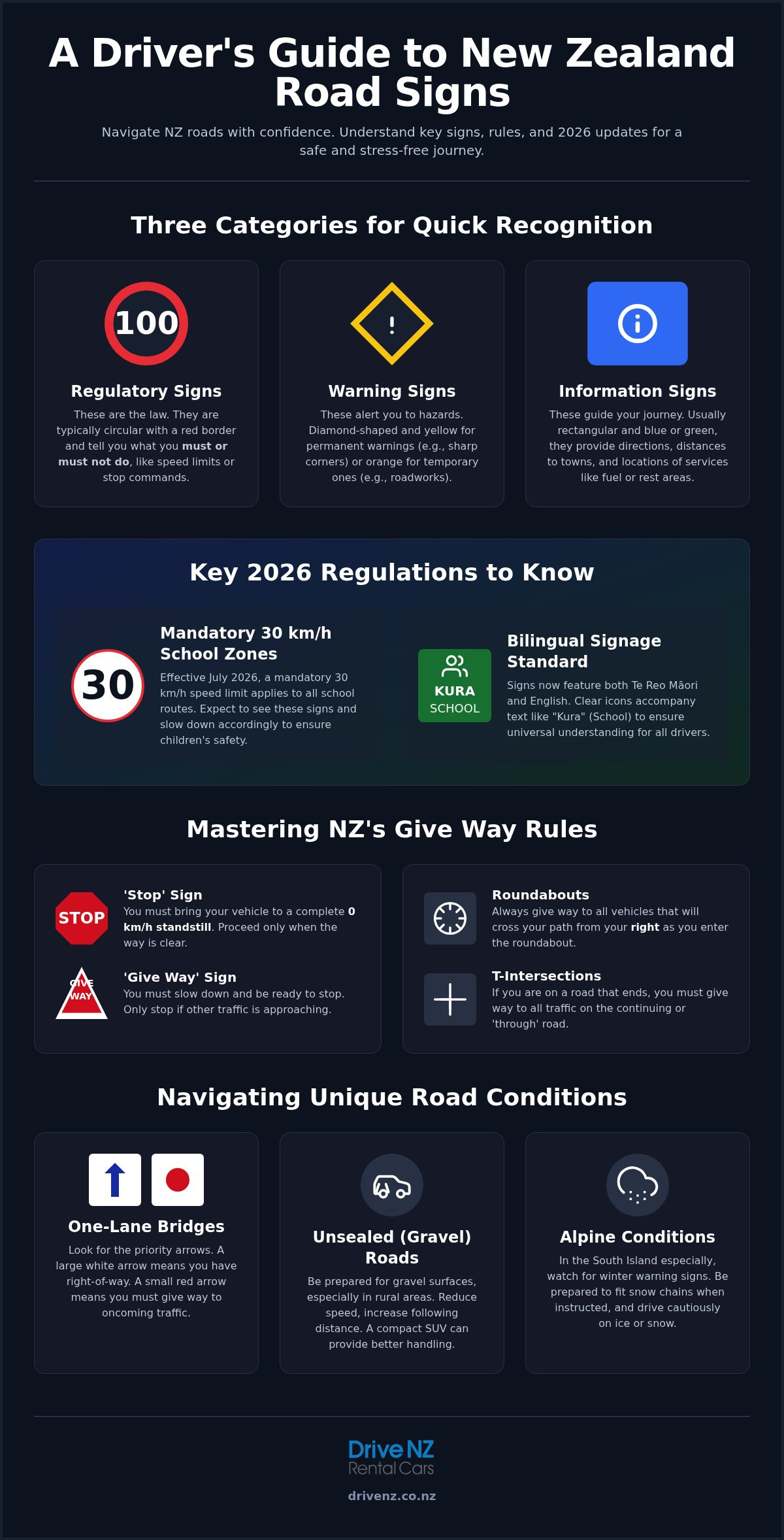
Signs are grouped into three distinct categories to help you filter information quickly:
- Regulatory: These are the law. They tell you what you must or must not do, such as speed limits or turn restrictions.
- Warning: These alert you to permanent or temporary hazards like sharp corners, hidden driveways, or roadworks.
- Information: These help you find your way, providing distances to towns and locations of essential services like fuel or toilets.
By identifying the silhouette of a sign from a distance, you can prioritize information before the text becomes legible. A circular sign usually dictates a strict rule, while a diamond shape suggests caution. This visual hierarchy allows you to adjust your speed or lane position early. It's a vital skill when driving an intermediate sedan or compact SUV through the rolling hills outside Auckland, where road conditions can shift around every bend.
The Color Palette of NZ Roads
Colors provide the quickest visual cue for drivers interacting with new zealand road signs. Red borders or backgrounds indicate mandatory instructions. If you see red, it's a "must-do" situation, such as stopping or staying under a specific speed limit. Yellow diamonds signal permanent warnings about the road's physical layout, like a narrowing lane or a steep grade. We also use orange for temporary hazards. You'll often see these near roadworks or during winter in Christchurch when conditions change fast. If you're heading into alpine areas, orange signs might signal it's time to fit your snow chains.
Dual-Language Signage (Te Reo Māori and English)
By 2026, the shift toward bilingual signage has become a standard feature on our national road network. These updated signs display both Te Reo Māori and English, reflecting our unique heritage while maintaining high safety standards. You'll frequently encounter terms like "Kura" for school or "Hūmārie" for go slow. This dual-language approach doesn't just foster cultural connection; it creates a more intuitive driving environment for everyone. Clear, modern icons always accompany the text. This ensures that whether you're a local or a visitor in a rental car, the message is unmistakable. The transition helps reduce hesitation at busy intersections and ensures every driver feels confident on their journey.
Regulatory Signs: The Rules You Must Follow
Regulatory signs are the non-negotiable rules of the road. In New Zealand, these are typically circular with a red border. The most critical instruction you'll encounter isn't always a sign, but a recurring reminder: "Keep Left." You'll see these signs frequently when exiting major airports in Auckland or Christchurch. Understanding these new zealand road signs is your first line of defense against both safety risks and costly fines. For a full visual library of every mandatory symbol, the Official NZ Road Signs Guide provides the most current government standards.
Speed limits are strictly enforced across the country. Most urban areas have a default limit of 50 km/h, while the "open road" limit is 100 km/h. On certain newer, high-standard motorways, you might see 110 km/h signs. Exceeding these limits can lead to fines starting at $30 for minor infractions and reaching $630 for more serious offenses. If you're hiring an intermediate sedan for your journey, staying mindful of these transitions ensures a stress-free trip.
Mastering the Give Way Rule
The distinction between 'Stop' and 'Give Way' is a legal requirement you can't afford to ignore. A 'Stop' sign requires your vehicle to come to a complete, 0 km/h standstill before proceeding. A 'Give Way' sign means you must slow down and stop only if other traffic is approaching. At roundabouts, the rule is to always give way to vehicles coming from your right. If you're at a T-intersection, the driver on the road that ends must give way to all traffic traveling on the through road.
Speed Limits and Variable Messaging
New Zealand's infrastructure uses electronic variable speed limit signs that change based on traffic flow or weather conditions. As of July 1, 2026, a mandatory 30 km/h limit applies to all school routes, even if a physical sign isn't immediately visible. You may also encounter 'LSZ' (Limited Speed Zone) signs. These indicate that while the maximum legal limit is technically 100 km/h, you're expected to drive at a speed that's safe for the current conditions, such as heavy rain or fog.
Parking signs are equally important to decode to avoid a $150 fine. They usually feature a 'P' followed by a number, such as P30 or P60, which tells you how many minutes you're allowed to park. Always check for 'Clearway' signs in urban centers. These indicate lanes that must remain clear for moving traffic during peak hours; parking there will result in your vehicle being towed immediately.
Warning Signs: Navigating NZ's Unique Terrain
New Zealand's landscape changes fast. One minute you're on a smooth highway near Auckland; the next, you're facing a winding gravel track. Warning signs are your early warning system for these shifts. Unlike the regulatory signs we discussed earlier, these are usually yellow diamonds. They highlight hazards that require a change in driving style rather than a strict legal halt. Mastering these new zealand road signs is essential for anyone driving a rental car through our more remote regions.
One of the most common sights on rural roads is the unsealed road sign. If you see a car kicking up a cloud of dust, you're likely on gravel. These surfaces offer much less grip than asphalt. If you're driving a Compact SUV, you'll have better ground clearance, but you still need to slow down. Loose stones can act like ball bearings under your tires, making braking distances much longer than you expect. Always increase your following distance to avoid stone chips from the car in front.
The One-Lane Bridge Protocol
One-lane bridges are a unique feature of the Kiwi roading network that often cause anxiety for visitors. Success depends on reading the arrows correctly to understand who stops and who goes:
- Step 1: Look for the priority sign. If the big red arrow is pointing in your direction, you must give way to oncoming traffic. If the big white arrow is on your side, you have priority.
- Step 2: Always verify the bridge is clear. Even if you have the white arrow, check for a vehicle that has already entered the bridge from the other side. They have the right of way once they are on the structure.
- Step 3: Use the "Kiwi wave." It's local custom to give a small wave or a finger-lift from the steering wheel to acknowledge a driver who has waited for you, as this is the friendly NZ way.
Rural and Wilderness Hazards
Our roads can be deceptive. A "Slippery When Wet" sign is a serious warning here because many of our rural roads use a "chip-seal" surface that becomes incredibly slick after a light rain. High winds are another factor, especially in the open plains near Christchurch. If you're carrying gear on roof racks, pay close attention to wind warning signs to avoid being buffeted out of your lane.
Wildlife and livestock are constant companions on new zealand road signs. You'll see signs for sheep, cattle, and even the rare Kiwi crossing. If you see a "Stock" sign, slow down immediately. Farmers often move large herds across or along the road. Finally, when heading into the mountains, watch for "Chains Must Be Carried" signs. In winter, this is a legal requirement. We provide snow chain hire with our vehicles to ensure you aren't caught out by a sudden alpine cold front.
Information and Parking Signs: Finding Your Way
While regulatory and warning signs keep you safe, information signs ensure you actually reach your destination. These new zealand road signs are typically blue or green. They provide essential guidance on distances, services, and local amenities. It's vital to remember that all distances in New Zealand are measured in kilometers, not miles. If a sign indicates a town is 50 km away, you should allow roughly 45 to 60 minutes for the drive, depending on the terrain. You'll also frequently see the blue 'i' symbol, which marks an i-SITE visitor information center. These are excellent places to stop for local maps or to check road conditions before heading into more remote areas.
Emergency services are also clearly marked. Look for the large blue 'H' sign to find the nearest hospital. In rural areas, you might see smaller white signs with a green cross, indicating first aid stations. When planning your trip budget, it's helpful to look at how much to rent a car in NZ, but don't forget to set aside a small fund for paid parking in major cities like Auckland and Christchurch. Our compact hatchback rentals are particularly popular for city driving because they make navigating these busy urban parking zones much easier.
Navigating with Confidence
Following the right path is simple once you understand the hierarchy of directional signs. State Highways are identified by red shields with white numbers, such as SH1. On rural backroads, you'll encounter "fingerpost" signs. These are small white planks at intersections that point toward specific local roads or farms. If you're looking for scenic lookouts or hiking trails, keep an eye out for brown signs. These are dedicated to tourist attractions and natural landmarks, helping you find the best photo opportunities without needing to constantly check your GPS.
Parking Rules to Avoid Fines
Parking in New Zealand is straightforward if you know the visual shorthand. A sign with 'P' followed by a number, such as P30 or P120, tells you exactly how many minutes you can stay. Some zones require payment through a nearby machine or a mobile app, so always check the smaller text on the sign. You must also be aware of specific restricted zones:
- Yellow Dashed Lines: You cannot park or even stop your vehicle here at any time. These are usually near intersections or fire hydrants.
- Loading Zones: These are reserved for commercial vehicles. Parking a rental car here will likely result in a fine or a tow.
- Clearways: As mentioned in previous sections, these lanes must be empty during peak traffic times. Always check the times listed on the sign before leaving your car.
By respecting these boundaries, you'll avoid the $150 infringements that can quickly dampen a holiday. Understanding these symbols allows you to park with confidence and enjoy your time exploring the local shops and cafes.
Staying Safe on Your NZ Road Trip with Drive NZ
Mastering the visual language of new zealand road signs is a major step toward a successful holiday. However, the most prepared driver still needs a vehicle that aligns with the terrain. At Drive NZ, we bridge the gap between knowing the rules and having the right tools. Our fleet is meticulously maintained to handle everything from the urban motorways of Auckland to the rugged alpine passes near Christchurch. We don't just hand over the keys; we provide the context you need to navigate our unique roading network safely.
Our commitment to your peace of mind starts with transparency. We explain the nuances of local driving laws, such as the mandatory 30 km/h school zones and the mobile phone penalties mentioned earlier in this guide. By providing a reliable, modern vehicle and clear safety advice, we ensure that the signs you see on the road are simple instructions rather than sources of stress. This holistic approach is why we've been a trusted partner for travelers since 2005.
Vehicle Choice and Road Conditions
Choosing the right car depends entirely on where those road signs lead you. An intermediate sedan offers a smooth, fuel-efficient ride if you're sticking to the sealed state highways. For those planning to explore the "off the beaten track" areas marked by unsealed road signs, a compact SUV is a superior alternative. The elevated seating position provides a better vantage point to spot new zealand road signs from a distance, while the increased ground clearance handles loose gravel with ease. Explore our full range in the Drive NZ Rental Cars Fleet guide to match a vehicle to your itinerary.
Winter Driving Preparation
In the South Island, weather-related signs can change your plans in minutes. If you encounter a "Chains Must Be Carried" sign on the way to a ski field or through a mountain pass, having the right equipment is vital. We offer snow chain hire and provide hands-on demonstrations at our Christchurch and Auckland locations. This ensures you're confident using them before you're stuck in the snow. For a complete look at how to prepare for your journey, read our Driving in New Zealand for Tourists: Safety Checklist. Our team is always ready to share local tips that help you avoid accidents and infringements, making your rental experience as seamless as possible.
Drive with Confidence Across the Long White Cloud
Navigating the diverse landscapes of Aotearoa becomes a seamless experience once you understand the logic behind new zealand road signs. From the strict regulatory circles in busy Auckland to the yellow warning diamonds on the winding roads near Christchurch, your ability to read the road ahead is your best safety tool. By mastering the 2026 school zone speed limits and the etiquette of one-lane bridges, you've already removed the biggest stressors from your upcoming journey. You're now ready to transition from a cautious visitor to a confident explorer who understands the rhythm of the local roads.
Since 2005, we've helped thousands of travelers navigate these routes safely. Whether you need a compact hatchback for easy city parking or a compact SUV for rural gravel tracks, we provide the local expertise to keep you moving. We offer convenient pickups in both Auckland and Christchurch; we also ensure you're equipped with snow chains for any alpine adventures. Don't leave your safety to chance. Book your safe and reliable NZ rental car today with Drive NZ and enjoy the freedom of the open road with total peace of mind. Your New Zealand adventure starts here.
Frequently Asked Questions
What is the most important road sign to know in New Zealand?
The 'Give Way' sign is arguably the most critical because it governs how you interact with other traffic at intersections and roundabouts. In New Zealand, the rules for giving way are strict to prevent accidents; you must always yield to traffic coming from your right. Failing to obey these signs can lead to heavy fines and dangerous collisions. Understanding these symbols is essential for anyone driving a rental car through Auckland's busy city streets.
Do New Zealand road signs use miles or kilometers?
New Zealand uses the metric system, so all road signs display distances in kilometers and speed limits in kilometers per hour (km/h). You won't see miles mentioned on any official signage. It's helpful to remember that 100 km/h is the standard open road limit. When you pick up your intermediate sedan in Christchurch, our team can help you get comfortable with the metric speedometer if you're used to imperial measurements.
What does a yellow diamond sign with a black symbol mean?
A yellow diamond with a black symbol is a permanent warning sign designed to alert you to a hazard ahead. These signs might indicate a sharp curve, a steep hill, or a narrowing road. They don't require a legal stop, but they do signal that you should adjust your speed for safety. Paying attention to these new zealand road signs helps you stay prepared for the country's often unpredictable rural terrain.
How do I know who has the right of way on a one-lane bridge?
You determine right of way on a one-lane bridge by looking at the arrows on the priority sign. If the arrow pointing in your direction is red and smaller, you must give way to oncoming traffic. If the arrow for your side is white and larger, you have priority. However, you should always check that the bridge is clear before entering. Even with priority, you must stop if another vehicle is already on the bridge.
Are there unique road signs for tourists in New Zealand?
Yes, New Zealand features specific signs to help tourists find attractions and essential services. Brown signs indicate natural landmarks, scenic lookouts, and walking tracks. You'll also see blue signs with a white 'i' pointing toward i-SITE visitor centers. These are helpful hubs for local maps and travel advice. Using these new zealand road signs ensures you don't miss the best sights while driving your compact SUV between Auckland and our regional parks.
What should I do if I see a sign for livestock on the road?
If you see a sign for livestock or "Stock," you should slow down immediately and be prepared to stop. Farmers often move sheep or cattle across the road in rural areas. Don't sound your horn as it can startle the animals and cause them to run toward your vehicle. Wait patiently for the road to clear or follow the farmer's hand signals. This is a common part of the rural driving experience in New Zealand.
What does a 'LSZ' sign mean on New Zealand roads?
An 'LSZ' sign stands for Limited Speed Zone. It indicates that the legal speed limit is technically 100 km/h, but you must drive at a speed that's safe for the current conditions. If it's raining, foggy, or the road is winding, you should drop your speed significantly. These zones are often found in areas where environmental factors change quickly. It's a reminder to use your judgment rather than just following a specific number.
Can I park anywhere if there is no sign present?
No, you can't park anywhere just because a sign isn't present. You must always park in the direction of traffic flow on the left side of the road. It's illegal to park on a bend, near an intersection, or over a driveway. Also, keep a close watch for yellow dashed lines painted on the road surface. These lines indicate a strict no-parking zone, and stopping there can result in a fine or your rental vehicle being towed.


